

It is located in Serra de Sintra, in the parish of São Martinho, municipality of Sintra, district of Lisbon, Portugal
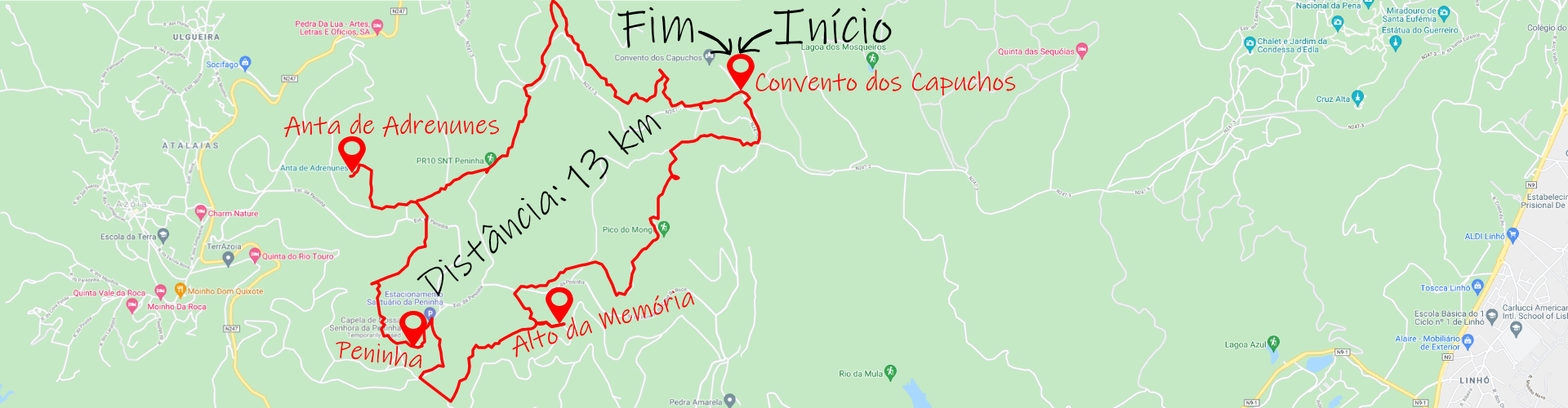
Peninha and Anta Adrenunes Trail – Serra de Sintra;
Distance: 13 km;
Circular: yes, 4.5 km;
Technical Difficulty: Moderate;
Departure/Arrival Location: Convento dos Capuchos car park.
Distance: 13 km;
Circular: yes, 4.5 km;
Technical Difficulty: Moderate;
Departure/Arrival Location: Convento dos Capuchos car park.
Serra de Sintra, located just over 30 km from Lisbon, is a small paradise for all nature and hiking lovers with a range of well-signposted walking routes.
The Convento dos Capuchos is a former convent of the Order of Saint Francis located in Serra de Sintra, in the parish of São Martinho, municipality of Sintra, district of Lisbon, Portugal.
The walking route we suggest is circular and enchants with its natural beauty, starting and ending in the Convento dos Capuchos car park (free).
The best place to start this trail is in a small parking lot just below the Peninha Sanctuary and here the route begins in a clockwise direction.
When the visitor climbs, they start by taking a very short path to the Sanctuary and there is a fantastic view that reaches the Arrábida mountain range, passing along the entire Atlantic coast that goes from Cabo da Roca to Cabo Espichel.
The main points of interest on this walking trail are: Convento dos Capuchos, Anta Adrenunes, Peninha and Alto da Memória.
Most of the trail is on a dirt road (road) but there are some small sections that are a little more demanding, which is why we classified the trail as having moderate difficulty.
The Peninha and Anta Adrenunes Trail is one of the official trails that cross the Sintra mountain range and owes its name to the Peninha Sanctuary located on one of its highest peaks.
After a short steep climb, the visitor sees a romantic palace (20th century) that resembles a fortification, but it is the views over the coast of Sintra-Cascais that first capture our attention.
In the palace, climb the stairs that lead to the Chapel of Nossa Senhora da Penha (17th century) at the highest point, but up there the wind is usually very strong.
At the Sanctuary and always following the trail signs, we descend slightly towards the ruins of a hermitage founded at the time of the formation of the kingdom of Portugal: the Hermitage of São Saturnino.
Looking around we see a rocky landscape whose vegetation is reduced to meadows and bushes due to prolonged agro-pastoral use, strong winds and successive fires.
The Peninha Sanctuary is now clearly visible on a chaotic jumble of giant rocks.
The visitor, after passing by the hermitage, is faced with a different reality: he enters a forest often shrouded in fog where Buçaco cedars predominate and some relic species of Laurissilva appear, the original vegetation cover of the Iberian Peninsula.
A forest so characteristic of this mountain where some species of trees native to South America that originated in some attempts to reforest the mountain mix together, creating Laurissilva, which is typical of subtropical humid forests.
The tree trunks are hugged by ivy and even the rocks are green and covered in fresh moss.
The visitor while walking down the slope through the forest is a type of place that unites us with the universe where you can meditate and be alone with yourself and your thoughts.
When visitors descend, they will find a place to rest among the trees with some wooden tables.
When walking down the slope and following a forest on flat terrain, at some point it is possible to make a detour to visit Adrenunes (except from January to June so as not to disturb the nesting of threatened birds).
A little further on we made a detour to the Anta de Adrenunes, which is characterized by being a megalithic monument 422 meters high. It is possible to have a view over the entire region.
The view from there is very beautiful, extending along the Atlantic coast and the Serra de Sintra, with views of the Palácio da Pena and the Castelo dos Mouros.
The visitor returning to the Peninha route now continues with more open vegetation until encountering a longer slight climb.
In addition to being a short stage, it helps to appreciate what comes next and what follows is the most beautiful part of the route and probably the most beautiful area of the Sintra mountain range.
The visitor returns to the Buçaco cedar forest walking towards the Duas Irmãs, two imposing rocks close to the starting point of the route and on the way back, ivy covers the ground and climbs the tree trunks while the fog and the sun's rays make everything even more beautiful.
A trail with beautiful features and every kilometer is worth it just to climb to the top of Anta de Adrenunes and see the Atlantic coast and the Chapel of Nossa Senhora da Peninha.
The Convento dos Capuchos is a former convent of the Order of Saint Francis located in Serra de Sintra, in the parish of São Martinho, municipality of Sintra, district of Lisbon, Portugal.
The walking route we suggest is circular and enchants with its natural beauty, starting and ending in the Convento dos Capuchos car park (free).
The best place to start this trail is in a small parking lot just below the Peninha Sanctuary and here the route begins in a clockwise direction.
When the visitor climbs, they start by taking a very short path to the Sanctuary and there is a fantastic view that reaches the Arrábida mountain range, passing along the entire Atlantic coast that goes from Cabo da Roca to Cabo Espichel.
The main points of interest on this walking trail are: Convento dos Capuchos, Anta Adrenunes, Peninha and Alto da Memória.
Most of the trail is on a dirt road (road) but there are some small sections that are a little more demanding, which is why we classified the trail as having moderate difficulty.
The Peninha and Anta Adrenunes Trail is one of the official trails that cross the Sintra mountain range and owes its name to the Peninha Sanctuary located on one of its highest peaks.
After a short steep climb, the visitor sees a romantic palace (20th century) that resembles a fortification, but it is the views over the coast of Sintra-Cascais that first capture our attention.
In the palace, climb the stairs that lead to the Chapel of Nossa Senhora da Penha (17th century) at the highest point, but up there the wind is usually very strong.
At the Sanctuary and always following the trail signs, we descend slightly towards the ruins of a hermitage founded at the time of the formation of the kingdom of Portugal: the Hermitage of São Saturnino.
Looking around we see a rocky landscape whose vegetation is reduced to meadows and bushes due to prolonged agro-pastoral use, strong winds and successive fires.
The Peninha Sanctuary is now clearly visible on a chaotic jumble of giant rocks.
The visitor, after passing by the hermitage, is faced with a different reality: he enters a forest often shrouded in fog where Buçaco cedars predominate and some relic species of Laurissilva appear, the original vegetation cover of the Iberian Peninsula.
A forest so characteristic of this mountain where some species of trees native to South America that originated in some attempts to reforest the mountain mix together, creating Laurissilva, which is typical of subtropical humid forests.
The tree trunks are hugged by ivy and even the rocks are green and covered in fresh moss.
The visitor while walking down the slope through the forest is a type of place that unites us with the universe where you can meditate and be alone with yourself and your thoughts.
When visitors descend, they will find a place to rest among the trees with some wooden tables.
When walking down the slope and following a forest on flat terrain, at some point it is possible to make a detour to visit Adrenunes (except from January to June so as not to disturb the nesting of threatened birds).
A little further on we made a detour to the Anta de Adrenunes, which is characterized by being a megalithic monument 422 meters high. It is possible to have a view over the entire region.
The view from there is very beautiful, extending along the Atlantic coast and the Serra de Sintra, with views of the Palácio da Pena and the Castelo dos Mouros.
The visitor returning to the Peninha route now continues with more open vegetation until encountering a longer slight climb.
In addition to being a short stage, it helps to appreciate what comes next and what follows is the most beautiful part of the route and probably the most beautiful area of the Sintra mountain range.
The visitor returns to the Buçaco cedar forest walking towards the Duas Irmãs, two imposing rocks close to the starting point of the route and on the way back, ivy covers the ground and climbs the tree trunks while the fog and the sun's rays make everything even more beautiful.
A trail with beautiful features and every kilometer is worth it just to climb to the top of Anta de Adrenunes and see the Atlantic coast and the Chapel of Nossa Senhora da Peninha.