
It is located in Largo Salvador Carvalho dos Santos, parish of São Mamede, Municipality of Bombarral, District of Leiria, Central Portugal
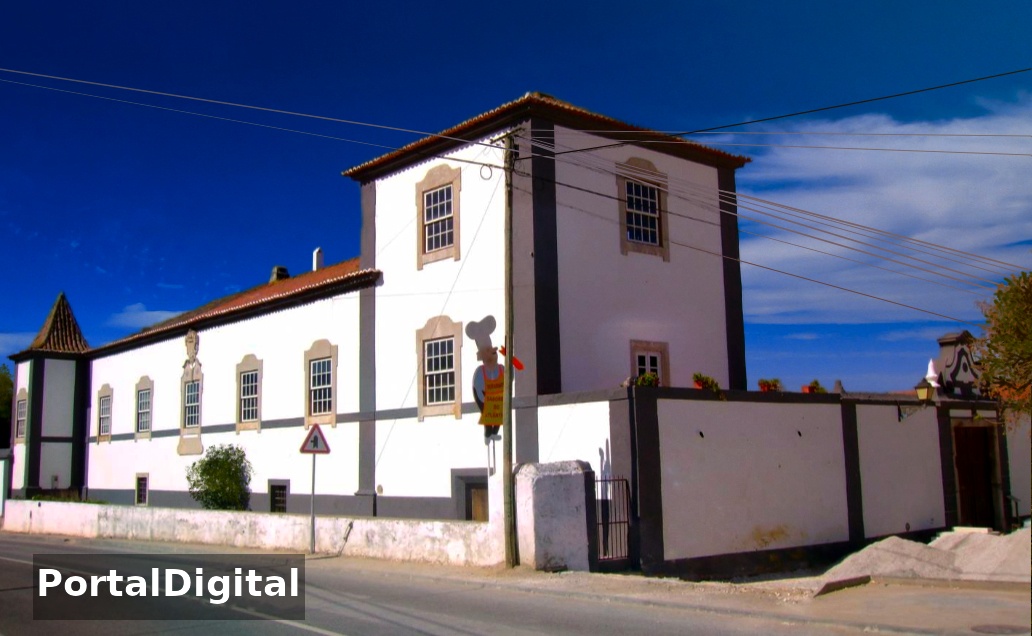
The manor house was built in the 16th century with an L-shaped plan and a chapel outside.
The main chapel with a ribbed vault roof and walls covered in 18th century tile panels.
The Melo e Castro family manor was built in the 40s of the 16th century, by Martim Afonso de Melo e Castro Zuzarte, captain of the Indies, who also ordered the construction of the São Lourenço Chapel, at the time the property's private church.
The building constructed presents a structure with a very erudite Italian taste, derived from the renewal of civil architecture models that took place in Portugal from the middle of the century onwards.
The plan of the primitive building is composed of three quadrangular bodies marked by the arrangement of towers at the corners of the building, forming an L-shaped set where the regularity and symmetry characteristic of Renaissance models stand out.
Next to the manor house there are traces of the existence of a fresco house, an element that also came to play an important role in the architectural ensemble of 16th century manor houses.
In the following years, the original structure of the house would be changed by the construction of a body parallel to the main building, which transformed the layout of the planimetry into a U, closing the house's courtyard.
The building was visited by two royal visits in the 18th century and it was during the visits of Queen D. Maria I and the Princes that the property was renovated and the main facade and the portal leading to the house's courtyard were remodeled.
Attached to the manor is the Chapel of São Lourenço, which originated in the 16th century and was built by Martin Afonso de Mello in fulfillment of a promise made by São Lourenço, his patron saint, for having freed him from a great danger at sea.
Inside the Chapel of São Lourenço there is a carved tabernacle marbled in dark blue and with a round dome, a tile baseboard representing scenes from the life of the patron saint (18th century).
The main chapel with a ribbed vault roof and walls covered in 18th century tile panels.
The Melo e Castro family manor was built in the 40s of the 16th century, by Martim Afonso de Melo e Castro Zuzarte, captain of the Indies, who also ordered the construction of the São Lourenço Chapel, at the time the property's private church.
The building constructed presents a structure with a very erudite Italian taste, derived from the renewal of civil architecture models that took place in Portugal from the middle of the century onwards.
The plan of the primitive building is composed of three quadrangular bodies marked by the arrangement of towers at the corners of the building, forming an L-shaped set where the regularity and symmetry characteristic of Renaissance models stand out.
Next to the manor house there are traces of the existence of a fresco house, an element that also came to play an important role in the architectural ensemble of 16th century manor houses.
In the following years, the original structure of the house would be changed by the construction of a body parallel to the main building, which transformed the layout of the planimetry into a U, closing the house's courtyard.
The building was visited by two royal visits in the 18th century and it was during the visits of Queen D. Maria I and the Princes that the property was renovated and the main facade and the portal leading to the house's courtyard were remodeled.
Attached to the manor is the Chapel of São Lourenço, which originated in the 16th century and was built by Martin Afonso de Mello in fulfillment of a promise made by São Lourenço, his patron saint, for having freed him from a great danger at sea.
Inside the Chapel of São Lourenço there is a carved tabernacle marbled in dark blue and with a round dome, a tile baseboard representing scenes from the life of the patron saint (18th century).