
It is located in Largo Cónego Maia, city and district of Leiria, in Central Portugal
History of the Cathedral of Leiria
The Cathedral of Leiria was founded by D. Frei Brás de Barros in the 16th century at the request of D. João III and its construction began in 1559 and was consecrated in 1574. (after the creation of the diocese of Leiria, on May 22, 1545).
At the request of D. João III to Pope Paul III, the Diocese of Leiria was created on May 22, 1545 in the bull Pro Excellenti.
The reduced dimensions of the temples then existing in Leiria (the churches of Nossa Senhora da Pena and São Pedro) made it necessary to construct a new building appropriate to the new requirements.
The Cathedral was founded in the mid-16th century by the humanist D. Frei Brás de Barros, bishop of Leiria since the creation of the new diocese.
The Cathedral began to be built in 1559 with the design and direction of the work of Afonso Álvares (the design could be by Miguel de Arruda, father-in-law of Afonso Álvares).
The Portuguese architect and military engineer Afonso Álvares was the author of the project for the Cathedral of Leiria built between 1551-1574 after his death in 1575 and was succeeded by his nephew Baltazar Álvares.
The temple follows the typology drawn up by Miguel de Arruda, father-in-law of Afonso Álvares for the new cathedrals built during the reign of D. João III and possibly the Cathedral of Portalegre started in 1556.
The direction of the works was assumed successively by Baltasar Álvares and Frei João Turriano (other recovery and improvement works would be carried out in subsequent centuries).
In the year 1574, the temple was consecrated, the Chapter moved from the Church of São Pedro to the new Cathedral, which was still incomplete (at the time it did not have a sacristy or other facilities).
The 1755 earthquake caused serious damage to the main façade and it was necessary to carry out some restoration work, including the construction of a new bell tower.
In 1772, a new baroque-style bell tower was built in the original location (the bell tower is located far from the Cathedral, next to the Portas do Sol or Portas do Sul).
At the request of D. João III to Pope Paul III, the Diocese of Leiria was created on May 22, 1545 in the bull Pro Excellenti.
The reduced dimensions of the temples then existing in Leiria (the churches of Nossa Senhora da Pena and São Pedro) made it necessary to construct a new building appropriate to the new requirements.
The Cathedral was founded in the mid-16th century by the humanist D. Frei Brás de Barros, bishop of Leiria since the creation of the new diocese.
The Cathedral began to be built in 1559 with the design and direction of the work of Afonso Álvares (the design could be by Miguel de Arruda, father-in-law of Afonso Álvares).
The Portuguese architect and military engineer Afonso Álvares was the author of the project for the Cathedral of Leiria built between 1551-1574 after his death in 1575 and was succeeded by his nephew Baltazar Álvares.
The temple follows the typology drawn up by Miguel de Arruda, father-in-law of Afonso Álvares for the new cathedrals built during the reign of D. João III and possibly the Cathedral of Portalegre started in 1556.
The direction of the works was assumed successively by Baltasar Álvares and Frei João Turriano (other recovery and improvement works would be carried out in subsequent centuries).
In the year 1574, the temple was consecrated, the Chapter moved from the Church of São Pedro to the new Cathedral, which was still incomplete (at the time it did not have a sacristy or other facilities).
The 1755 earthquake caused serious damage to the main façade and it was necessary to carry out some restoration work, including the construction of a new bell tower.
In 1772, a new baroque-style bell tower was built in the original location (the bell tower is located far from the Cathedral, next to the Portas do Sol or Portas do Sul).
Characteristics of the Cathedral of Leiria
The Sé de Leiria has a Baroque and Mannerist style church and also has some Gothic features.
Its design is Mannerist, with a Latin cross plan consisting of 3 naves and a tripartite chevet and a cloister with 3 wings attached to the chevet.
The Cathedral of Leiria is a sober building with mannerist characteristics and structurally has affinities with its contemporary Cathedrals (Portalegre and Miranda do Douro).
The Cathedral of Leiria, framed by the Renaissance classicism program, reveals some traces of the Gothic heritage alongside elements characteristic of particularly Baroque periods.
Leiria Cathedral has a Latin cross plan composed of three naves of equal height (separated by pillars with a cruciform section), a exposed transept and roofs with ribbed and star vaults.
The rectangular sacristy has a roof with ribbed vaults and walls with ashlar tiles in a polychrome pattern.
The tripartite headboard is formed by two apses and a deep central headboard with barrel-vaulted roofs decorated with coffers.
The chancel dates from the 17th century. XVII and is by Baltasar Álvares and Frei João Turriano and includes an altarpiece with paintings by Simão Rodrigues depicting episodes from the life of Our Lady and an image of Christ crucified in the center.
The two-story cloister has three wings, a central courtyard that is connected to the body of the church from the arms of the transept and the chancel.
In the transept there is an image of the Sacred Heart of Jesus and Our Lady of Fátima on the right side and an image of Saint Joseph and the Immaculate Conception on the left side of those facing the main altar.
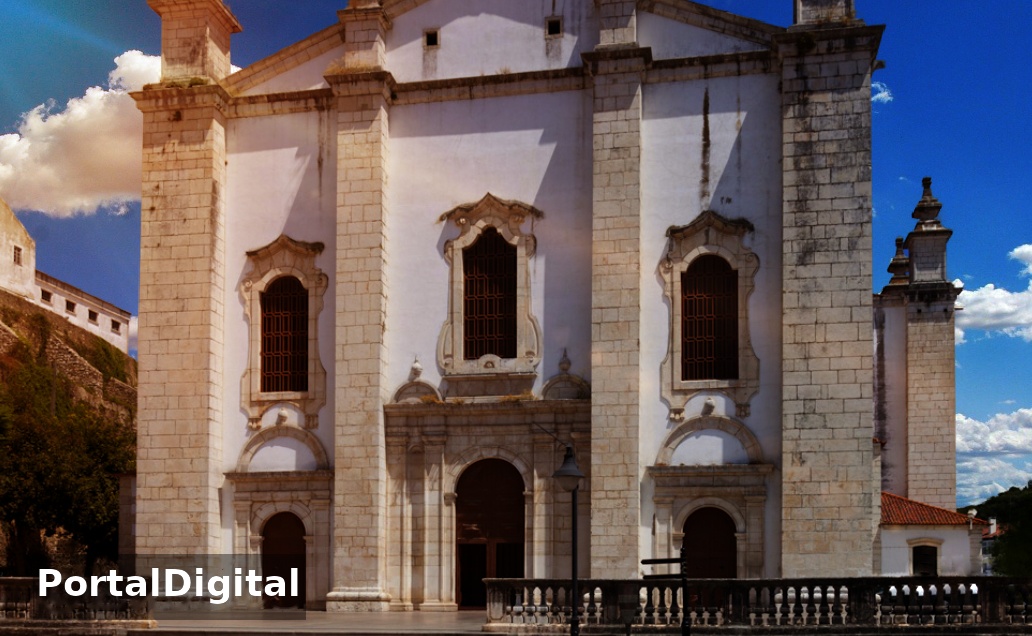
The main facade is tripartite by pillars with a strong presence and ends in a simple triangular pediment and is torn by three perfectly round portals topped by large windows.
The bell tower is separate from the church and has two perfectly round openings on each side and has a bulbous Coruchéu roof (the pyramidal or conical top of a tower).
Its design is Mannerist, with a Latin cross plan consisting of 3 naves and a tripartite chevet and a cloister with 3 wings attached to the chevet.
The Cathedral of Leiria is a sober building with mannerist characteristics and structurally has affinities with its contemporary Cathedrals (Portalegre and Miranda do Douro).
The Cathedral of Leiria, framed by the Renaissance classicism program, reveals some traces of the Gothic heritage alongside elements characteristic of particularly Baroque periods.
Leiria Cathedral has a Latin cross plan composed of three naves of equal height (separated by pillars with a cruciform section), a exposed transept and roofs with ribbed and star vaults.
The rectangular sacristy has a roof with ribbed vaults and walls with ashlar tiles in a polychrome pattern.
The tripartite headboard is formed by two apses and a deep central headboard with barrel-vaulted roofs decorated with coffers.
The chancel dates from the 17th century. XVII and is by Baltasar Álvares and Frei João Turriano and includes an altarpiece with paintings by Simão Rodrigues depicting episodes from the life of Our Lady and an image of Christ crucified in the center.
The two-story cloister has three wings, a central courtyard that is connected to the body of the church from the arms of the transept and the chancel.
In the transept there is an image of the Sacred Heart of Jesus and Our Lady of Fátima on the right side and an image of Saint Joseph and the Immaculate Conception on the left side of those facing the main altar.
The main facade is tripartite by pillars with a strong presence and ends in a simple triangular pediment and is torn by three perfectly round portals topped by large windows.
The bell tower is separate from the church and has two perfectly round openings on each side and has a bulbous Coruchéu roof (the pyramidal or conical top of a tower).
Classification of the Cathedral of Leiria
The Sé de Leiria was an important Mannerist cathedral and classified as a National Monument in November 2014.