
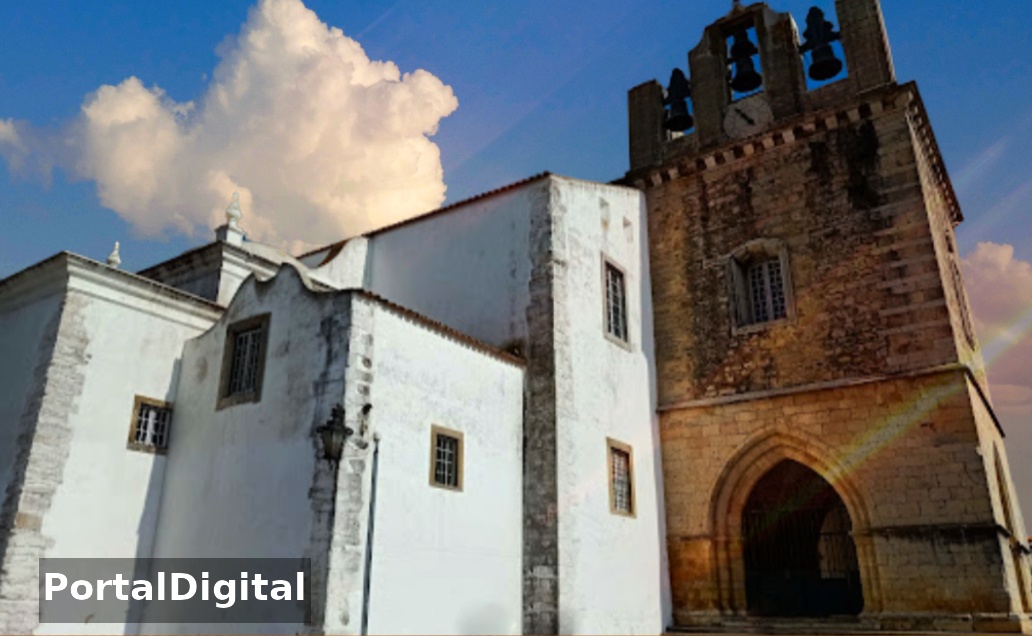
It is located in Largo da Sé of the city, in the heart of the historic center, City of Faro, Algarve, Southern Portugal/div>
Although there is no documentary evidence, it is likely that the Church of Santa Maria de Faro, consecrated to the Marian Devotion and built from 1251, two years after the reconquest of the town by order of the Archbishop of Braga, D. João Viegas, was built on the ruins of an old Paleo-Christian basilica that was converted into a mosque.
The Church was built on the ruins of the old Roman temple, it was a mosque during the Arab period and was adapted to the Church after the conquest of D. Afonso III.
The Temple preserves several architectural elements from the original construction from the 13th/14th centuries, such as the bell tower and two chapels of the cross.
In 1271, the temple was donated to the Order of Saint James as a reward for services rendered in the conquest of the area.
In the 14th century it was elevated to a Cathedral, and underwent a series of expansions during the reign of D. Dinis.
In 1577, the See of Faro was elevated to the category of Episcopal See of the Diocese of the Algarve, replacing that of Silves.
In 1596 the church and town were sacked and burned by the English troops of Robert Devereux, 2nd Earl of Essex.
The attack by English troops and the earthquakes that shook the city forced successive reconstruction works on the building, significantly altering its original design.
In this Gothic-era church, only the sanctuary chapels, the facade tower and the nave walls survived, while the altars and wooden ceilings were destroyed.
The interior was later rebuilt in the Mannerist style during the 17th century, and was enriched with several gilded works, an organ built around 1715 of which D. João V made a copy in 1750, and was sent to the Mariana Cathedral in Brazil.
The earthquakes of 1722 and 1755 caused some damage to the building and led to other works, but since then this church has not undergone any major changes.
The interior of the Cathedral of Faro contains one of the most valuable artistic collections from the 17th and 18th centuries in the Algarve: the altarpiece and chancel and the Chapel of São Lenho stand out for being covered in gilded woodwork where you can admire an important set of reliquaries and the tomb of the founding bishop, as well as tiles from the 17th century, the figurative panels of the Chapel of Nossa Senhora do Rosário, and the panels on the floor of the chancel and the side walls of the temple.
The Chapel of Nossa Senhora dos Prazeres is a tiny jewel of Baroque art with beautiful examples of gilded carving, inlays, tiles and painting.
In the Modern Age this temple was greatly transformed, but it still maintains some fundamental elements of the Gothic costume achieved at that time.
The quadrangular tower that adjoins the main façade is the most eloquent testimony of the 14th century work, imposing itself scenographically in the large cathedral forecourt.
Preceded by a staircase, it has two floors, the first being occupied by a narthex providing access to the interior of the temple, and the second by a widely lit dependency, and in the modern era it had communication with the high choir.
The narthex has entrances on each side, through triple arches with a broken profile, with marked imposts, but without columns and capitals.
The axial portal of the church is more careful, appearing to repeat the typical Gothic portals inserted in gables, here interrupted by the cross vault that covers the narthex: with three archivolts (the exterior decorated with a frieze of four-pointed stars), its capitals clearly reveal the artistic landmark in which the work was carried out, aesthetically resembling the great Batalha shipyard due to the flora tended to be organized on two floors and the thin contour of the collar.
Inside, there are two Gothic chapels located at the ends of the transept, with a polygonal plan that were transformed in the modern era, but they still retain the original stepped buttresses and the double-light windows whose capitals also repeat a two-story organization of a battle-like nature.
In 1540, by order of D. João III, Faro became the seat of the Algarve diocese, a decision that combined with the violent fire of 1596 caused by the attack of English pirates, gave rise to the great works of the Mannerist and Baroque periods.
The interior was radically transformed, firstly the body whose arcades went from pointed to round arch, by means of Tuscan columns, according to a floor model, and the main chapel with a rectangular plan and covered by coffers, preceded by a triumphal arch with an architrave frieze, and with an axial coat of arms alluding to Bishop D. Francisco Barreto (1636-1649).
The architectural works are completed, and the Baroque architectural style acts preferentially on the decoration applied, highlighting the altarpieces of the Santíssimo Sacramento (from 1676), the Santo Lenho (early 18th century), the Chapel of Nossa Senhora dos Prazeres, among many other creations of imagination, tiles, organism, etc.
Outside, there was a building that reflects the intervention of various eras, and with an interior with Renaissance characteristics, and Baroque style decoration.
Church with three naves separated by Doric columns and round arches, and has a chancel and seven chapels built in different periods.
Inside, the altarpieces are worth highlighting, some of which are exquisitely executed, and the 18th century organ with chinoiserie motifs.
In the main square of the Cathedral, two other notable buildings deserve attention: the Episcopal Palace and the Episcopal Seminary of São José.
The interior has a main chapel covered by a coffered vault, and the side chapels inscribed in the side naves feature carved and tile ornamentation.
In the central nave stands out the baroque organ with three castles and four niches, and next to the cloister is the Chapel of Bones. The Sé Cathedral of Faro presents a religious architecture with Gothic manifestations, floor and baroque styles, and has a longitudinal plan with a chancel, two side chapels, three naves, seven side chapels and a high choir. .
The Church was built on the ruins of the old Roman temple, it was a mosque during the Arab period and was adapted to the Church after the conquest of D. Afonso III.
The Temple preserves several architectural elements from the original construction from the 13th/14th centuries, such as the bell tower and two chapels of the cross.
In 1271, the temple was donated to the Order of Saint James as a reward for services rendered in the conquest of the area.
In the 14th century it was elevated to a Cathedral, and underwent a series of expansions during the reign of D. Dinis.
In 1577, the See of Faro was elevated to the category of Episcopal See of the Diocese of the Algarve, replacing that of Silves.
In 1596 the church and town were sacked and burned by the English troops of Robert Devereux, 2nd Earl of Essex.
The attack by English troops and the earthquakes that shook the city forced successive reconstruction works on the building, significantly altering its original design.
In this Gothic-era church, only the sanctuary chapels, the facade tower and the nave walls survived, while the altars and wooden ceilings were destroyed.
The interior was later rebuilt in the Mannerist style during the 17th century, and was enriched with several gilded works, an organ built around 1715 of which D. João V made a copy in 1750, and was sent to the Mariana Cathedral in Brazil.
The earthquakes of 1722 and 1755 caused some damage to the building and led to other works, but since then this church has not undergone any major changes.
The interior of the Cathedral of Faro contains one of the most valuable artistic collections from the 17th and 18th centuries in the Algarve: the altarpiece and chancel and the Chapel of São Lenho stand out for being covered in gilded woodwork where you can admire an important set of reliquaries and the tomb of the founding bishop, as well as tiles from the 17th century, the figurative panels of the Chapel of Nossa Senhora do Rosário, and the panels on the floor of the chancel and the side walls of the temple.
The Chapel of Nossa Senhora dos Prazeres is a tiny jewel of Baroque art with beautiful examples of gilded carving, inlays, tiles and painting.
In the Modern Age this temple was greatly transformed, but it still maintains some fundamental elements of the Gothic costume achieved at that time.
The quadrangular tower that adjoins the main façade is the most eloquent testimony of the 14th century work, imposing itself scenographically in the large cathedral forecourt.
Preceded by a staircase, it has two floors, the first being occupied by a narthex providing access to the interior of the temple, and the second by a widely lit dependency, and in the modern era it had communication with the high choir.
The narthex has entrances on each side, through triple arches with a broken profile, with marked imposts, but without columns and capitals.
The axial portal of the church is more careful, appearing to repeat the typical Gothic portals inserted in gables, here interrupted by the cross vault that covers the narthex: with three archivolts (the exterior decorated with a frieze of four-pointed stars), its capitals clearly reveal the artistic landmark in which the work was carried out, aesthetically resembling the great Batalha shipyard due to the flora tended to be organized on two floors and the thin contour of the collar.
Inside, there are two Gothic chapels located at the ends of the transept, with a polygonal plan that were transformed in the modern era, but they still retain the original stepped buttresses and the double-light windows whose capitals also repeat a two-story organization of a battle-like nature.
In 1540, by order of D. João III, Faro became the seat of the Algarve diocese, a decision that combined with the violent fire of 1596 caused by the attack of English pirates, gave rise to the great works of the Mannerist and Baroque periods.
The interior was radically transformed, firstly the body whose arcades went from pointed to round arch, by means of Tuscan columns, according to a floor model, and the main chapel with a rectangular plan and covered by coffers, preceded by a triumphal arch with an architrave frieze, and with an axial coat of arms alluding to Bishop D. Francisco Barreto (1636-1649).
The architectural works are completed, and the Baroque architectural style acts preferentially on the decoration applied, highlighting the altarpieces of the Santíssimo Sacramento (from 1676), the Santo Lenho (early 18th century), the Chapel of Nossa Senhora dos Prazeres, among many other creations of imagination, tiles, organism, etc.
Outside, there was a building that reflects the intervention of various eras, and with an interior with Renaissance characteristics, and Baroque style decoration.
Church with three naves separated by Doric columns and round arches, and has a chancel and seven chapels built in different periods.
Inside, the altarpieces are worth highlighting, some of which are exquisitely executed, and the 18th century organ with chinoiserie motifs.
In the main square of the Cathedral, two other notable buildings deserve attention: the Episcopal Palace and the Episcopal Seminary of São José.
The interior has a main chapel covered by a coffered vault, and the side chapels inscribed in the side naves feature carved and tile ornamentation.
In the central nave stands out the baroque organ with three castles and four niches, and next to the cloister is the Chapel of Bones. The Sé Cathedral of Faro presents a religious architecture with Gothic manifestations, floor and baroque styles, and has a longitudinal plan with a chancel, two side chapels, three naves, seven side chapels and a high choir. .
The Classification of the Cathedral of Faro
The Faro Cathedral is classified as a Property of Public Interest, and is the seat of the Diocese of the Algarve.