
It is located on Rua dos Valinhos, parish and city of Fátima, central Portugal
The beginning of the Path was next to Rotunda dos Pastorinhos, and this was the path that Lúcia, Jacinto and Francisco took from Aljustrel to Cova da Iria.
This sacred route has 14 stations in memory of the Passion of Jesus and there is also a 15th station that evokes the Resurrection, known as the Hungarian Calvary or Saint Stephen's Chapel.
The chapel and stations of the cross were gifts from Hungarian Catholics who were refugees in the West after the Soviet invasion of Hungary.
The via sacra (inaugurated on August 11, 1962) and the Chapel (inaugurated on March 12, 1964) were designed by engineer Ladislau Marec, the 15th station was inaugurated on October 13, 1992.
Before arriving at the Chapel of Saint Stephen, travelers can see the “Loca do Anjo” where the three shepherd children received the “Angel of Peace” for the first and third time (in the spring and autumn of 1916).
Here it is also a recognized destination for religious tourism, mainly due to the appearances of the Angel of Peace to the three shepherd children of Fátima, and a monument commemorating the apparition was inaugurated: a niche where the image of Our Lady of Fátima is located (August 12, 1956).
The Hungarian Calvary and the Valinhos Way of the Cross are a must for all pilgrims who travel to Fátima, the altar of the world in search of faith and answers to their daily problems.
In this place there were two apparitions of the Angel of Portugal (or Angel of Peace) in 1916 (and where children learned the Angel's Prayers), and an apparition of the Virgin Mary on August 19, 1917.
Currently, Valinhos is visited by thousands of Portuguese and foreign pilgrims who follow the Stations of the Cross to the Hungarian Calvary, and visit the Chapel of Saint Stephen of Hungary.
In Valinhos, the sculptures of the Angel of Portugal and the various Stations of the Cross are all by Maria Amélia Carvalheira da Silva.
The Stations of the Cross are made up of 15: Stations of the Cross I: Jesus is condemned to death, Stations of the Cross II: Jesus carries the cross on his back, Stations of the Cross III: Jesus falls for the first time, Stations of the Cross IV: Jesus meets His Mother, Stations of the Cross V: Simon of Cyrene helps Jesus, Stations of the Cross VI: Veronica wipes Jesus' face, Stations of the Cross VII: Jesus falls for the second time, Stations of the Cross VIII: Jesus meets the women of Jerusalem, Stations of the Cross IX: Jesus falls for the third time, Way of the Cross X: Jesus is stripped of His clothes, Way of the Cross
Also known as Via Sacra or Caminho dos Pastorinhos, it is one of the most popular routes in Fátima that takes pilgrims to take a route along 14 chapels that represent the different stations of the Passion of Christ.
One of its most emblematic points is the Loca do Anjo, the place where the Angel's appearances to the visionaries took place, and where a sculpture marks this fact. The Way of the Cross begins at the South Rotunda and ends at the Hungarian Calvary, where there is a chapel dedicated to Saint Stephen.
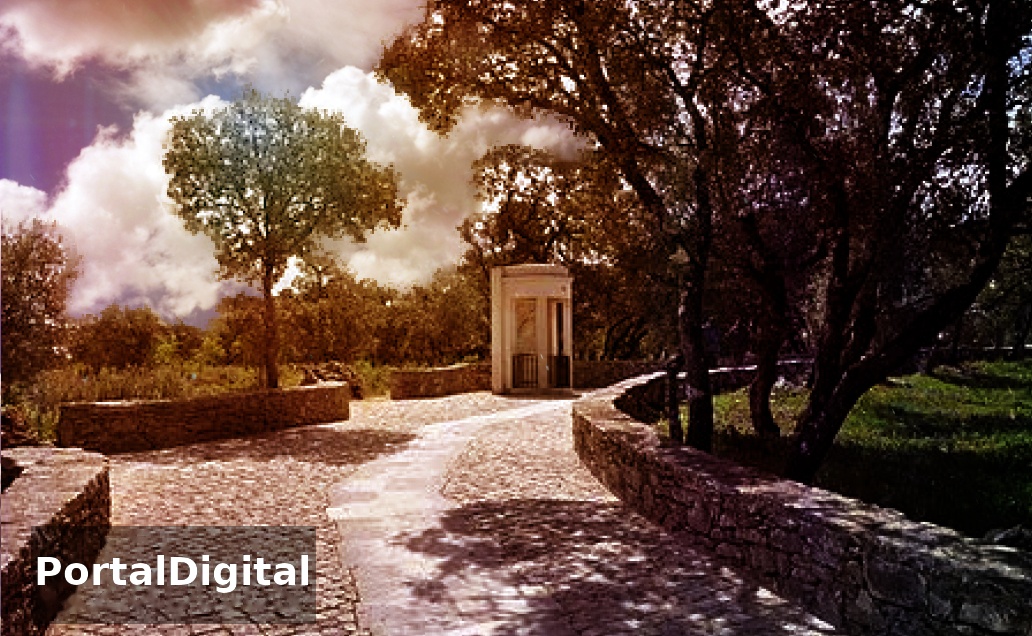
Inside the Chapel of Saint Stephen you can see on the ceiling a Panel of the Seven Sorrows of Mary, stained glass windows acting as windows, a Statue representing Our Lady Queen of Hungary with the Child Jesus, plaques evoking the merits of the construction of the Chapel and Calvary.
This sacred route has 14 stations in memory of the Passion of Jesus and there is also a 15th station that evokes the Resurrection, known as the Hungarian Calvary or Saint Stephen's Chapel.
The chapel and stations of the cross were gifts from Hungarian Catholics who were refugees in the West after the Soviet invasion of Hungary.
The via sacra (inaugurated on August 11, 1962) and the Chapel (inaugurated on March 12, 1964) were designed by engineer Ladislau Marec, the 15th station was inaugurated on October 13, 1992.
Before arriving at the Chapel of Saint Stephen, travelers can see the “Loca do Anjo” where the three shepherd children received the “Angel of Peace” for the first and third time (in the spring and autumn of 1916).
Here it is also a recognized destination for religious tourism, mainly due to the appearances of the Angel of Peace to the three shepherd children of Fátima, and a monument commemorating the apparition was inaugurated: a niche where the image of Our Lady of Fátima is located (August 12, 1956).
The Hungarian Calvary and the Valinhos Way of the Cross are a must for all pilgrims who travel to Fátima, the altar of the world in search of faith and answers to their daily problems.
In this place there were two apparitions of the Angel of Portugal (or Angel of Peace) in 1916 (and where children learned the Angel's Prayers), and an apparition of the Virgin Mary on August 19, 1917.
Currently, Valinhos is visited by thousands of Portuguese and foreign pilgrims who follow the Stations of the Cross to the Hungarian Calvary, and visit the Chapel of Saint Stephen of Hungary.
In Valinhos, the sculptures of the Angel of Portugal and the various Stations of the Cross are all by Maria Amélia Carvalheira da Silva.
The Stations of the Cross are made up of 15: Stations of the Cross I: Jesus is condemned to death, Stations of the Cross II: Jesus carries the cross on his back, Stations of the Cross III: Jesus falls for the first time, Stations of the Cross IV: Jesus meets His Mother, Stations of the Cross V: Simon of Cyrene helps Jesus, Stations of the Cross VI: Veronica wipes Jesus' face, Stations of the Cross VII: Jesus falls for the second time, Stations of the Cross VIII: Jesus meets the women of Jerusalem, Stations of the Cross IX: Jesus falls for the third time, Way of the Cross X: Jesus is stripped of His clothes, Way of the Cross
Also known as Via Sacra or Caminho dos Pastorinhos, it is one of the most popular routes in Fátima that takes pilgrims to take a route along 14 chapels that represent the different stations of the Passion of Christ.
One of its most emblematic points is the Loca do Anjo, the place where the Angel's appearances to the visionaries took place, and where a sculpture marks this fact. The Way of the Cross begins at the South Rotunda and ends at the Hungarian Calvary, where there is a chapel dedicated to Saint Stephen.
Inside the Chapel of Saint Stephen you can see on the ceiling a Panel of the Seven Sorrows of Mary, stained glass windows acting as windows, a Statue representing Our Lady Queen of Hungary with the Child Jesus, plaques evoking the merits of the construction of the Chapel and Calvary.