
Located in São João do Estoril, in the municipality of Cascais, district of Lisbon, Central Portugal
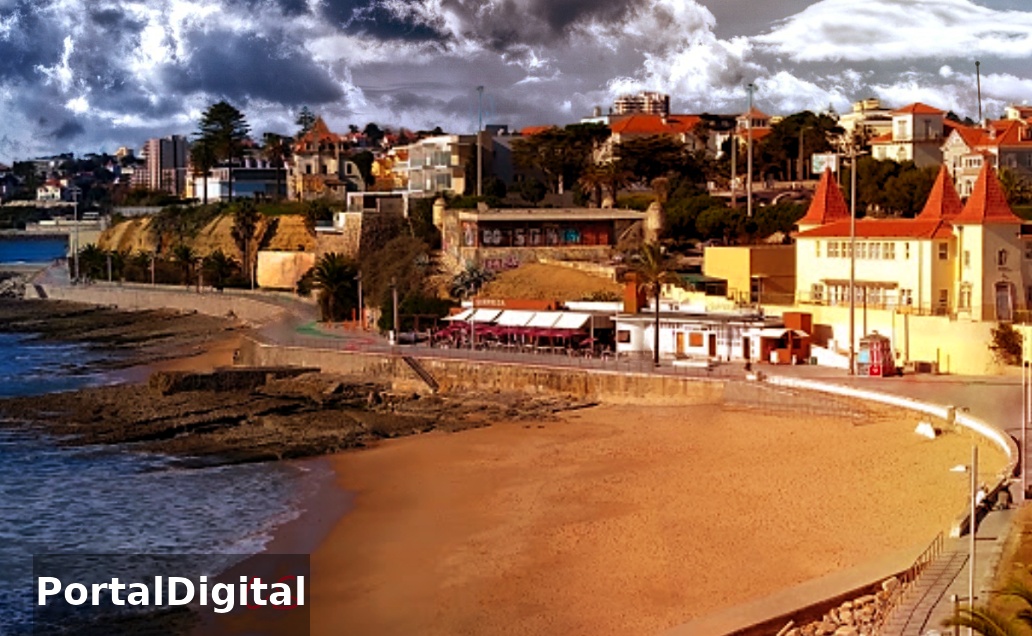
Poça beach is a bathing water, with an urban typology and intensive use.
The beach is located close to the Estrada Marginal delimited by two slopes where the Forte Velho and the Fort of São Teodósio da Cadaveira are located.
The front is sandy with a gentle slope, access to the beach can be done on foot via Estrada Marginal, Paredão de Cascais or the tunnel that connects it to Vale de Santa Rita.
In the Santa Rita Valley and on the slopes that border it there are car parks, restaurants, bars, a medical and first aid post and it is monitored during the bathing season.
The beach has forts, imposing mansions in its surroundings, it housed the Poça Thermal Baths and in this place the Cadaveira river flowed.
The Fort of São Pedro do Estoril, also known as Forte da Poça, is located on Poça beach, parish of São João do Estoril, municipality of Cascais, district of Lisbon, Central Portugal.
Forte da Poça with a square polygonal plan, its main body housed the accommodation, arranged around a courtyard covered by a terrace, in the adjacent space there was the battery, with a "slow, elongated" structure with circular guardhouses covered at the apexes.
The complex was surrounded by an irregularly shaped outer parapet, which constituted a first defensive barrier.
The epigraphic inscription on the coat of arms, now partially covered by the nightclub's awning, says: "Jesus, Mary. The very high and powerful king Dom João III of Portugal, our Lord, ordered the construction of this fortification, being governor of the arms of this square Dom Antonio Luiz de Menezes, and it began on April 5, 1642; it ended in the era of 1643."
Forte da Poça was classified as a Property of Public Interest on September 29, 1977 and currently operates as a nightclub.
Forte de São Teodósio, also known as Forte de São João or Forte da Cadaveira, is located off Avenida Marginal, in the parish of Cascais and Estoril in Lisbon.
The Fort of São Teodósio is part of a series of maritime fortifications carried out during the period of the Restoration of Independence, in order to protect the entire coast from the Torre de Belém in Lisbon to Cabo da Roca in Sintra, avoiding possible enemy landings.
Its construction began in April 1642 and was completed the following year. Its location allowed the use of crossfire in conjunction with the Fort of Santo António in order to protect Praia da Poça. It was named in honor of Prince D. Teodósio, Duke of Bragança, eldest son of João IV of Portugal, and was also known as Forte d’Assubida because it is located at the top of the Cadaveira ramp.
Forte da Cadaveira was classified as a Property of Public Interest on September 29, 1977.
Currently, the poorly maintained building came into the possession of Cascais City Council in 2003 with a project for its requalification and use as a tea house and exhibition areas scheduled for completion in October 2006, but in 2018 the fort was still in ruins.
The beach is located close to the Estrada Marginal delimited by two slopes where the Forte Velho and the Fort of São Teodósio da Cadaveira are located.
The front is sandy with a gentle slope, access to the beach can be done on foot via Estrada Marginal, Paredão de Cascais or the tunnel that connects it to Vale de Santa Rita.
In the Santa Rita Valley and on the slopes that border it there are car parks, restaurants, bars, a medical and first aid post and it is monitored during the bathing season.
The beach has forts, imposing mansions in its surroundings, it housed the Poça Thermal Baths and in this place the Cadaveira river flowed.
The Fort of São Pedro do Estoril, also known as Forte da Poça, is located on Poça beach, parish of São João do Estoril, municipality of Cascais, district of Lisbon, Central Portugal.
Forte da Poça with a square polygonal plan, its main body housed the accommodation, arranged around a courtyard covered by a terrace, in the adjacent space there was the battery, with a "slow, elongated" structure with circular guardhouses covered at the apexes.
The complex was surrounded by an irregularly shaped outer parapet, which constituted a first defensive barrier.
The epigraphic inscription on the coat of arms, now partially covered by the nightclub's awning, says: "Jesus, Mary. The very high and powerful king Dom João III of Portugal, our Lord, ordered the construction of this fortification, being governor of the arms of this square Dom Antonio Luiz de Menezes, and it began on April 5, 1642; it ended in the era of 1643."
Forte da Poça was classified as a Property of Public Interest on September 29, 1977 and currently operates as a nightclub.
Forte de São Teodósio, also known as Forte de São João or Forte da Cadaveira, is located off Avenida Marginal, in the parish of Cascais and Estoril in Lisbon.
The Fort of São Teodósio is part of a series of maritime fortifications carried out during the period of the Restoration of Independence, in order to protect the entire coast from the Torre de Belém in Lisbon to Cabo da Roca in Sintra, avoiding possible enemy landings.
Its construction began in April 1642 and was completed the following year. Its location allowed the use of crossfire in conjunction with the Fort of Santo António in order to protect Praia da Poça. It was named in honor of Prince D. Teodósio, Duke of Bragança, eldest son of João IV of Portugal, and was also known as Forte d’Assubida because it is located at the top of the Cadaveira ramp.
Forte da Cadaveira was classified as a Property of Public Interest on September 29, 1977.
Currently, the poorly maintained building came into the possession of Cascais City Council in 2003 with a project for its requalification and use as a tea house and exhibition areas scheduled for completion in October 2006, but in 2018 the fort was still in ruins.