
It is located in the parish of Santa Maria Maior, city of Lisbon, Central Portugal
Praça Dom Pedro IV or Rossio is a square in downtown Lisbon and has been one of the city's nerve centers.
Praça do Rossio in Lisbon, also known as Praça Dom Pedro IV, and this square is characterized by being one of the oldest squares in the Portuguese capital full of history and memories, very busy and visited by tourists.
Praça do Rossio in Lisbon, also known as Praça Dom Pedro IV, and this square is characterized by being one of the oldest squares in the Portuguese capital full of history and memories, very busy and visited by tourists.
Reconstruction of Praça Dom Pedro IV or Rossio after the 1755 Earthquake
After the 1755 earthquake, the square was rebuilt according to Carlos Mardel's plan, as few buildings could resist it, giving rise to a rectangular square measuring 166 m long x 52 m wide.
In place of the Palácio dos Estaus, the Regency Palace (1807), the Chamber of Peers (1826), the Royal Academy of Fortification, the Secretariat of the Police Intendency, the Army School and the Public Treasury were installed.
This square witnessed bullfights, military parades, courtly festivities, popular revolutions and also acts of faith during the Inquisition, popular riots, liberal and Miguelist struggles (August 22, 1831).
Between 1846 and 1849, the D. Maria II Theater was built in the square, with trees, fountains and taverns.
In 1848, on the initiative of General Eusébio Pinheiro Furtado, the pavement was paved with Portuguese basalt and limestone mosaics in undulating patterns, and was one of the first designs of this type to decorate the city's pavements.
At the beginning of the 19th century, the famous taverns of “Nicola” and “Parras” where the literati of the time gathered, Manuel Maria Barbosa du Bocage, Nuno Álvares Pato Moniz, Francisco Joaquim Bingre, João Vicente Pimentel Maldonado, Manuel Maria Barbosa du Bocage.
In place of the Palácio dos Estaus, the Regency Palace (1807), the Chamber of Peers (1826), the Royal Academy of Fortification, the Secretariat of the Police Intendency, the Army School and the Public Treasury were installed.
This square witnessed bullfights, military parades, courtly festivities, popular revolutions and also acts of faith during the Inquisition, popular riots, liberal and Miguelist struggles (August 22, 1831).
Between 1846 and 1849, the D. Maria II Theater was built in the square, with trees, fountains and taverns.
In 1848, on the initiative of General Eusébio Pinheiro Furtado, the pavement was paved with Portuguese basalt and limestone mosaics in undulating patterns, and was one of the first designs of this type to decorate the city's pavements.
At the beginning of the 19th century, the famous taverns of “Nicola” and “Parras” where the literati of the time gathered, Manuel Maria Barbosa du Bocage, Nuno Álvares Pato Moniz, Francisco Joaquim Bingre, João Vicente Pimentel Maldonado, Manuel Maria Barbosa du Bocage.
The Characteristics of Praça Dom Pedro IV or Rossio (Downtown Lisbon)
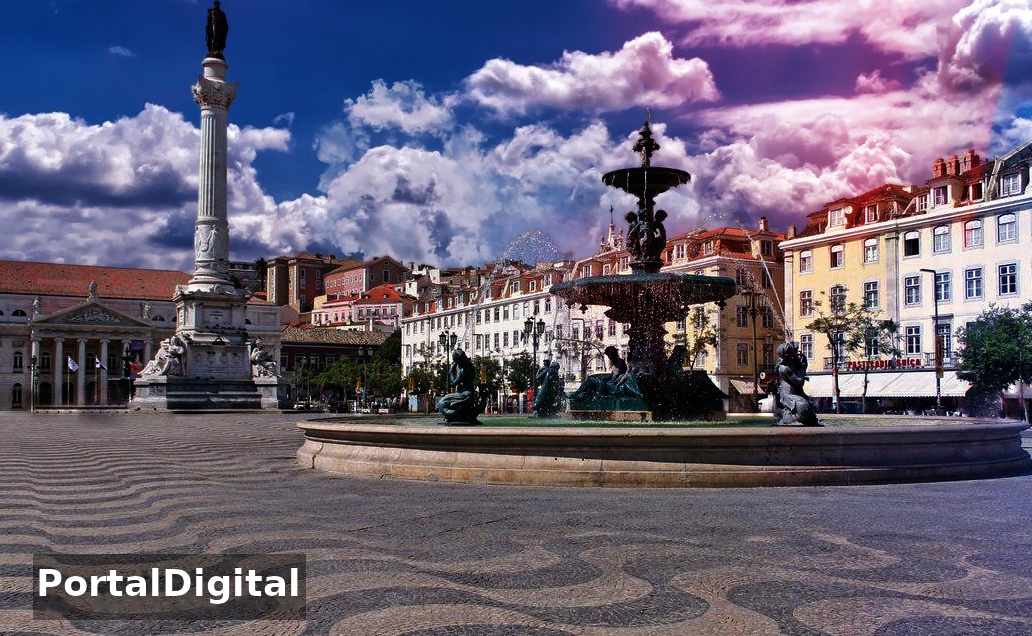
The square features a large tree-lined pedestrian area with several cafes, restaurants, tourist shops, a fountain (19th century), Café Nicola and Café Beira Gare (two of Lisbon's most famous cafés) were favorites among 18th and 19th century writers and artists.
In this space, the floor is paved with Portuguese basalt and limestone mosaics in undulating patterns and pays homage to Lisbon's maritime past, in the middle just a fountain with several fountains.
In the center of the square, on a 23 meter high pedestal, stands a bronze statue of Dom Pedro IV, King of Portugal and first emperor of Brazil. (1870 proclaimed independence from Portugal).
Today in this place you can attend occasional political rallies, observe its sober Pombaline buildings, which have already been greatly altered, souvenir shops, jewelry stores and cafes.
In Rossio Square we find a magnificent neoclassical style building called Teatro Nacional Dona Maria II, historic buildings, a large and busy place, taxis, and it is close to the Santa Justa Elevator.
On the northwest side of the square is Rossio Station, which features a beautiful façade designed by José Luís Monteiro (1887).
In this space, the floor is paved with Portuguese basalt and limestone mosaics in undulating patterns and pays homage to Lisbon's maritime past, in the middle just a fountain with several fountains.
In the center of the square, on a 23 meter high pedestal, stands a bronze statue of Dom Pedro IV, King of Portugal and first emperor of Brazil. (1870 proclaimed independence from Portugal).
Today in this place you can attend occasional political rallies, observe its sober Pombaline buildings, which have already been greatly altered, souvenir shops, jewelry stores and cafes.
In Rossio Square we find a magnificent neoclassical style building called Teatro Nacional Dona Maria II, historic buildings, a large and busy place, taxis, and it is close to the Santa Justa Elevator.
On the northwest side of the square is Rossio Station, which features a beautiful façade designed by José Luís Monteiro (1887).