
It is located in the parish of Alcobaça, city and municipality of the same name, in the district of Leiria, Central Portugal
In Praça Afonso Henriques, the passage is through two Cistercian arches, a residual architectural piece from the old outbuildings of the abbey complex, which housed the granary and the rear area of the economic activities associated with the Abbey (passage to Praça da República).
Distinctive artistic marks are visible on the arches, such as the order's coat of arms, the fountain, the stone benches, Manueline sculptural pieces that were introduced in the 20th century in an action of historical urban revivalist reinterpretation.
An architectural work of art that connects Praça da República to Praça Dom Afonso Henriques, a legacy of the era of the Cistercian Order, a Benedictine order that settled in Portugal in the mid-12th century.
In Praça D. Afonso Henriques, the enhancement of the space is achieved through a play of lights to illuminate the hawks, the fountain, and the traditional lanterns that create a welcoming atmosphere in the small square.
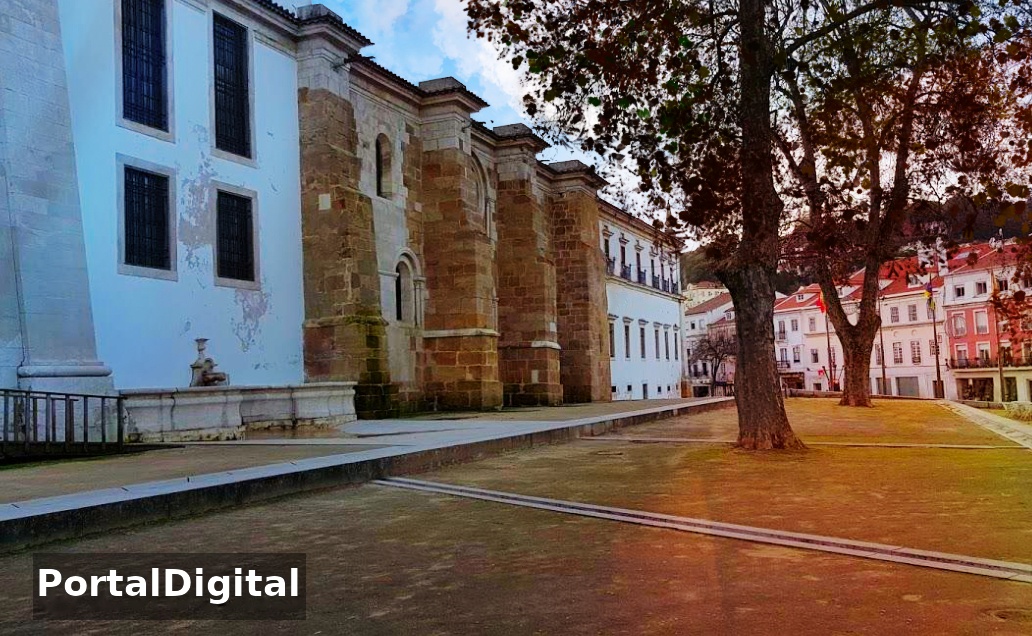
The Square has a Portuguese sidewalk with centuries-old trees with intense local commerce, historic buildings painted white with flower pots on the balconies, narrow streets lit by beautiful lamps, shrubby vegetation, decorative vases along the streets, large terraces with umbrellas, older non-habitable houses painted with graffiti.
The Cistercian Arch or Clairvaux Arch makes the connection between Praça da República and Praça D. Afonso Henriques, it is a beautiful legacy revealing the presence of the Cistercian monks in the city, there are two arches very close to each other between the monastery and the beautiful Praça da República.
A very pleasant place with souvenir shops (postcards from the region, pottery with decorative crockery, chintz fabric with different patterns), cafes, pastry shops where you can eat some traditional sweets from the region (almond queijadas, the secret of Saint Bernard, abbess crowns, cheeses from heaven and bread from the Alcobaça Monastery), traditional grocery stores where visitors can buy the famous Alcobaça apple.
Calico is a printed cotton fabric that was taken from India to Europe by the Portuguese in the 15th century and is characterized by wide stripes with figures such as birds, exotic birds, animals, flowers, fruits, human figures, cornucopias, amphorae, nests and tropical fruits. In Praça Afonso Henriques you can breathe history in every corner, transporting the visitor to a time in the past where Baroque and Manueline architecture was valued.
Distinctive artistic marks are visible on the arches, such as the order's coat of arms, the fountain, the stone benches, Manueline sculptural pieces that were introduced in the 20th century in an action of historical urban revivalist reinterpretation.
An architectural work of art that connects Praça da República to Praça Dom Afonso Henriques, a legacy of the era of the Cistercian Order, a Benedictine order that settled in Portugal in the mid-12th century.
In Praça D. Afonso Henriques, the enhancement of the space is achieved through a play of lights to illuminate the hawks, the fountain, and the traditional lanterns that create a welcoming atmosphere in the small square.
The Square has a Portuguese sidewalk with centuries-old trees with intense local commerce, historic buildings painted white with flower pots on the balconies, narrow streets lit by beautiful lamps, shrubby vegetation, decorative vases along the streets, large terraces with umbrellas, older non-habitable houses painted with graffiti.
The Cistercian Arch or Clairvaux Arch makes the connection between Praça da República and Praça D. Afonso Henriques, it is a beautiful legacy revealing the presence of the Cistercian monks in the city, there are two arches very close to each other between the monastery and the beautiful Praça da República.
A very pleasant place with souvenir shops (postcards from the region, pottery with decorative crockery, chintz fabric with different patterns), cafes, pastry shops where you can eat some traditional sweets from the region (almond queijadas, the secret of Saint Bernard, abbess crowns, cheeses from heaven and bread from the Alcobaça Monastery), traditional grocery stores where visitors can buy the famous Alcobaça apple.
Calico is a printed cotton fabric that was taken from India to Europe by the Portuguese in the 15th century and is characterized by wide stripes with figures such as birds, exotic birds, animals, flowers, fruits, human figures, cornucopias, amphorae, nests and tropical fruits. In Praça Afonso Henriques you can breathe history in every corner, transporting the visitor to a time in the past where Baroque and Manueline architecture was valued.