
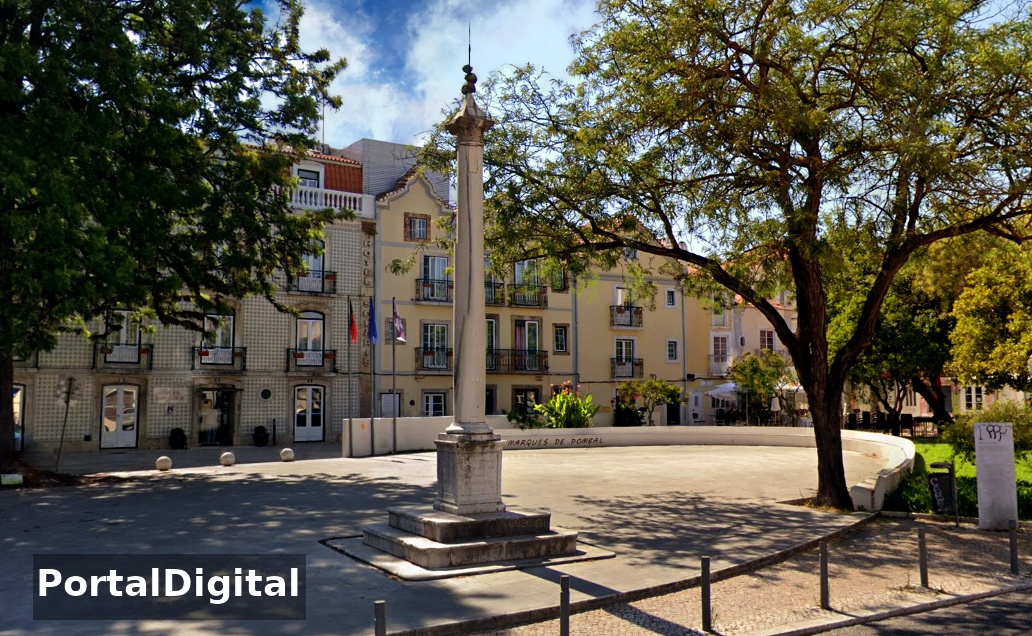
It is located in Praça Marquês de Pombal (formerly Praça de São Pedro), in the parish of Nossa Senhora da Anunciada, in the City of Setúbal, District of Lisbon, Central Portugal
Pelourinho moved from Praça Ribeira to Praça Marquês de Pombal in 1774 by order of the illustrious and excellent Mr. Marquês de Pombal, from the Council of State.
The Pelourinho was carried out by the Chamber of this town, with Leandro de Souza da Silva Alcoforado as judge from outside, and by decree of His Most Faithful Majesty appointed inspector of public works in this town José Bruno de Cabedo, colonel of the regiment and governor of the square, director of these João Vasco M. de Braun, sergeant-major of the same, engineer and artillery commander.
The Pelourinho located in Praça Marquês de Pombal, in one of the city's expansion areas during the modern and contemporary eras, was originally built for Praça da Ribeira (formerly Largo da Ribeira Velha) in the heart of the historic center of Setubal in the heart of the medieval town.
Its construction dates back to the reign of D. Maria I, in a chronology already well advanced in the 18th century and was established as one of the main symbols of the government of the Duke of Aveiro who then held the rights over the city.
Throughout the 18th century, the pillory was moved at least twice, at first it moved to the Largo in front of the Convent of Espírito Santo, later it was partially buried as it affected the equestrian races that were taking place.
In 1774, by order of the Marquis of Pombal, the pillory was demolished precisely because it represented the former authority of the Duke of Aveiro.
The column, undoubtedly the element with the greatest impact and artistic quality in the entire complex, was reused in the construction of the current pillory, the work of Engineer Cabedo who also left his mark here.
The current configuration of the Setúbal pillory consists of a quadrangular pedestal, on which rests the shaft of the column that contains a long inscription that historically contextualizes the monument.
Along its four sides, it is mentioned that the pillory was moved from Praça da Ribeira in 1774, that its author was Regimental Colonel José Bruno de Cabedo, General Inspector of Public Works in Setúbal, and that the promoter of the work was the City Council, which paid for the costs of its execution.
The pedestal with its delicate upper frame reveals a clear neo-classical taste, the black veined marble column is an element of great quality due to its slender and well-proportioned profile.
Above, a capital with vegetal decoration, typologically Corinthian, crowns the monument, on which, at an uncertain date, an iron element was superimposed.
The height and scenographic dignity of the complex is further reinforced by the foundation of two steps on which it rests, which give it a greater visual impact on the square.
The Pelourinho was carried out by the Chamber of this town, with Leandro de Souza da Silva Alcoforado as judge from outside, and by decree of His Most Faithful Majesty appointed inspector of public works in this town José Bruno de Cabedo, colonel of the regiment and governor of the square, director of these João Vasco M. de Braun, sergeant-major of the same, engineer and artillery commander.
The Pelourinho located in Praça Marquês de Pombal, in one of the city's expansion areas during the modern and contemporary eras, was originally built for Praça da Ribeira (formerly Largo da Ribeira Velha) in the heart of the historic center of Setubal in the heart of the medieval town.
Its construction dates back to the reign of D. Maria I, in a chronology already well advanced in the 18th century and was established as one of the main symbols of the government of the Duke of Aveiro who then held the rights over the city.
Throughout the 18th century, the pillory was moved at least twice, at first it moved to the Largo in front of the Convent of Espírito Santo, later it was partially buried as it affected the equestrian races that were taking place.
In 1774, by order of the Marquis of Pombal, the pillory was demolished precisely because it represented the former authority of the Duke of Aveiro.
The column, undoubtedly the element with the greatest impact and artistic quality in the entire complex, was reused in the construction of the current pillory, the work of Engineer Cabedo who also left his mark here.
The current configuration of the Setúbal pillory consists of a quadrangular pedestal, on which rests the shaft of the column that contains a long inscription that historically contextualizes the monument.
Along its four sides, it is mentioned that the pillory was moved from Praça da Ribeira in 1774, that its author was Regimental Colonel José Bruno de Cabedo, General Inspector of Public Works in Setúbal, and that the promoter of the work was the City Council, which paid for the costs of its execution.
The pedestal with its delicate upper frame reveals a clear neo-classical taste, the black veined marble column is an element of great quality due to its slender and well-proportioned profile.
Above, a capital with vegetal decoration, typologically Corinthian, crowns the monument, on which, at an uncertain date, an iron element was superimposed.
The height and scenographic dignity of the complex is further reinforced by the foundation of two steps on which it rests, which give it a greater visual impact on the square.
The Classification of the Setúbal Pelourinho
Its white marble column has a Corinthian capital and has been classified by the Institute of Architectural and Archaeological Heritage Management as a national monument since 1910.