
It is located in Largo da Misericórdia, R. Luís Silva Mouzinho de Albuquerque, Vila de Batalha, District of Leiria, in the province of Beira Litoral, Central Portugal
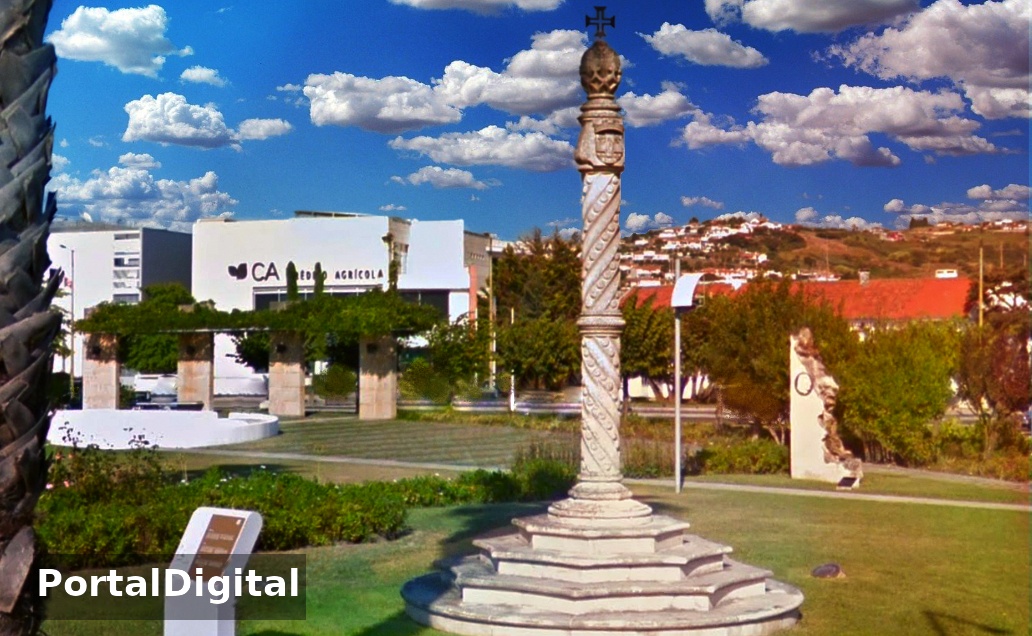
Pelourinho appears in a landscaped square formed by the confluence of several road axes, surrounded by the Batalha Monastery.
The Pelourinho is made up of a basement with four steps and a shaft with two twisted and striated slopes.
At the top of the shaft there is a capital with the coat of arms of Batalha where you can see the patron saint Santa Maria da Vitória and topped with a terminal piece in its center, the iron Cross of Chris.
The Pelourinho has a structure in limestone stonework, made up of a base of four steps, the first of which is circular and the rest are hexagonal, all of them with a bullnose upper edge, where the base of the column is based, made up of a circular and an octagonal element.
The shaft is made up of two striated torsional sections, with opposite directions, decorated on half of the striations by small half spheres, both sections are separated by a strung central knot.
The shaft is topped by a capital with the coat of arms of Batalha where the patron saint Santa Maria da Vitória stands out, topped by the terminal piece with a crown having three-leaf clovers at the ends and in the middle a sphere on which sits an iron cross of Christ.
Pelourinho is made up of commemorative architecture from the 19th century. 20, oval pine cone, mixed, circular and hexagonal base, with four steps, on which the torso rests with bands decorated by spheres, with a central knot.
At the top, the heraldic symbol of Batalha and an oval finish, surmounted by the Cross of Christ.
The Pelourinho is built based on documentation that shows the pillory that would have existed in Batalha, highlighting the shaft with a shaft cut by a cordiform knot and with decoration on the bands that make up the torso.
Pillory composed of a four-step socket and a shaft with two ribbed torsional sections (Solomonic Column).
Topping the shaft there is a capital with the coat of arms of Batalha, where the patron saint Santa Maria da Vitória stands out and topped by a terminal piece that presents, in the center, an iron cross of Christ.
The Pelourinho is made up of a basement with four steps and a shaft with two twisted and striated slopes.
At the top of the shaft there is a capital with the coat of arms of Batalha where you can see the patron saint Santa Maria da Vitória and topped with a terminal piece in its center, the iron Cross of Chris.
The Pelourinho has a structure in limestone stonework, made up of a base of four steps, the first of which is circular and the rest are hexagonal, all of them with a bullnose upper edge, where the base of the column is based, made up of a circular and an octagonal element.
The shaft is made up of two striated torsional sections, with opposite directions, decorated on half of the striations by small half spheres, both sections are separated by a strung central knot.
The shaft is topped by a capital with the coat of arms of Batalha where the patron saint Santa Maria da Vitória stands out, topped by the terminal piece with a crown having three-leaf clovers at the ends and in the middle a sphere on which sits an iron cross of Christ.
Pelourinho is made up of commemorative architecture from the 19th century. 20, oval pine cone, mixed, circular and hexagonal base, with four steps, on which the torso rests with bands decorated by spheres, with a central knot.
At the top, the heraldic symbol of Batalha and an oval finish, surmounted by the Cross of Christ.
The Pelourinho is built based on documentation that shows the pillory that would have existed in Batalha, highlighting the shaft with a shaft cut by a cordiform knot and with decoration on the bands that make up the torso.
Pillory composed of a four-step socket and a shaft with two ribbed torsional sections (Solomonic Column).
Topping the shaft there is a capital with the coat of arms of Batalha, where the patron saint Santa Maria da Vitória stands out and topped by a terminal piece that presents, in the center, an iron cross of Christ.