
It is located next to the Setúbal-Mar Railway Station, on Estrada da Graça, city of Setúbal, Central Portugal
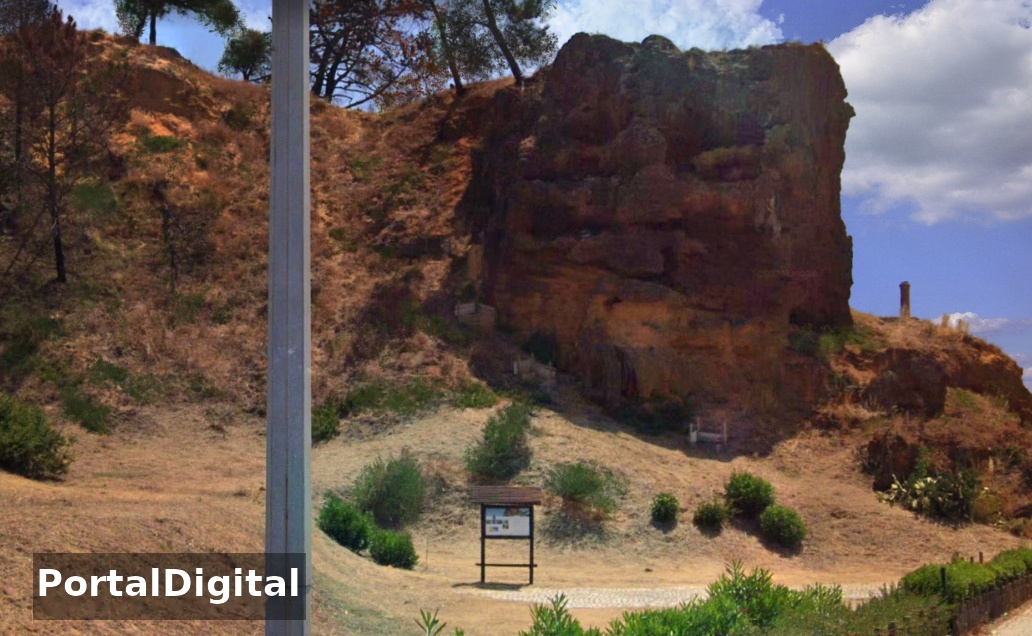
Pedra Furada consists of a ferruginous sandstone rock crossed by several hollow vertical tubes filled with loose, light sand. It is estimated to be between two and four million years old, 18 meters high and 12 meters long, and oriented from north to south.
Pedra Furada, unique at a national, European and global level, was described for the first time by Baron de Eschwege in 1831 and appears in legends and popular beliefs in the area.
In 2003 it became part of one of the centers of the National Museum of Natural History, its submerged part was destroyed in 2019 following works to improve maritime accessibility to the Port of Setúbal.
Pedra Furada, a sandstone consolidated in iron over two million years old, could become the center of a museum center on geological formations and with ethnographic documents associated with the natural monument.
The ferruginous rock is a rare formation in the world and only in California there is something similar.
The particularity of Pedra Furada is its composition of sand consolidated with iron, through tubular structures, while the rock formation discovered in the United States had limestone as a hardening element.
Despite the differences between the two sandstones, the research experience in California is being used in a master's degree in geology on the monument taking place at the Faculty of Sciences of the University of Lisbon, supported by the Setúbal City Council.
The holed stone in Setúbal is an exceptional geological phenomenon in its formation and origin and has been a source of curiosity and interest for the people of Setúbal since ancient times, both in scholarly and more popular terms.
Legends and rituals are associated with its presence, from waiting for the wise men to waiting for the royal entourages themselves when they moved from the palaces located in Alentejo to the court in Lisbon.
Pedra Furada has been scientifically proven to be a natural phenomenon that resulted from the consolidation of sandy terrain, which continues to exist in the cliffs that flank it, and is estimated to have existed for between two and four million years.
Pedra Furada, unique at a national, European and global level, was described for the first time by Baron de Eschwege in 1831 and appears in legends and popular beliefs in the area.
In 2003 it became part of one of the centers of the National Museum of Natural History, its submerged part was destroyed in 2019 following works to improve maritime accessibility to the Port of Setúbal.
Pedra Furada, a sandstone consolidated in iron over two million years old, could become the center of a museum center on geological formations and with ethnographic documents associated with the natural monument.
The ferruginous rock is a rare formation in the world and only in California there is something similar.
The particularity of Pedra Furada is its composition of sand consolidated with iron, through tubular structures, while the rock formation discovered in the United States had limestone as a hardening element.
Despite the differences between the two sandstones, the research experience in California is being used in a master's degree in geology on the monument taking place at the Faculty of Sciences of the University of Lisbon, supported by the Setúbal City Council.
The holed stone in Setúbal is an exceptional geological phenomenon in its formation and origin and has been a source of curiosity and interest for the people of Setúbal since ancient times, both in scholarly and more popular terms.
Legends and rituals are associated with its presence, from waiting for the wise men to waiting for the royal entourages themselves when they moved from the palaces located in Alentejo to the court in Lisbon.
Pedra Furada has been scientifically proven to be a natural phenomenon that resulted from the consolidation of sandy terrain, which continues to exist in the cliffs that flank it, and is estimated to have existed for between two and four million years.