

It is located in Terra Fria Trás-os-Montes, Portugal
The Montesinho Natural Park extends into the northern territory of the municipalities of Vinhais and Bragança, and is characterized by a high morphological, geological and climatic diversity that is reflected in the adaptation of animal and plant species to the physical environment and landscape, and is therefore a protected area located in the Northeast of Trás-os-Montes Portugal.
The Park has a size of around 75 thousand hectares, was recognized in 1979 as a Natural Park, and currently has 9,000 inhabitants, 92 villages, and located in Terra Fria Trás-os-Montes, temperatures vary between 12º C and 40º C.
It presents a heterogeneous relief with undulating plateaus cut by deep valleys surrounded by some mountains, the two most important of which are the “Serra de Montesinho” north of Bragança, and the “Serra da Coroa” north of Vinhais.
In Serra de Montesinho, altitudes vary between 1486 meters and in the River Mente, 438 meters in bed.
The Park has an extensive biodiversity inhabited by species such as the Iberian wolf, roe deer or deer, located in the cold land of Trás-os-Montes, shales are the dominant rocks, but granites, ultrabasic rocks and small limestone patches can also be found.
The Montesinho Natural Park is characterized by the sobriety of the landscape characterized by smooth reliefs with rounded hills separated by embedded river valleys where shale dominates, but there are patches of limestone in plateau areas and granite in the Montesinho mountain range.
In terms of vegetation, the highlights include the oak groves, chestnut trees and castinçais (whose chestnut serves as a symbol of the park), an extensive cover of broom, heather and rockrose bushes that give color to the landscape, the riverside vegetation, the natural meadows (lameiros) and the rainfed crops of the Ribeira da Anta.
In Terra Fria Transmontana, the park has a varied birdlife (more than 120 species of nesting birds), including the presence of 70% of the terrestrial animal species that occur in Portugal, with emphasis on one of the most important populations of the Iberian wolf.
The flavor of rurality is clearly evident in the presence of local ovens and favours, mills, community mills, dovecotes, and a repository of old traditions still expressed today in different festive moments.
In spring, observe the flowering of plants and the multiplication of colors, and the birdlife that can bring unforgettable experiences.
In the summer, get lost in the alleys of the Trás-os-Montes villages and get to know the lives of their populations, appreciate the geological contrasts of this region, and dive into the cold waters of the trout rivers and wander through the riparian galleries (on the banks of the rivers).
In autumn, enjoy the autumnal colors of the chestnut groves and oak groves, the Lagarelhos chestnut tree needs 12 open arms to hug it, it's well worth it to gather your friends to see if you can surround it.
The Corisco castro appears in the landscape, and from time to time strange circular constructions known as dovecotes.
In winter, notice the natural meadows, marshes that, through a centuries-old irrigation method, remain green all year round and do not freeze at this time, and sit at the table and enjoy the sausages or the delicious Montesinho honey.
Visitors can ride horses at the Center Hípico de França and take interesting equestrian tours.
The Montesinho Natural Park converges to the north with Spain, along the border with the communities of Galicia and Castilla-León, and to the west and east also with Spain (Galicia and Castile-León, respectively).
In the west, it briefly borders the municipality of Chaves, while to the south it continues to be part of the municipalities of Vinhais and Bragança.
In the Brigantine part there are the Sabor, Maçãs and Baceiro rivers, and the flavor is born on the border with Spain, on the tops of the Serra de Montesinho passing a short distance from Bragança.
Maçãs originates in Spain, and forms the international border in two distinct sections, also constituting the easternmost and southernmost borders of the Park.
The Baceiro also originates in Spain, being the smallest of the Park's main rivers and along its route there is an important trout farm next to the Castrelos Bridge.
In the Vineyard area there are the rivers Mente, Rabaçal and Tuela, and all three originate in Spain, the first two coming from Galicia and the last from Castilla-León.
The Mente runs along part of its route along the international border, forming the western border of the Park and within it are the thermal waters of Sendim/Segirei shared by the municipalities of Vinhais and Chaves.
The Rabaçal is one of two rivers (the other is the Tuela) that form the Tua river upstream of Mirandela.
The Park offers the leisure of a river beach next to the bridge on the Sobreiró de Cima road (one of the entrances to the Rota da Terra Fria) called Zona de Lomba.
The series of mountains between the Mente and Rabaçal rivers that gave shape to the term Terras de Lomba due to its continuous undulating profile between the two valleys.
These two rivers flow very close to the north, and progressively move apart as they go south, but they come closer together again and end up converging, forming a peninsula or hump.
The region, as a result of its isolation, became a municipality for several centuries, but the Tuela, which passes a short distance from Vinhais, offers two very popular beaches as an attraction, one of which is close to the border of the Park at Ponte de Soeira (EN103).
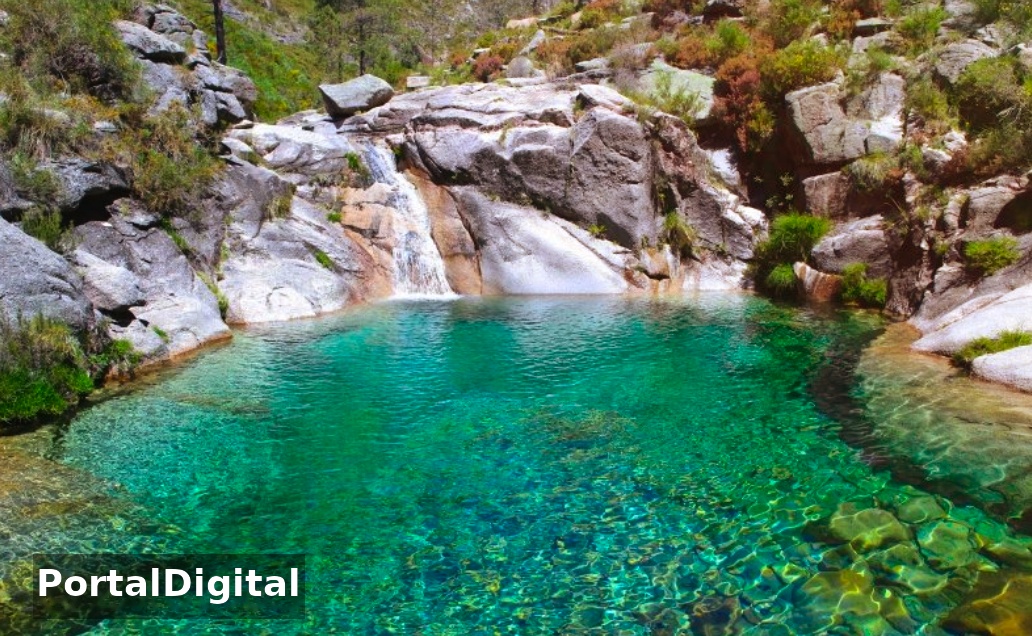
The rivers, with deep valleys and waters that are sometimes crystal clear and sometimes black with thermal properties or simply refreshing for the region's torrid summer heat, wind through valleys that are as quickly inhospitable as they are verdant and full of both animal and plant life.
The ancient mills, most of which are still used by the population, and crossed by ancient Roman bridges, are an attraction for fishing for trout, boga, barbel and scallop.
In the Montesinho Natural Park there is a great diversity of fauna and flora, such as heaths, rockroses and brooms, commonly known as scrubland, occupy large areas of land abandoned by agriculture, the edges of forests or land formerly occupied by native forests.
The forests, and particularly those that occur at higher altitudes, are extremely important biotopes for several species of wildlife.
The marshes, also known as meadows or mountain pastures, are associated with a large part of the riverside areas that run through the Montesinho Natural Park.
Chestnut groves represent the majority of agricultural land that is occupied by perennial crops, they occupy vast territories in the region and their importance is such that it is difficult to imagine life in these parts without the existence of these leafy trees.
The holm oak forests, known as sardoais, occur in less elevated areas, along steep and sunny slopes, and the black oak forests are one of the main types of autochthonous arboreal vegetation that occurs in the Park, forming part of a continuum that extends southwards to the Serra da Nogueira.
The Portuguese terrestrial fauna is represented here with around two hundred and fifty species of vertebrates, and a high richness and diversity of invertebrates as well.
The presence of the Iberian wolf, the deer, the water mole, the wild cat, the greater horseshoe bat and the marsh rat stands out in this space, but there are also around 160 species of birds including the golden eagle and the black stork.
The Park has a size of around 75 thousand hectares, was recognized in 1979 as a Natural Park, and currently has 9,000 inhabitants, 92 villages, and located in Terra Fria Trás-os-Montes, temperatures vary between 12º C and 40º C.
It presents a heterogeneous relief with undulating plateaus cut by deep valleys surrounded by some mountains, the two most important of which are the “Serra de Montesinho” north of Bragança, and the “Serra da Coroa” north of Vinhais.
In Serra de Montesinho, altitudes vary between 1486 meters and in the River Mente, 438 meters in bed.
The Park has an extensive biodiversity inhabited by species such as the Iberian wolf, roe deer or deer, located in the cold land of Trás-os-Montes, shales are the dominant rocks, but granites, ultrabasic rocks and small limestone patches can also be found.
The Montesinho Natural Park is characterized by the sobriety of the landscape characterized by smooth reliefs with rounded hills separated by embedded river valleys where shale dominates, but there are patches of limestone in plateau areas and granite in the Montesinho mountain range.
In terms of vegetation, the highlights include the oak groves, chestnut trees and castinçais (whose chestnut serves as a symbol of the park), an extensive cover of broom, heather and rockrose bushes that give color to the landscape, the riverside vegetation, the natural meadows (lameiros) and the rainfed crops of the Ribeira da Anta.
In Terra Fria Transmontana, the park has a varied birdlife (more than 120 species of nesting birds), including the presence of 70% of the terrestrial animal species that occur in Portugal, with emphasis on one of the most important populations of the Iberian wolf.
The flavor of rurality is clearly evident in the presence of local ovens and favours, mills, community mills, dovecotes, and a repository of old traditions still expressed today in different festive moments.
In spring, observe the flowering of plants and the multiplication of colors, and the birdlife that can bring unforgettable experiences.
In the summer, get lost in the alleys of the Trás-os-Montes villages and get to know the lives of their populations, appreciate the geological contrasts of this region, and dive into the cold waters of the trout rivers and wander through the riparian galleries (on the banks of the rivers).
In autumn, enjoy the autumnal colors of the chestnut groves and oak groves, the Lagarelhos chestnut tree needs 12 open arms to hug it, it's well worth it to gather your friends to see if you can surround it.
The Corisco castro appears in the landscape, and from time to time strange circular constructions known as dovecotes.
In winter, notice the natural meadows, marshes that, through a centuries-old irrigation method, remain green all year round and do not freeze at this time, and sit at the table and enjoy the sausages or the delicious Montesinho honey.
Visitors can ride horses at the Center Hípico de França and take interesting equestrian tours.
The Montesinho Natural Park converges to the north with Spain, along the border with the communities of Galicia and Castilla-León, and to the west and east also with Spain (Galicia and Castile-León, respectively).
In the west, it briefly borders the municipality of Chaves, while to the south it continues to be part of the municipalities of Vinhais and Bragança.
In the Brigantine part there are the Sabor, Maçãs and Baceiro rivers, and the flavor is born on the border with Spain, on the tops of the Serra de Montesinho passing a short distance from Bragança.
Maçãs originates in Spain, and forms the international border in two distinct sections, also constituting the easternmost and southernmost borders of the Park.
The Baceiro also originates in Spain, being the smallest of the Park's main rivers and along its route there is an important trout farm next to the Castrelos Bridge.
In the Vineyard area there are the rivers Mente, Rabaçal and Tuela, and all three originate in Spain, the first two coming from Galicia and the last from Castilla-León.
The Mente runs along part of its route along the international border, forming the western border of the Park and within it are the thermal waters of Sendim/Segirei shared by the municipalities of Vinhais and Chaves.
The Rabaçal is one of two rivers (the other is the Tuela) that form the Tua river upstream of Mirandela.
The Park offers the leisure of a river beach next to the bridge on the Sobreiró de Cima road (one of the entrances to the Rota da Terra Fria) called Zona de Lomba.
The series of mountains between the Mente and Rabaçal rivers that gave shape to the term Terras de Lomba due to its continuous undulating profile between the two valleys.
These two rivers flow very close to the north, and progressively move apart as they go south, but they come closer together again and end up converging, forming a peninsula or hump.
The region, as a result of its isolation, became a municipality for several centuries, but the Tuela, which passes a short distance from Vinhais, offers two very popular beaches as an attraction, one of which is close to the border of the Park at Ponte de Soeira (EN103).
The rivers, with deep valleys and waters that are sometimes crystal clear and sometimes black with thermal properties or simply refreshing for the region's torrid summer heat, wind through valleys that are as quickly inhospitable as they are verdant and full of both animal and plant life.
The ancient mills, most of which are still used by the population, and crossed by ancient Roman bridges, are an attraction for fishing for trout, boga, barbel and scallop.
In the Montesinho Natural Park there is a great diversity of fauna and flora, such as heaths, rockroses and brooms, commonly known as scrubland, occupy large areas of land abandoned by agriculture, the edges of forests or land formerly occupied by native forests.
The forests, and particularly those that occur at higher altitudes, are extremely important biotopes for several species of wildlife.
The marshes, also known as meadows or mountain pastures, are associated with a large part of the riverside areas that run through the Montesinho Natural Park.
Chestnut groves represent the majority of agricultural land that is occupied by perennial crops, they occupy vast territories in the region and their importance is such that it is difficult to imagine life in these parts without the existence of these leafy trees.
The holm oak forests, known as sardoais, occur in less elevated areas, along steep and sunny slopes, and the black oak forests are one of the main types of autochthonous arboreal vegetation that occurs in the Park, forming part of a continuum that extends southwards to the Serra da Nogueira.
The Portuguese terrestrial fauna is represented here with around two hundred and fifty species of vertebrates, and a high richness and diversity of invertebrates as well.
The presence of the Iberian wolf, the deer, the water mole, the wild cat, the greater horseshoe bat and the marsh rat stands out in this space, but there are also around 160 species of birds including the golden eagle and the black stork.