
The Park marks the border between the provinces of Beira Litoral, Ribatejo and Estremadura (West sub-region), covers the municipalities of Alcobaça and Porto de Mós (in the district of Leiria) and Alcanena, Rio Maior, Santarém, Torres Novas and Ourém (in the district of Santarém)
The Serras de Aire e Candeeiros Natural Park is a protected area and aims to protect the environment and defend the architectural heritage existing in Serra de Aire and Serra dos Candeeiros, and has an area of 38,900 hectares.
The park is part of the Estremenho Limestone Massif, covering the two mountains of Aires and Candeeiros, the plateaus of Santo António and São Mamede.
The park covers 4 morphological units at altitude: Planalto de Santo António (to the south and center), Serra dos Candeeiros (to the west), Planalto de São Mamede (to the north) and Serra de Aire (to the east).
The region derived from tectonic movements is delimited by geological units resulting from the formation of faults: the Alvados depression, the Mira-Minde polje and the Mendiga depression.
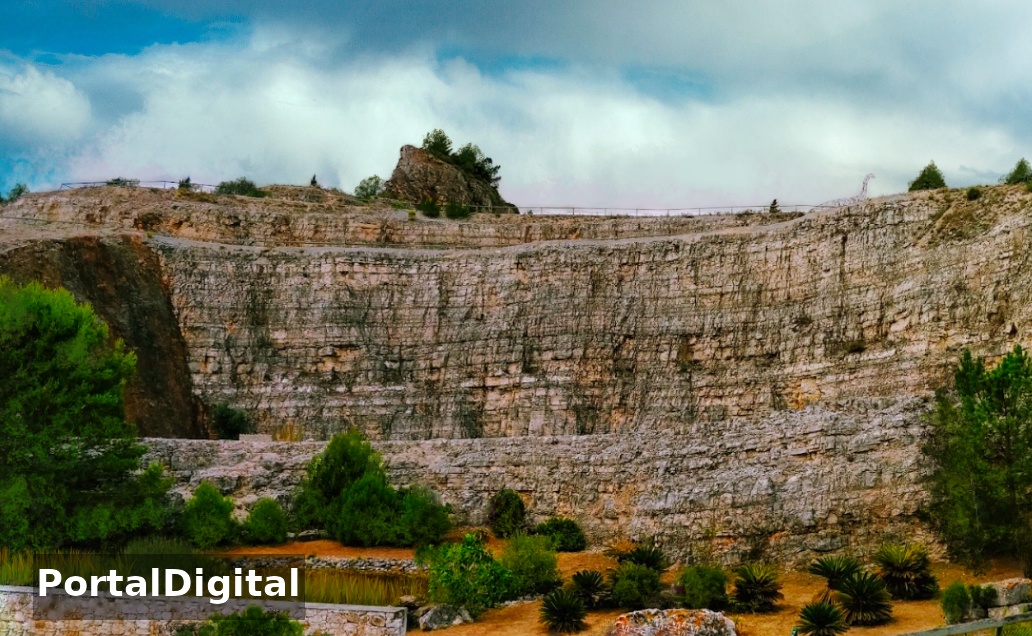
Rock is an ever-present element in the landscape of the Serras de Aire e Candeeiros Natural Park, which occupies more than two thirds of the Estremenho Limestone Massif (in the Mesozoic Limestone Massif), which is the most important limestone area in Portugal.
Over time, through geomorphological processes, natural elements shaped the rock, especially of limestone origin, giving rise to more than one thousand and five hundred caves.
The Massif, like any mountainous formation, originated from the tectonic movements of the Earth's crust which, after thousands of years of movement of the continental and oceanic plates, emerged from the surface. (Poljes: Minde, Alvados and Mendiga poliges, and the Arrimal sinkholes).
The place has non-marine salt pans, which are Fonte da Bica located in Rio Maior.
The water reservoir that runs from Rio Maior to Porto de Mós covers around sixty-five thousand hectares and is fed mainly by rain, which quickly infiltrates underground and forms underground streams, then returning the surplus to the surface, forming a karst spring, such as the Olhos de Água do Alviela spring, which has been captured by EPAL to supply water to Lisbon since 1880.
The existence of caves and rocky cavities leads to the appearance of some species of bats in the park: teddy bat (Miniopterus schreibersii), woolly bat (Myotis emarginatus), Mediterranean horseshoe bat (Rhinolophus euryale).
Bat species allow the subsistence of specific fauna in the rocky cavities in which they take refuge, because they are the ones who provide food (in the form of organic matter: feces and others) to this cave fauna (crustaceans, arachnids and various types of worms).
The existence of different habitats in the park leads to the appearance of several birds that are adapted to particular conditions: red-billed crow, eagle owl, round-winged eagle, Bonelli's eagle, short-toed eagle, crow, hawk, kestrel, barn owl, booted eagle, bush owl and Galician owl.
The great biological diversity is supported by the existence of a heterogeneity of habitats: aquatic, rocky and limestone grasslands.
The park is one of the best places in Portugal where you can observe many species of insects associated with limestone areas and limestone habitats, with more than 300 species of butterflies (Lepidoptera) recognized, including the rare Portuguese White (Euchloe tagis) whose population here is the northernmost in Portugal, the Cupido lorquinii and the Crocallis auberti.
More than six hundred plant species can be found in the Park, which represents around a fifth of the total species in Portugal, and many of them are not found anywhere else (they are endemic).
Most of the Park's surface is occupied by shrublands, many of them considered in the Natura 2000 Network as a type of priority habitat and unique examples in the world.
Currently, there are still relics of the primitive vegetation cover, mainly in the form of oak groves made up of red oak (Quercus faginea).
In this place, many of the existing botanical species have characteristics that allow them to survive fires more adequately, as is the case of orchids, which have their flowering stimulated when this type of event occurs.
The park is part of the Estremenho Limestone Massif, covering the two mountains of Aires and Candeeiros, the plateaus of Santo António and São Mamede.
The park covers 4 morphological units at altitude: Planalto de Santo António (to the south and center), Serra dos Candeeiros (to the west), Planalto de São Mamede (to the north) and Serra de Aire (to the east).
The region derived from tectonic movements is delimited by geological units resulting from the formation of faults: the Alvados depression, the Mira-Minde polje and the Mendiga depression.
Rock is an ever-present element in the landscape of the Serras de Aire e Candeeiros Natural Park, which occupies more than two thirds of the Estremenho Limestone Massif (in the Mesozoic Limestone Massif), which is the most important limestone area in Portugal.
Over time, through geomorphological processes, natural elements shaped the rock, especially of limestone origin, giving rise to more than one thousand and five hundred caves.
The Massif, like any mountainous formation, originated from the tectonic movements of the Earth's crust which, after thousands of years of movement of the continental and oceanic plates, emerged from the surface. (Poljes: Minde, Alvados and Mendiga poliges, and the Arrimal sinkholes).
The place has non-marine salt pans, which are Fonte da Bica located in Rio Maior.
The water reservoir that runs from Rio Maior to Porto de Mós covers around sixty-five thousand hectares and is fed mainly by rain, which quickly infiltrates underground and forms underground streams, then returning the surplus to the surface, forming a karst spring, such as the Olhos de Água do Alviela spring, which has been captured by EPAL to supply water to Lisbon since 1880.
The existence of caves and rocky cavities leads to the appearance of some species of bats in the park: teddy bat (Miniopterus schreibersii), woolly bat (Myotis emarginatus), Mediterranean horseshoe bat (Rhinolophus euryale).
Bat species allow the subsistence of specific fauna in the rocky cavities in which they take refuge, because they are the ones who provide food (in the form of organic matter: feces and others) to this cave fauna (crustaceans, arachnids and various types of worms).
The existence of different habitats in the park leads to the appearance of several birds that are adapted to particular conditions: red-billed crow, eagle owl, round-winged eagle, Bonelli's eagle, short-toed eagle, crow, hawk, kestrel, barn owl, booted eagle, bush owl and Galician owl.
The great biological diversity is supported by the existence of a heterogeneity of habitats: aquatic, rocky and limestone grasslands.
The park is one of the best places in Portugal where you can observe many species of insects associated with limestone areas and limestone habitats, with more than 300 species of butterflies (Lepidoptera) recognized, including the rare Portuguese White (Euchloe tagis) whose population here is the northernmost in Portugal, the Cupido lorquinii and the Crocallis auberti.
More than six hundred plant species can be found in the Park, which represents around a fifth of the total species in Portugal, and many of them are not found anywhere else (they are endemic).
Most of the Park's surface is occupied by shrublands, many of them considered in the Natura 2000 Network as a type of priority habitat and unique examples in the world.
Currently, there are still relics of the primitive vegetation cover, mainly in the form of oak groves made up of red oak (Quercus faginea).
In this place, many of the existing botanical species have characteristics that allow them to survive fires more adequately, as is the case of orchids, which have their flowering stimulated when this type of event occurs.