
It is located at the eastern entrance to the city, passes through the Alcoa River and preserves the ancient water routes to the Monastery of Alcobaça, city and municipality of Alcobaça, District of Leiria, Central Portugal
The construction of the building for the residence of José Pereira da Silva Rino dates back to 1891/1892, married to Dna. Capitolina Araújo Guimarães, daughter of the founder of the Fiação e Tecidos Factory.
In the 1970s, Maria Cristina Rino donated the mansion to the religious Congregation of S. José de Cluny, which sold its contents, which are one of the richest in Alcobaça.
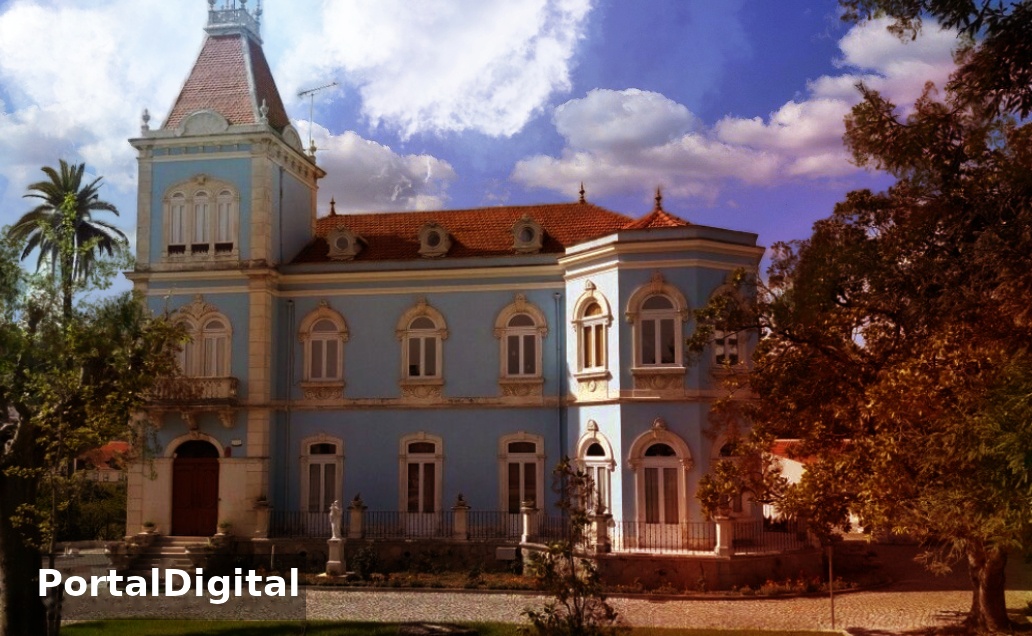
The building is a mansion that has the decorative language characteristic of late romanticism in Portugal and was adapted into a child welfare center that still remains.
The Rino Family Palace is characterized by a romantic Chalet that has the decorative language characteristic of late romanticism in Portugal, but still reveals in some aspects a reminiscence of 19th century architecture in the articulation of volumes.
The Palace has a composite plan, the result of a longitudinal structure from which two perpendicular bodies derive that together form a "U".
The building has two floors, marked by the horizontal arrangement of volumes and differentiated roofs in hipped roofs with scales on the turret and three-pitched roofs, the roofs have dormers with bull's-eye windows with a semicircular roof.
The rusticated basement has a circulation area with metal and lithic guards on the South and East facades, served by stairs, blue-painted walls are highlighted by a lithic frieze.
The building has a stone cornice and a smooth and continuous platband, the turret has corners with fitted pilasters (isodome device), a projecting cornice supported by modillions and four urns at each angle at the level of the roof.
Arched with a corbelled closure and decorated with vegetal ornaments more common on the second floor, the windows on the second floor have an apron decorated with the capital "R" and with vegetal motifs, openings have a curvilinear lintel with a rectilinear closure more common on the first floor
The main façade faces south, marked by the main entrance located in the turret and by the pentagonal structure placed at the opposite end of the turret, the rear façade facing north has two flights of stairs placed at the angles.
In the 1970s, Maria Cristina Rino donated the mansion to the religious Congregation of S. José de Cluny, which sold its contents, which are one of the richest in Alcobaça.
The building is a mansion that has the decorative language characteristic of late romanticism in Portugal and was adapted into a child welfare center that still remains.
The Rino Family Palace is characterized by a romantic Chalet that has the decorative language characteristic of late romanticism in Portugal, but still reveals in some aspects a reminiscence of 19th century architecture in the articulation of volumes.
The Palace has a composite plan, the result of a longitudinal structure from which two perpendicular bodies derive that together form a "U".
The building has two floors, marked by the horizontal arrangement of volumes and differentiated roofs in hipped roofs with scales on the turret and three-pitched roofs, the roofs have dormers with bull's-eye windows with a semicircular roof.
The rusticated basement has a circulation area with metal and lithic guards on the South and East facades, served by stairs, blue-painted walls are highlighted by a lithic frieze.
The building has a stone cornice and a smooth and continuous platband, the turret has corners with fitted pilasters (isodome device), a projecting cornice supported by modillions and four urns at each angle at the level of the roof.
Arched with a corbelled closure and decorated with vegetal ornaments more common on the second floor, the windows on the second floor have an apron decorated with the capital "R" and with vegetal motifs, openings have a curvilinear lintel with a rectilinear closure more common on the first floor
The main façade faces south, marked by the main entrance located in the turret and by the pentagonal structure placed at the opposite end of the turret, the rear façade facing north has two flights of stairs placed at the angles.