
It is located in the city of Viseu, parish of Santa Maria de Viseu, Municipality and District of Viseu, central Portugal
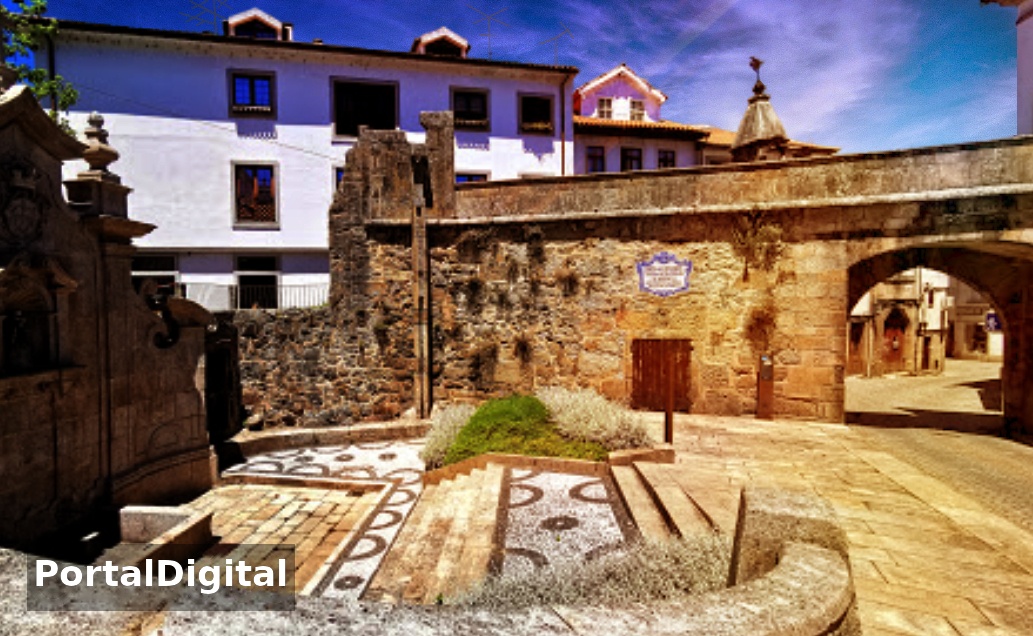
The Walls of Viseu appear in a dominant position on a hill at the confluence of the Pavia River with the Dão River (sub-tributaries of the Mondego River), the city's fortification is very old and did not constitute a castle in the strict sense.
History of the Walls of Viseu
The primitive human occupation of the site of Viseu dates back to a prehistoric hillfort where the Lusitanian leader Viriato (180 BC-139 BC) was born.
In the year 137 BC it was conquered by the consul Decimus Júnio Bruto Galaico, with the town gaining expression at the time of the Romanization of the peninsula and a junction of Roman roads was established here, as evidenced by the various milestones found in the region.
The perimeter of the town had the following current route: Rua da Regueira (north side), today Rua de João Mendes, Largo Mouzinho de Albuquerque, Rua do Carvalho along a straight line to Largo da Misericórdia, Rua do Chão do Mestre, Rua de D. Duarte, Largo de Santa Cristina to Rua da Regueira (south side).
At the end of the 3rd century, faced with the threat of invading people, it is possible that the perimeter of the wall was reduced to facilitate the defense of the town.
It is believed to be a section of the wall and a semicircular turret that were discovered in March 2004 on Rua Formosa during renovation work on that pedestrian route.
The remains were made into a museum and are now visible through a glass plate placed at ground level. Three children's graves, a coin and pieces of ceramics were discovered.
Under the rule of the Visigoths, from the 6th century onwards, Viseu was elevated to a city, becoming the seat of the Diocese, with the Visigothic currency being created in the 7th century.
During the Muslim rule of Al-Andalus, from the beginning of the following century the city was known as Castro Vesense (vesi = Visigoth) and remained fortified.
At the time of the Christian Reconquest of the peninsula, the city was conquered in the middle of the 8th century by the forces of Afonso I of Asturias, who left it abandoned, preventing it from serving as support for new Muslim attacks.
During the formation of the Portucalense County, Viseu was the residence of the counts and after the death of her husband D. Teresa granted the first charter to Viseu (1123).
A new charter alluding to an identical diploma previously passed by D. Afonso Henriques (1112-1185) was issued in 1187 by D. Sancho I (1185-1211) and confirmed by D. Afonso II (1211-1223) in 1217.
In this charter by D. Sancho II, reference is also made to the "old city" as opposed to a new demographically and economically expanded nucleus.
During the reign of D. Fernando (1367-1383), the Royal Charter of January 5, 1370 shows that the castle of Viseu was handed over to the residents, with the expression "castle" comprising the walled complex that surrounded the original Cathedral and the old part of the city.
The city was a victim of the Fernandian wars on four occasions in the last third of the 14th century and was again attacked and burned by Castilian troops in 1396.
At the time of D. João I (1385-1433), work was in progress to expand the defensive fence, completed only in 1472 under the reign of D. Afonso V (1438-1481) according to the epigraphic inscription at Porta do Soar, with the urban fabric expanding outside the walls.
During the reign of D. Manuel I (1495-1521) the city received the New Charter (1513), a time when the expansion of the urban network to the so-called Rossio began.
The stages of destruction of Viseu's walls began in the 16th century with work to expand the old Episcopal Palace, and there were later construction works, as evidenced by the epigraphic inscription on the Knights' Gate dated 1646.
In the year 137 BC it was conquered by the consul Decimus Júnio Bruto Galaico, with the town gaining expression at the time of the Romanization of the peninsula and a junction of Roman roads was established here, as evidenced by the various milestones found in the region.
The perimeter of the town had the following current route: Rua da Regueira (north side), today Rua de João Mendes, Largo Mouzinho de Albuquerque, Rua do Carvalho along a straight line to Largo da Misericórdia, Rua do Chão do Mestre, Rua de D. Duarte, Largo de Santa Cristina to Rua da Regueira (south side).
At the end of the 3rd century, faced with the threat of invading people, it is possible that the perimeter of the wall was reduced to facilitate the defense of the town.
It is believed to be a section of the wall and a semicircular turret that were discovered in March 2004 on Rua Formosa during renovation work on that pedestrian route.
The remains were made into a museum and are now visible through a glass plate placed at ground level. Three children's graves, a coin and pieces of ceramics were discovered.
Under the rule of the Visigoths, from the 6th century onwards, Viseu was elevated to a city, becoming the seat of the Diocese, with the Visigothic currency being created in the 7th century.
During the Muslim rule of Al-Andalus, from the beginning of the following century the city was known as Castro Vesense (vesi = Visigoth) and remained fortified.
At the time of the Christian Reconquest of the peninsula, the city was conquered in the middle of the 8th century by the forces of Afonso I of Asturias, who left it abandoned, preventing it from serving as support for new Muslim attacks.
During the formation of the Portucalense County, Viseu was the residence of the counts and after the death of her husband D. Teresa granted the first charter to Viseu (1123).
A new charter alluding to an identical diploma previously passed by D. Afonso Henriques (1112-1185) was issued in 1187 by D. Sancho I (1185-1211) and confirmed by D. Afonso II (1211-1223) in 1217.
In this charter by D. Sancho II, reference is also made to the "old city" as opposed to a new demographically and economically expanded nucleus.
During the reign of D. Fernando (1367-1383), the Royal Charter of January 5, 1370 shows that the castle of Viseu was handed over to the residents, with the expression "castle" comprising the walled complex that surrounded the original Cathedral and the old part of the city.
The city was a victim of the Fernandian wars on four occasions in the last third of the 14th century and was again attacked and burned by Castilian troops in 1396.
At the time of D. João I (1385-1433), work was in progress to expand the defensive fence, completed only in 1472 under the reign of D. Afonso V (1438-1481) according to the epigraphic inscription at Porta do Soar, with the urban fabric expanding outside the walls.
During the reign of D. Manuel I (1495-1521) the city received the New Charter (1513), a time when the expansion of the urban network to the so-called Rossio began.
The stages of destruction of Viseu's walls began in the 16th century with work to expand the old Episcopal Palace, and there were later construction works, as evidenced by the epigraphic inscription on the Knights' Gate dated 1646.