
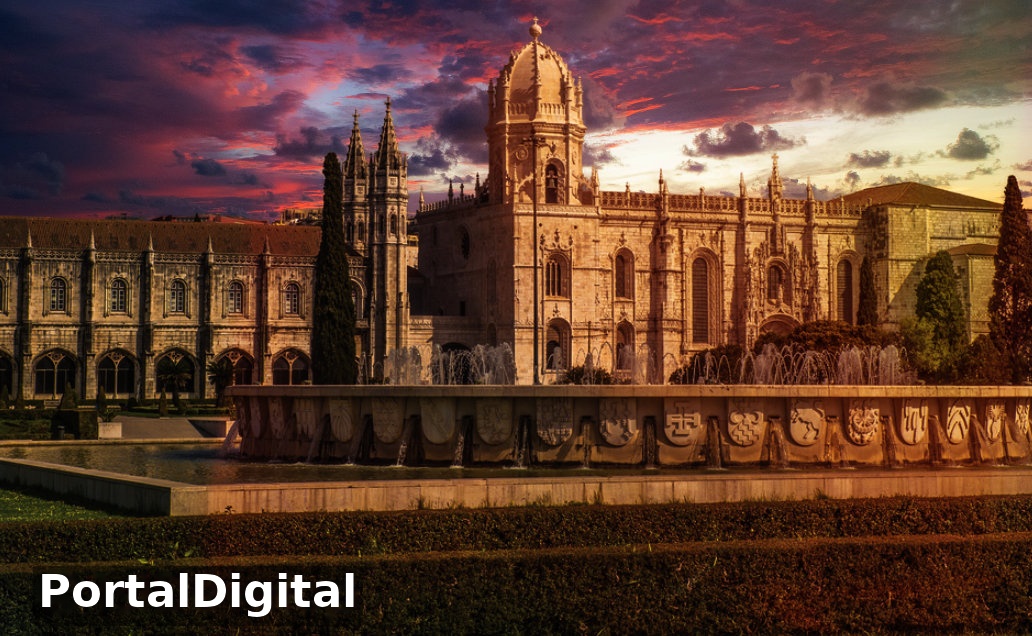
It is located in Praça do Império, parish of Belém, city of Lisbon, center of Lisbon, municipality and district of Lisbon, central Portugal.
The Jerónimos Monastery is a Portuguese monastery built at the end of the 15th century by King D. Manuel I and was handed over to the Order of Saint Jerónimo, and has had the status of National Pantheon since 2016.
The culmination of Manueline architecture, this monastery is the most notable Portuguese monastic complex of its time and one of the main hall churches in Europe.
Its construction began at the beginning of the 16th century and lasted for a hundred years, being directed by a notable group of architects/master builders.
The Church has a Latin cross plan, made up of three naves at the same height (hall church), covered by an extensive polyveined vault supported by six pillars.
The vault of the cross covers, without intermediate supports, a width of 30 meters, the profusion of ornaments reaches its peak in this vast space.
In the chapel to the left of the transept, Cardinal-King D. Henrique and the children of D. Manuel I are buried.
The initial main chapel, in Boitaca, was demolished and replaced by another, ordered to be built in 1571 by D. Catarina, wife of D. João III, and was designed by Jerónimo de Ruão who introduced the Mannerist style here, establishing a strong contrast with the Manueline body of the Church.
On the main altar there is an altarpiece by the painter Lourenço de Salzedo with scenes from the Passion of Christ and the Adoration of the Magi.
The culmination of Manueline architecture, this monastery is the most notable Portuguese monastic complex of its time and one of the main hall churches in Europe.
Its construction began at the beginning of the 16th century and lasted for a hundred years, being directed by a notable group of architects/master builders.
The Church has a Latin cross plan, made up of three naves at the same height (hall church), covered by an extensive polyveined vault supported by six pillars.
The vault of the cross covers, without intermediate supports, a width of 30 meters, the profusion of ornaments reaches its peak in this vast space.
In the chapel to the left of the transept, Cardinal-King D. Henrique and the children of D. Manuel I are buried.
The initial main chapel, in Boitaca, was demolished and replaced by another, ordered to be built in 1571 by D. Catarina, wife of D. João III, and was designed by Jerónimo de Ruão who introduced the Mannerist style here, establishing a strong contrast with the Manueline body of the Church.
On the main altar there is an altarpiece by the painter Lourenço de Salzedo with scenes from the Passion of Christ and the Adoration of the Magi.
Classification of the Jerónimos Monastery
The Jerónimos Monastery has been classified as a National Monument since 1907, and in 1983 it was classified as a World Heritage Site by UNESCO along with the Belém Tower and on July 7, 2007 it was elected as one of the seven wonders of Portugal.