
It is located on Rua de S. Vicente, city and municipality in the District of Guarda, and headquarters of the sub-region of Beiras and Serra da Estrela, Central Portugal
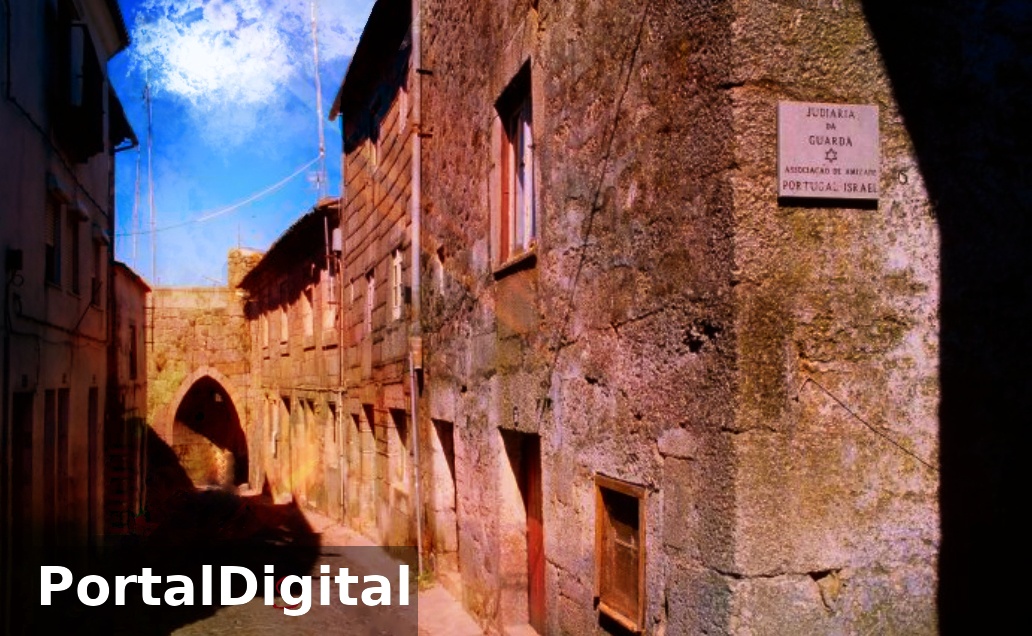
The Guarda Jewry is one of the most genuine corners of the medieval city, it is considered the oldest in the region and remained active until the time of the expulsion of the Jews.
The Jewry located within the city walls, the old Jewish quarter still exists today near Porta D’ El Rei.
The Jewish community of Guarda was for a long time one of the most important Jewish communities in the country, and also one of the most ancient.
In the 13th century there is evidence that King D. Dinis gave birth to the Jewish communities in the parish of S. Vicente, and one of these families was housed in the synagogue.
The Jewish quarter began near Porta d’ El Rei, which covers the churchyard of S. Vicente, on the border with the city wall and Rua Direita that led to that entrance.
The new Jewish quarter is a continuation of the previous one and was mentioned in the Charter of 1199 and in 1465, but this access was closed due to protests by Christians.
At the end of the 14th century, around 200 people lived there, and around 50 years later the number of people of the Jewish faith totaled 600 to 850 people.
The families had names such as Ergas, Castro, Falilho, Baruch, Mocatel, Mark Querida, Alva, Cáceres, Castelão, among others.
The Jewish community was very dynamic and provided numerous services to the population, performing the most varied professions: tailors, shoemakers, tanners, blacksmiths, weavers, barbers, doctors, surgeons, goldsmiths and carpenters.
The historic center of the city of Guarda still retains traces of the old Jewish quarter and houses in earlier times only had one floor.
From the 14th century onwards, merchants' houses had two doors: a wider one that led to the store, and a smaller one that was the door to the residence.
The synagogue was initially located in a rented building, but was later moved to a new building.
The main entrance to the Jewish quarter was located at Quatro Quinas, the point where three roads converge that intersect and form four corners, the widest road leading to Porta D’ El Rei, one of the entrances to the city.
In the old Rua Nova da Judiaria, today Rua do Amparo, we still find the door, currently a confined door of the guard's house in which the night watchman controlled access to the city by opening and closing the door.
Thus, the Jewish neighborhood was isolated from the rest of the city, a fact that makes evident the notion of privacy cultivated by the Jews themselves.
The Inquisition and religious persecution cast a shadow over the traditional tolerance of the Guard that existed since the occupation of the city, as happened in other cities.
However, in the urban area comprising the old Jewish quarter and adjacent areas inhabited by Jews and later by New Christians.
Today, marks of crosses still remain on the doors, usually on the right side, and the crosses were a symbol of the Christianization of houses, but also the testimony of the “mezuzah” that every Jew must touch with his right hand while muttering a prayer before entering the house.
The Jewry located within the city walls, the old Jewish quarter still exists today near Porta D’ El Rei.
The Jewish community of Guarda was for a long time one of the most important Jewish communities in the country, and also one of the most ancient.
In the 13th century there is evidence that King D. Dinis gave birth to the Jewish communities in the parish of S. Vicente, and one of these families was housed in the synagogue.
The Jewish quarter began near Porta d’ El Rei, which covers the churchyard of S. Vicente, on the border with the city wall and Rua Direita that led to that entrance.
The new Jewish quarter is a continuation of the previous one and was mentioned in the Charter of 1199 and in 1465, but this access was closed due to protests by Christians.
At the end of the 14th century, around 200 people lived there, and around 50 years later the number of people of the Jewish faith totaled 600 to 850 people.
The families had names such as Ergas, Castro, Falilho, Baruch, Mocatel, Mark Querida, Alva, Cáceres, Castelão, among others.
The Jewish community was very dynamic and provided numerous services to the population, performing the most varied professions: tailors, shoemakers, tanners, blacksmiths, weavers, barbers, doctors, surgeons, goldsmiths and carpenters.
The historic center of the city of Guarda still retains traces of the old Jewish quarter and houses in earlier times only had one floor.
From the 14th century onwards, merchants' houses had two doors: a wider one that led to the store, and a smaller one that was the door to the residence.
The synagogue was initially located in a rented building, but was later moved to a new building.
The main entrance to the Jewish quarter was located at Quatro Quinas, the point where three roads converge that intersect and form four corners, the widest road leading to Porta D’ El Rei, one of the entrances to the city.
In the old Rua Nova da Judiaria, today Rua do Amparo, we still find the door, currently a confined door of the guard's house in which the night watchman controlled access to the city by opening and closing the door.
Thus, the Jewish neighborhood was isolated from the rest of the city, a fact that makes evident the notion of privacy cultivated by the Jews themselves.
The Inquisition and religious persecution cast a shadow over the traditional tolerance of the Guard that existed since the occupation of the city, as happened in other cities.
However, in the urban area comprising the old Jewish quarter and adjacent areas inhabited by Jews and later by New Christians.
Today, marks of crosses still remain on the doors, usually on the right side, and the crosses were a symbol of the Christianization of houses, but also the testimony of the “mezuzah” that every Jew must touch with his right hand while muttering a prayer before entering the house.