
It is located in Largo Dom Manuel Vieira de Matos, city of Peso da Régua, district of Vila Real, Northern Region, Douro sub-region
History of the Mother Church of Peso da Régua
Couto da Régua was donated by Dona Teresa, between 1114 and 1122, to Dom Hugo, bishop of Porto.
In the year 1287, the town of Peso appears in Couto da Régua under the spiritual and temporal jurisdiction of the bishops of Porto.
The parish of the town of Peso da Régua, in the region of Lamego, was the annual curate for the presentation of the Archdeacon of Régua, from the chapter of the Cathedral of Porto, passing through the rectory.
Peso and Régua originate from two distinct villages united in the mid-18th century and when they were brought together the new parish church of São Faustino was built (1750-160).
On November 6, 1836, Peso da Régua changed from a simple parish to the head of a municipality, integrating the parishes of Sedielos, Fontelas, Moura Morta, Loureiro and Godim.
The municipality of Peso da Régua includes the parishes of Covelinhas, Galafura, Poiares and Vilarinho dos Freires.
The parish of Peso da Régua has belonged to the archpriest of Peso da Régua and the diocese of Vila Real since April 22, 1922 and its patron saint is Saint Faustino.
In the year 1287, the town of Peso appears in Couto da Régua under the spiritual and temporal jurisdiction of the bishops of Porto.
The parish of the town of Peso da Régua, in the region of Lamego, was the annual curate for the presentation of the Archdeacon of Régua, from the chapter of the Cathedral of Porto, passing through the rectory.
Peso and Régua originate from two distinct villages united in the mid-18th century and when they were brought together the new parish church of São Faustino was built (1750-160).
On November 6, 1836, Peso da Régua changed from a simple parish to the head of a municipality, integrating the parishes of Sedielos, Fontelas, Moura Morta, Loureiro and Godim.
The municipality of Peso da Régua includes the parishes of Covelinhas, Galafura, Poiares and Vilarinho dos Freires.
The parish of Peso da Régua has belonged to the archpriest of Peso da Régua and the diocese of Vila Real since April 22, 1922 and its patron saint is Saint Faustino.
Characteristic Church of Peso da Régua
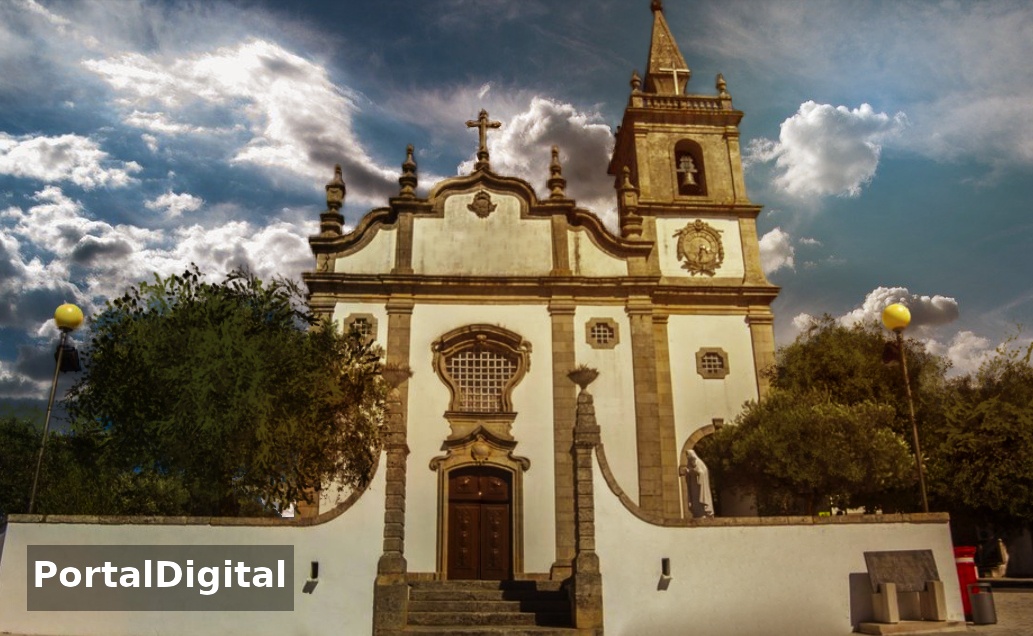
The main church of Peso da Régua/Igreja de São Faustino was built in the 18th century with baroque architecture and dedicated to S. Faustino.
During this period, visual manipulations were used to broaden the perspectives of the buildings, such as concave and convex walls, the use of cartouches, interrupted pediments and twisted columns that cross the floor.
The Nave with a painted ceiling with phytomorphic elements arranged to form false sections and with a central cartouche representing the patron.
Inside, the gilded main altar dominates, where a panel of the “Last Supper” by Pedro Alexandrino de Carvalho stands out, which leads us to consider the hypothesis that it was made between the end of the 18th century and the first decade of the following century.
In addition to the main altar, there are 6 more in gilded carvings, each dedicated to a Saint and the altars of greatest devotion will be: Our Lady of Help and the Sacred Heart of Jesus.
The church has a longitudinal plan composed of a single nave and the chancel to which the sacristy of differentiated and staggered volumes and heights is attached.
Inside it has seven gilded altarpieces, two in each of the corners of the crossing arch on the wall on the epistle side and two others on the gospel side.
The work Última Supper, signed by Pedro Alexandrino, presents a painting that has an exhibition system that allows it to be collected while remaining hidden, to characterize the pictorial technique used and identify changes resulting from the history of the work.
The largest one is located in the main chapel and covers the entire wall of the headboard on which the painting by Pedro Alexandrino de Carvalho is located and, as a specific feature, it is mobile.
The screen has a rectangular shape developed vertically, however the dressing room that frames it is topped with a perfect round arch giving the impression that it is rounded at the top edge.
The main scene unfolds in the foreground, highlighting the figures of Christ and Saint Peter who have one of their companions prostrated on their legs.
In the background, there are the remaining ten characters flanking a table distributed in two balanced groups positioned on the right and left sides and opening the central space to the heart of the painting - the sharing of bread.
The disciples have divergent body postures and looks and an essentially figurative painting, with the proportions of large Baroque groups still present.
In the background plane on the right side, an opening to the outside is outlined, expanding the space with the representation of a domed building.
The characters wear a tunic tied at the waist with a string, a cloak over one shoulder and appear barefoot and in this panel the predominant colors are ochre, blue, violet and earthy tones such as beige and brown.
In this church, in the month of September, the traditional Mass of the Harvest is celebrated where the year's wine harvest is blessed and in the surrounding area you can see manors and houses displaying the coats of arms of ancient families.
During this period, visual manipulations were used to broaden the perspectives of the buildings, such as concave and convex walls, the use of cartouches, interrupted pediments and twisted columns that cross the floor.
The Nave with a painted ceiling with phytomorphic elements arranged to form false sections and with a central cartouche representing the patron.
Inside, the gilded main altar dominates, where a panel of the “Last Supper” by Pedro Alexandrino de Carvalho stands out, which leads us to consider the hypothesis that it was made between the end of the 18th century and the first decade of the following century.
In addition to the main altar, there are 6 more in gilded carvings, each dedicated to a Saint and the altars of greatest devotion will be: Our Lady of Help and the Sacred Heart of Jesus.
The church has a longitudinal plan composed of a single nave and the chancel to which the sacristy of differentiated and staggered volumes and heights is attached.
Inside it has seven gilded altarpieces, two in each of the corners of the crossing arch on the wall on the epistle side and two others on the gospel side.
The work Última Supper, signed by Pedro Alexandrino, presents a painting that has an exhibition system that allows it to be collected while remaining hidden, to characterize the pictorial technique used and identify changes resulting from the history of the work.
The largest one is located in the main chapel and covers the entire wall of the headboard on which the painting by Pedro Alexandrino de Carvalho is located and, as a specific feature, it is mobile.
The screen has a rectangular shape developed vertically, however the dressing room that frames it is topped with a perfect round arch giving the impression that it is rounded at the top edge.
The main scene unfolds in the foreground, highlighting the figures of Christ and Saint Peter who have one of their companions prostrated on their legs.
In the background, there are the remaining ten characters flanking a table distributed in two balanced groups positioned on the right and left sides and opening the central space to the heart of the painting - the sharing of bread.
The disciples have divergent body postures and looks and an essentially figurative painting, with the proportions of large Baroque groups still present.
In the background plane on the right side, an opening to the outside is outlined, expanding the space with the representation of a domed building.
The characters wear a tunic tied at the waist with a string, a cloak over one shoulder and appear barefoot and in this panel the predominant colors are ochre, blue, violet and earthy tones such as beige and brown.
In this church, in the month of September, the traditional Mass of the Harvest is celebrated where the year's wine harvest is blessed and in the surrounding area you can see manors and houses displaying the coats of arms of ancient families.