
It is located in the parish of Nossa Senhora do Pópulo, city and municipality of Caldas da Rainha, district of Leiria, sub-region of Oeste, Central Portugal
The Church of Nossa Senhora do Pópulo, also referred to as the Parish Church of Caldas da Rainha (1500), is part of the Rainha D. Leonor Thermal Hospital complex.
IN the village of Caldas da Rainha as its Misericórdia and the Hospital were founded by Queen D. Leonor in 1485, years later the Pope authorized the foundation of an attached chapel under the invocation of Nossa Senhora do Pópulo in direct communication with the hospital through a vaulted corridor intended for the spiritual accompaniment of patients.
The essential elements of the church, the nave and chancel, were completed in 1500, but the bell tower and the baptismal font were finished and the temple would be elevated to the Main Church in 1510.
IN the village of Caldas da Rainha as its Misericórdia and the Hospital were founded by Queen D. Leonor in 1485, years later the Pope authorized the foundation of an attached chapel under the invocation of Nossa Senhora do Pópulo in direct communication with the hospital through a vaulted corridor intended for the spiritual accompaniment of patients.
The essential elements of the church, the nave and chancel, were completed in 1500, but the bell tower and the baptismal font were finished and the temple would be elevated to the Main Church in 1510.
The Reconstruction of the Church of Nossa Senhora do Pópulo (Main Church of Caldas da Rainha)
Over the years, several improvement and rehabilitation works would take place: construction of the high choir (1544-46), the inclusion of decorative carved elements, paintings and sculptures, tiled coverings (1658-59) and the installation of a new organ donated by D. João VI (1825).
In 1937, 17th century tiles from one of the wings of the large cloister of the Convento da Graça (Lisbon) occupied by the Battalion of Caçadores 7 were applied to the interior of the church.
In 1937, 17th century tiles from one of the wings of the large cloister of the Convento da Graça (Lisbon) occupied by the Battalion of Caçadores 7 were applied to the interior of the church.
The Characteristics of the Church of Nossa Senhora do Pópulo (Main Church of Caldas da Rainha)
The design of the church was designed by Master Mateus Fernandes (architect of the Batalha Monastery for more than 25 years).
The building belongs to the pre-Male cycle, the typically Gothic options complemented by organic forms and a decorative grammar that foreshadow the nascent style.
The interior has a single nave covered by a craftsman's vault communicating with the main chapel through a polycentric triumphal arch topped by the royal shield and triptych of 16th century painting with episodes from the Passion of Christ (attributed to Cristóvão de Figueiredo or the Master of Lourinhã).
The main chapel is covered by a ribbed vault with heraldic decoration on the closure, the stone altarpiece of the main altar with classical columns topped by a low relief depicting the Eternal Father is a late Renaissance work (end of the 16th century), the walls of the nave and the main chapel are entirely covered with standard blue and yellow tiles (17th century).
The two side altars with baroque gilded altarpieces and 16th century tiles, the baptismal font with an octagonal plan and profusely tracery attributed to Pedro (or Pêro) and Filipe Henriques (sculptors of the old font in the Old Cathedral of Coimbra, now in the New Cathedral).
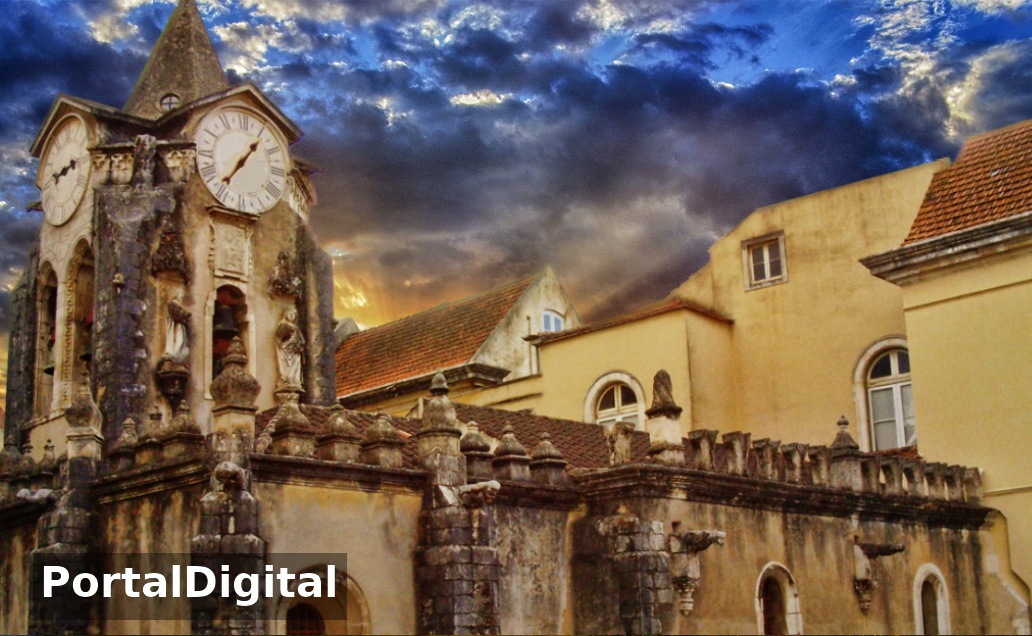
Outside, the bell tower stands out with polycentric arches topped by a clock that includes zoomorphic gargoyles and two 16th century sculptures representing the Angel Gabriel and the Virgin of the Annunciation.
The facade decorated with battlements opens onto the early 16th century portal with a round arch and great decorative sobriety.
The building belongs to the pre-Male cycle, the typically Gothic options complemented by organic forms and a decorative grammar that foreshadow the nascent style.
The interior has a single nave covered by a craftsman's vault communicating with the main chapel through a polycentric triumphal arch topped by the royal shield and triptych of 16th century painting with episodes from the Passion of Christ (attributed to Cristóvão de Figueiredo or the Master of Lourinhã).
The main chapel is covered by a ribbed vault with heraldic decoration on the closure, the stone altarpiece of the main altar with classical columns topped by a low relief depicting the Eternal Father is a late Renaissance work (end of the 16th century), the walls of the nave and the main chapel are entirely covered with standard blue and yellow tiles (17th century).
The two side altars with baroque gilded altarpieces and 16th century tiles, the baptismal font with an octagonal plan and profusely tracery attributed to Pedro (or Pêro) and Filipe Henriques (sculptors of the old font in the Old Cathedral of Coimbra, now in the New Cathedral).
Outside, the bell tower stands out with polycentric arches topped by a clock that includes zoomorphic gargoyles and two 16th century sculptures representing the Angel Gabriel and the Virgin of the Annunciation.
The facade decorated with battlements opens onto the early 16th century portal with a round arch and great decorative sobriety.
Classification of the Church of Nossa Senhora do Pópulo (Main Church of Caldas da Rainha)
Church of Nossa Senhora do Pópulo was classified as a National Monument in 1910 and is today one of the most significant heritage elements in the municipality.