
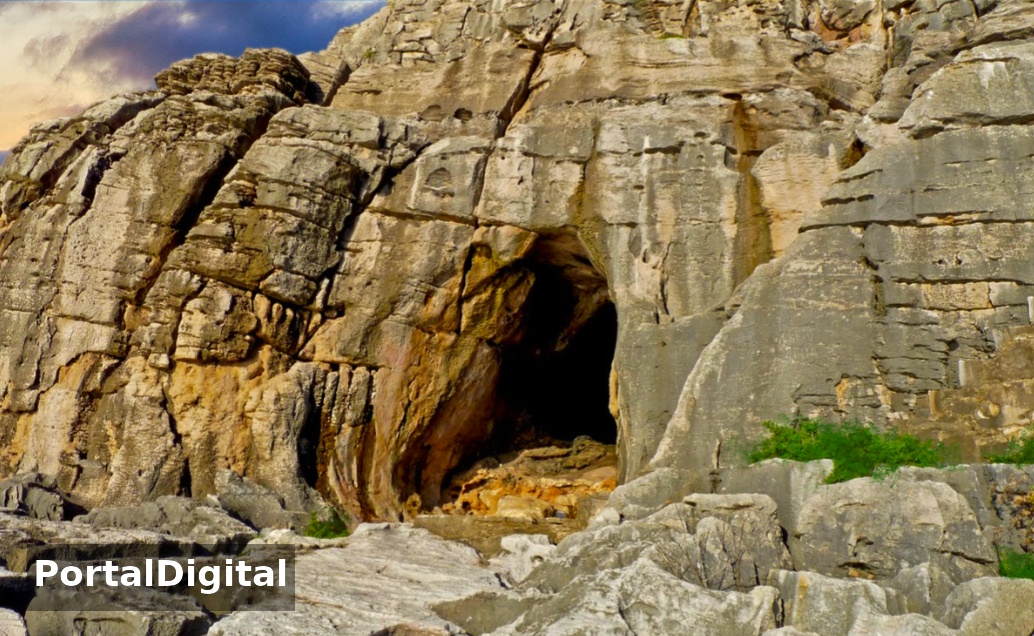
It is located on the southern slope of the Peniche peninsula on the cliffs between Forte de Peniche and Cabo Carvoeiro, facing the sea, District of Leiria, Central Portugal
Furninha, also known as Cova Dominique, is located on a cliff between Cabo Carvoeiro and Forte de Peniche. It is a natural cavity located approximately 15 meters above sea level and was occupied during the Middle Paleolithic period and the end of the Chalcolithic, being the most important prehistoric station in the municipality.
Furninha functioned as a shelter and necropolis, providing a vast archaeological collection, which can be seen in several museums, including the Municipal Museum of Peniche.
The Furninha cave is commonly known as Cova de Dominique through oral tradition, as a record of collective memory it owes its name to a solitary and elusive robber who took refuge there, a certain Dominique.
Furninha is testimony to the westernmost presence in Europe and the world of Neanderthal Man, who became extinct around 40,000 years ago and was also inhabited by Homo Sapiens during the Neolithic period.
The Furninha cave was explored at the end of the 19th century by Nery Delgado who, after exhaustive work, demonstrated that this cave is an archaeological heritage site of enormous importance: it is a landmark, at its western end, of a vast territory inhabited by Neanderthal Man, which extended across Europe from its eastern limits to the Iberian Peninsula.
The excavation and study by Nery Delgado reveal that there was animal occupation in Furninha in the Lower Paleolithic and human occupation in the Middle Paleolithic (Neanderthal Man) and at the end of the Chalcolithic (Modern Man).
Delgado also confirms the anthropophagy practices of the Furninha Neanderthals who, despite their proximity to the sea, were mainly hunters.
The historical interest of Furninha is dictated by the heritage value of the finds and as a geological monument.
The Furninha cave as a shelter and necropolis revealed the prehistoric presence of several humans, from Neanderthal Man to Homo sapiens sapiens (Modern Man) among other diverse remains: fauna from the Quaternary period, fish and mammals, bone and ceramic utensils.
The Furninha cave as a monument, a visible face, in its geological context, of a long period of Earth's mutations, even before the formation of the oceans, is part of a set of unique rock formations around the world.
This particularity is reinforced by the important discovery, in its vicinity, of a strong Neanderthal presence. Not far from there, in the Lapedo Valley, a cave was explored, known as Lagar Velho, with funerary remains of a child, the famous Menino do Lapedo, who was proven and confirmed by genetic analysis to be a hybrid of Neanderthal and Modern Man, which opens the way to a new understanding of the evolution of Man, since it was assumed until then that there would have been no crossings.
Observation of several photographs taken inside the cave by geologists (see references and external links) reveals the existence of a thin layer of flora, apparently in close relationship with fungi, with intense colors, with a predominance of green, yellow and reddish areas, that is, a unique ecosystem: specific microfauna, green worms, tiny sparrows, etc.
The walls of Furninha are covered in nutrients created by the mixture of rainwater infiltration that drips from the vault's vent with droplets of salt water that enter caves carried by the wind on bad weather days.
Furninha functioned as a shelter and necropolis, providing a vast archaeological collection, which can be seen in several museums, including the Municipal Museum of Peniche.
The Furninha cave is commonly known as Cova de Dominique through oral tradition, as a record of collective memory it owes its name to a solitary and elusive robber who took refuge there, a certain Dominique.
Furninha is testimony to the westernmost presence in Europe and the world of Neanderthal Man, who became extinct around 40,000 years ago and was also inhabited by Homo Sapiens during the Neolithic period.
The Furninha cave was explored at the end of the 19th century by Nery Delgado who, after exhaustive work, demonstrated that this cave is an archaeological heritage site of enormous importance: it is a landmark, at its western end, of a vast territory inhabited by Neanderthal Man, which extended across Europe from its eastern limits to the Iberian Peninsula.
The excavation and study by Nery Delgado reveal that there was animal occupation in Furninha in the Lower Paleolithic and human occupation in the Middle Paleolithic (Neanderthal Man) and at the end of the Chalcolithic (Modern Man).
Delgado also confirms the anthropophagy practices of the Furninha Neanderthals who, despite their proximity to the sea, were mainly hunters.
The historical interest of Furninha is dictated by the heritage value of the finds and as a geological monument.
The Furninha cave as a shelter and necropolis revealed the prehistoric presence of several humans, from Neanderthal Man to Homo sapiens sapiens (Modern Man) among other diverse remains: fauna from the Quaternary period, fish and mammals, bone and ceramic utensils.
The Furninha cave as a monument, a visible face, in its geological context, of a long period of Earth's mutations, even before the formation of the oceans, is part of a set of unique rock formations around the world.
This particularity is reinforced by the important discovery, in its vicinity, of a strong Neanderthal presence. Not far from there, in the Lapedo Valley, a cave was explored, known as Lagar Velho, with funerary remains of a child, the famous Menino do Lapedo, who was proven and confirmed by genetic analysis to be a hybrid of Neanderthal and Modern Man, which opens the way to a new understanding of the evolution of Man, since it was assumed until then that there would have been no crossings.
Observation of several photographs taken inside the cave by geologists (see references and external links) reveals the existence of a thin layer of flora, apparently in close relationship with fungi, with intense colors, with a predominance of green, yellow and reddish areas, that is, a unique ecosystem: specific microfauna, green worms, tiny sparrows, etc.
The walls of Furninha are covered in nutrients created by the mixture of rainwater infiltration that drips from the vault's vent with droplets of salt water that enter caves carried by the wind on bad weather days.