
It is located in the Arrábida Natural Park and is located on a hill bordering the coastal city of Setúbal, dominating the left bank of the mouth of the Sado River and the Atlantic Ocean, Central Portugal
The project for a modern fortification to defend the Portuguese coast dates back to the 14th century, with the construction of the Fort of Santiago do Outão to control the entrance to the riverbank and access to the medieval town.
During the reign of D. João III (1521-1557), financial difficulties that led to the abandonment of overseas positions in North Africa (Azamor Stronghold, Arzila Stronghold, Alcácer-Ceguer Stronghold and Safim Stronghold) delayed the development of these works.
In the Philippine dynasty, the sovereign D. Philip I (1580-1598) himself attended in person in 1582 the laying of the cornerstone of the new fortification designed by the Italian architect and military engineer Filippo Terzi (1520-1597).
The engineer would have worked on these works until mid-1594 when he signed a plan and section of the fortification (July 8, 1594) sent to the Spanish War Council, but with his death the Cremonese military engineer and architect Leonardo Torriani was appointed, who would have considered them completed in 1600.
During the Restoration of Independence under the reign of D. João IV (1640-1656), the Governor of Arms of Setúbal, João de Saldanha carried out the expansion of this defense by adding a low battery, between 1649 and 1655.
In the 18th century, the Chapel inside acquired its tile covering signed by Policarpo de Oliveira Bernardes (1736) and during the Pombaline consulate (1750-1777) it would not have been immune to the 1755 earthquake and was used as an Artillery School.
In the 20th century from the 1940s onwards, being the subject of conservation and restoration interventions carried out by the General Directorate of National Buildings and Monuments, it suffered new damage caused by the 1969 earthquake and the recovery was completed the following year.
The Council of Setúbal took over management of the fortification with the reopening of the bar and terrace, maintaining the public ban on some risk areas (31 March 2017), attributed for many years to Filipe Terzi.
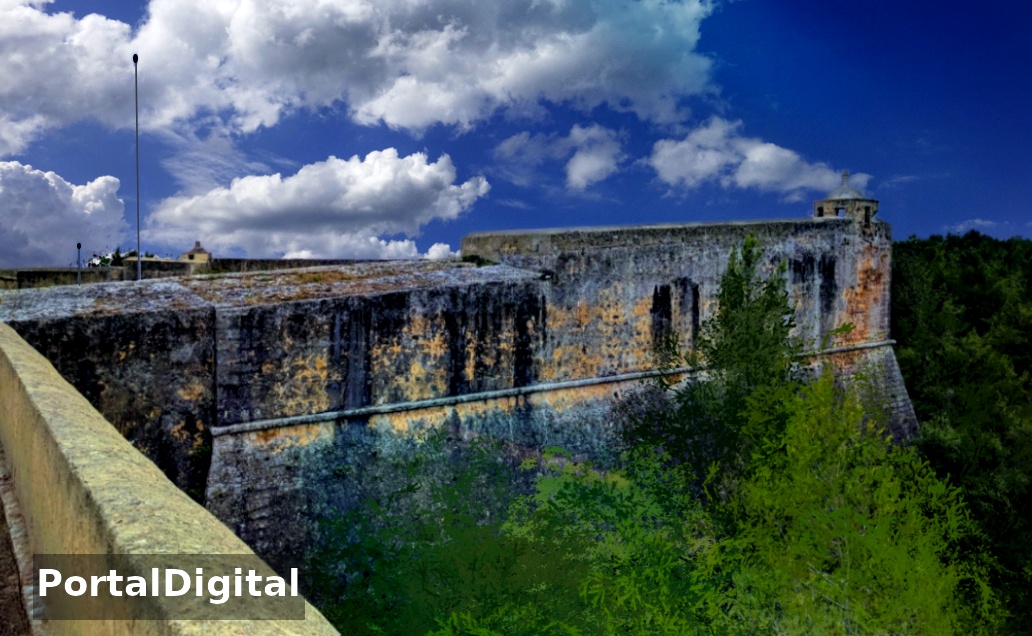
It is currently known that it was designed by Captain Fratino in 1583, being composed of an irregular polygonal plan in the shape of a six-pointed star with six bastions and on a steep slope over the sea, being protected on the north side by a second walled line.
Inside, accessed by a Gate of Arms to the west of the walls defended by two bastions and an atrium gives access to a stone masonry tunnel with a wide and smooth staircase with steps on two flights.
The tunnel is covered by a vault and the landing between its flights gives access to the casemates. On the embankment are the service buildings: the Command House (former residence of the Governor of Arms) and the Chapel on the left.
The small Chapel of São Filipe, patron saint of the fort, has a rectangular plan covered by a barrel vault, its portal displays a pediment decorated with volutes and a bell tower between pilasters.
Its interior is completely covered in blue and white tiles, featuring panels with scenes from the life of that Catholic saint signed by Policarpo de Oliveira Bernardes (1736).
The low battery, a structure dating from the 17th century, forms a trapezoidal-shaped bastion that extends towards the sea.
During the reign of D. João III (1521-1557), financial difficulties that led to the abandonment of overseas positions in North Africa (Azamor Stronghold, Arzila Stronghold, Alcácer-Ceguer Stronghold and Safim Stronghold) delayed the development of these works.
In the Philippine dynasty, the sovereign D. Philip I (1580-1598) himself attended in person in 1582 the laying of the cornerstone of the new fortification designed by the Italian architect and military engineer Filippo Terzi (1520-1597).
The engineer would have worked on these works until mid-1594 when he signed a plan and section of the fortification (July 8, 1594) sent to the Spanish War Council, but with his death the Cremonese military engineer and architect Leonardo Torriani was appointed, who would have considered them completed in 1600.
During the Restoration of Independence under the reign of D. João IV (1640-1656), the Governor of Arms of Setúbal, João de Saldanha carried out the expansion of this defense by adding a low battery, between 1649 and 1655.
In the 18th century, the Chapel inside acquired its tile covering signed by Policarpo de Oliveira Bernardes (1736) and during the Pombaline consulate (1750-1777) it would not have been immune to the 1755 earthquake and was used as an Artillery School.
In the 20th century from the 1940s onwards, being the subject of conservation and restoration interventions carried out by the General Directorate of National Buildings and Monuments, it suffered new damage caused by the 1969 earthquake and the recovery was completed the following year.
The Council of Setúbal took over management of the fortification with the reopening of the bar and terrace, maintaining the public ban on some risk areas (31 March 2017), attributed for many years to Filipe Terzi.
It is currently known that it was designed by Captain Fratino in 1583, being composed of an irregular polygonal plan in the shape of a six-pointed star with six bastions and on a steep slope over the sea, being protected on the north side by a second walled line.
Inside, accessed by a Gate of Arms to the west of the walls defended by two bastions and an atrium gives access to a stone masonry tunnel with a wide and smooth staircase with steps on two flights.
The tunnel is covered by a vault and the landing between its flights gives access to the casemates. On the embankment are the service buildings: the Command House (former residence of the Governor of Arms) and the Chapel on the left.
The small Chapel of São Filipe, patron saint of the fort, has a rectangular plan covered by a barrel vault, its portal displays a pediment decorated with volutes and a bell tower between pilasters.
Its interior is completely covered in blue and white tiles, featuring panels with scenes from the life of that Catholic saint signed by Policarpo de Oliveira Bernardes (1736).
The low battery, a structure dating from the 17th century, forms a trapezoidal-shaped bastion that extends towards the sea.