
It is located on a promontory in the place of Montedor, approximately 4 nautical miles north of the mouth of the river Lima and 7 miles south of the mouth of the river Minho, on Rua do Alto do Facho, parish of Carreço, city and district of Viana do Castelo, northern Portugal
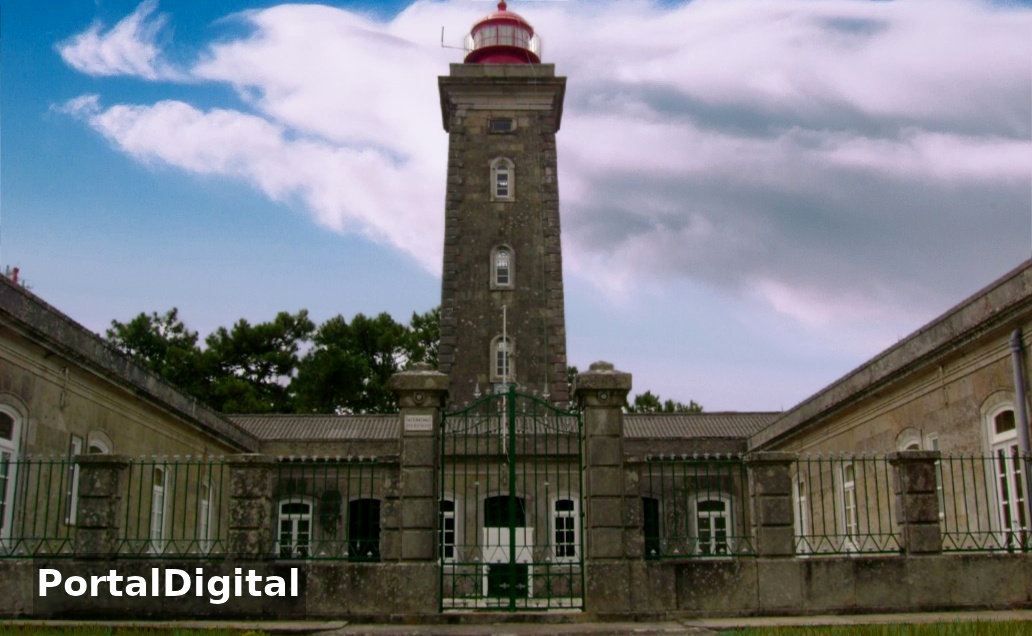
The Lighthouse is the northernmost in the country and came into operation on March 20, 1910, and has a quadrangular tower in granite stonework with a height of 28 meters (103 meters above sea level) and is a large ''U'' shaped annex building with a lantern and service balcony painted red.
The Signalman has a building with an inverted U-shaped plan, closed, integrating the quadrangular lighthouse tower into the center and forward of the S. wing, horizontally articulated volumes with two-, three- and four-pitched roofs, and a tower with a semicircular metallic roof topped with a metallic weathervane over a spherical acroterium.
The Montedor Orientation was one of eight lighthouses built by Júlio Zeferino Schultz Xavier, and came into operation on March 20, 1910.
Its designer is Engineer José Ribeiro de Almeida and this lighthouse is the northernmost on the coast of the Portuguese mainland with a height of 28 meters and an altitude of 103 meters.
Initially powered by olive oil, but later started to run on oil (1963), and with its connection to the public energy distribution network in 1947 it started to run on electricity.
The Costeiro Lighthouse was built between 1908 and 1910, and the current quadrangular Tower with four-disc facades, with a semicircular roof crowned by a metal weathervane.
Inside the staircase and to the guard tower, and Newel posts and copper handrails.
In 1987 it was automated, partially reducing human intervention. It is considered an architectural and cultural symbol of Viana do Castelo, and the lighthouse was the inspiration for the composition of a song entitled “Canção do Farol de Montedor”.
The interior with a lobby with a marble floor with a white and pink checkered motif, framed with plastered and beige-painted walls, ashlar tiles with a green and white pattern and a green frieze, and a plaster ceiling with arched sections between iron profiles.
The tower's stairwell has a pink and white marble floor, decorated with the compass rose between two circles, walls covered in white monochrome tiles with a helical staircase, occasionally marked by small landings of stone steps with a blanket with a bullnose edge, guards on metal balusters and a copper handrail.
The dome with a lower floor with a sheet metal floor and walls covered with varnished wood paneling, housing rotation motors and glow equipment, with a metal staircase, with one flight, providing access to the upper floor, with a floor and walls in sheet metal and with large glazing around its entire perimeter; metal ceiling, vaulted, over a structure of I-shaped, arched metal profiles housing optical apparatus in rotating directional crystal on a metal base.
The Sinaleiro has a cobbled courtyard with a central cistern covered by a rectangular volume painted white and with a metal sheet metal front door.
The main door of the atrium is part of a body that slightly protrudes from the rest of the façade on the cornice and iron flagpole.
The N. facade of the tower presents, under the window of the first register, a panel of white tiles with a blue phytomorphic border and the inscription: Farol de Montedor.
The Lighthouse was visited by a wide variety of groups such as schools, tourists, walkers, pilgrims from Santiago, cyclists, and in 2016 it was visited by 2,253 people.
The Signalman has a building with an inverted U-shaped plan, closed, integrating the quadrangular lighthouse tower into the center and forward of the S. wing, horizontally articulated volumes with two-, three- and four-pitched roofs, and a tower with a semicircular metallic roof topped with a metallic weathervane over a spherical acroterium.
The Montedor Orientation was one of eight lighthouses built by Júlio Zeferino Schultz Xavier, and came into operation on March 20, 1910.
Its designer is Engineer José Ribeiro de Almeida and this lighthouse is the northernmost on the coast of the Portuguese mainland with a height of 28 meters and an altitude of 103 meters.
Initially powered by olive oil, but later started to run on oil (1963), and with its connection to the public energy distribution network in 1947 it started to run on electricity.
The Costeiro Lighthouse was built between 1908 and 1910, and the current quadrangular Tower with four-disc facades, with a semicircular roof crowned by a metal weathervane.
Inside the staircase and to the guard tower, and Newel posts and copper handrails.
In 1987 it was automated, partially reducing human intervention. It is considered an architectural and cultural symbol of Viana do Castelo, and the lighthouse was the inspiration for the composition of a song entitled “Canção do Farol de Montedor”.
The interior with a lobby with a marble floor with a white and pink checkered motif, framed with plastered and beige-painted walls, ashlar tiles with a green and white pattern and a green frieze, and a plaster ceiling with arched sections between iron profiles.
The tower's stairwell has a pink and white marble floor, decorated with the compass rose between two circles, walls covered in white monochrome tiles with a helical staircase, occasionally marked by small landings of stone steps with a blanket with a bullnose edge, guards on metal balusters and a copper handrail.
The dome with a lower floor with a sheet metal floor and walls covered with varnished wood paneling, housing rotation motors and glow equipment, with a metal staircase, with one flight, providing access to the upper floor, with a floor and walls in sheet metal and with large glazing around its entire perimeter; metal ceiling, vaulted, over a structure of I-shaped, arched metal profiles housing optical apparatus in rotating directional crystal on a metal base.
The Sinaleiro has a cobbled courtyard with a central cistern covered by a rectangular volume painted white and with a metal sheet metal front door.
The main door of the atrium is part of a body that slightly protrudes from the rest of the façade on the cornice and iron flagpole.
The N. facade of the tower presents, under the window of the first register, a panel of white tiles with a blue phytomorphic border and the inscription: Farol de Montedor.
The Lighthouse was visited by a wide variety of groups such as schools, tourists, walkers, pilgrims from Santiago, cyclists, and in 2016 it was visited by 2,253 people.