
It is located in the Confraria Nossa Senhora da Nazaré, Rua 25 de Abril, parish and municipality of Nazaré, central region
At the origins of the Church of Memory there is a legend referring to the image of Our Lady sculpted by Saint Joseph and painted by Saint Luke, in the presence of the Virgin, who was in the monastery of Cauliniana, in Mérida, when D. Rodrigo, head of the Goths, arrived there, after the Christian defeat of Guadalete.
Later, he and Friar Romano moved west, arriving in 714 at the place where the hermitage of Memória now stands, where the image was deposited next to a small altar built by the friar.
The image was found in 1179 in a cave, over which the hermitage was later built, at the expense of D. Fuas Roupinho, then mayor of the castle of Porto de Mós, in thanksgiving to Our Lady of Nazaré, who saved him from falling down a cliff while chasing a deer in an intense fog.
This first chapel whose walls were opened by four arches, so the image could be seen on land and at sea, saw them closed by D. Fernando in 1370 in order to preserve the image that was rapidly deteriorating.
D. Fernando ordered the construction of a new church in a more accessible location, and it was completed in 1377, corresponding to the church of Nossa Senhora da Nazaré.
In 1600, the monk from Alcobaça, Friar Bernardo de Brito, had the primitive cave unearthed, rebuilding the old hermitage at the same time.
In the following years, the temple was subject to successive renovations that aimed to ennoble the space while altering its original idea.
In 1628, the arches were already boarded up, completely closing a space that Friar Bernardo de Brito had built as a centralized plan, opened by round arches, and certainly with the altar in the center, and the cave where the image had been discovered was protected by this structure.
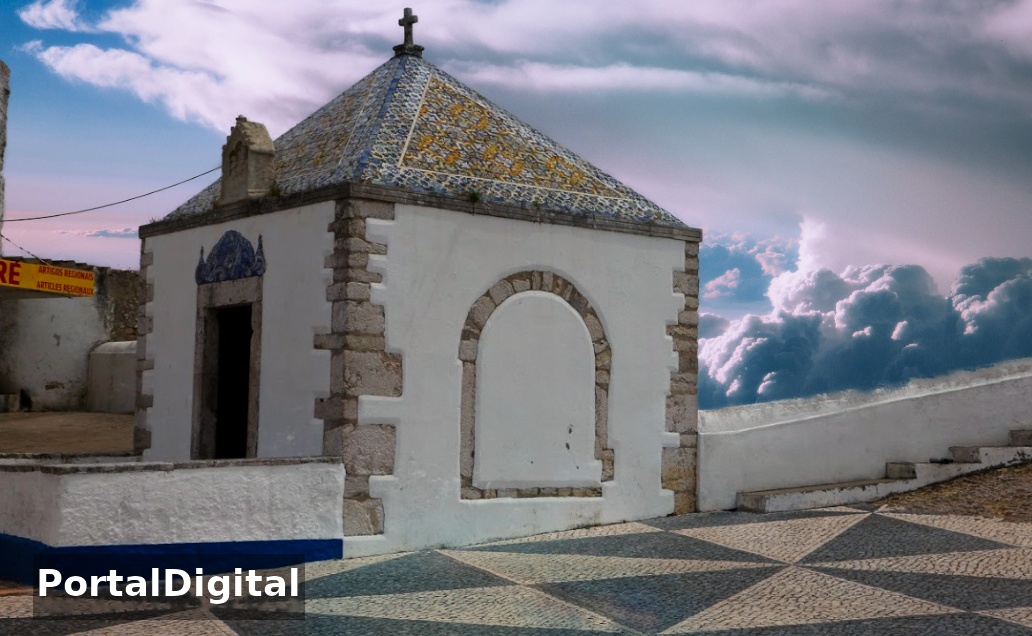
In the 17th century, the closed space took root and gained a new visual dynamic, with the integral tile covering inside and the outer hipped roof made of ceramic.
On the hermitage's elevations you can still see the old arches, the tile register that represents the miracle of Our Lady of Nazaré, and the facade is marked by the opening of the straight lintel portal topped by a blue and white tile overdoor, and on the cornice by a relief stone plaque representing the Virgin of Nazaré with the Child in her arms, Saint Blaise and Saint Bartholomew on the right, and D. Rodrigo and Frei Romano on the opposite side.
The Ermida da Memória is a small rectangular chapel covered in tiles, and consists of two floors.
On one of the walls of the facade there is a small panel of blue and white tiles that represents the miracle of Our Lady of Nazareth.
A staircase leads to the basement lined with tiles with a figurative panel depicting the miracle in the vault.
In the tunnel beneath the Chapel, there is the image of Our Lady of Nazaré behind an iron railing, but the interior tiles (17th and 18th centuries) should also be highlighted. The Chapel is also called “Local Chapel” and is traditionally linked to D. Fuas Roupinho.
A very small chapel that is carved into a ledge, but the story behind it is big and it is said that the stone that Madonna found coming down the stairs was from around 2,000 years ago and that the way the stone is worked originates from the Middle East.
However, Catholics believe that the Madonna was carved by Saint Joseph (Mary's husband) and then brought to Europe by the rulers, and this is a shrine to thank the Madonna for saving a life.
Inside the chapel we can see ancient blue tiles covering the entire church (also the ceiling of the church), and going down some narrow steps you reach another part of the sanctuary, this is supposedly the area where popular tales say that a hermit lived here.
The interior is completely covered in blue and white patterned tiles that frame other figurative tiles representing Marian emblems.
In the crypt that corresponds to the primitive cave we find a space also covered with tiles in whose vault the miracle is illustrated, and behind a railing appears the image of Our Lady of Nazareth.
These tiles have been attributed to the workshop of António de Oliveira Bernardes, who was one of the greatest exponents of baroque tile painting and oil painting between 1680 and 1732.
Later, he and Friar Romano moved west, arriving in 714 at the place where the hermitage of Memória now stands, where the image was deposited next to a small altar built by the friar.
The image was found in 1179 in a cave, over which the hermitage was later built, at the expense of D. Fuas Roupinho, then mayor of the castle of Porto de Mós, in thanksgiving to Our Lady of Nazaré, who saved him from falling down a cliff while chasing a deer in an intense fog.
This first chapel whose walls were opened by four arches, so the image could be seen on land and at sea, saw them closed by D. Fernando in 1370 in order to preserve the image that was rapidly deteriorating.
D. Fernando ordered the construction of a new church in a more accessible location, and it was completed in 1377, corresponding to the church of Nossa Senhora da Nazaré.
In 1600, the monk from Alcobaça, Friar Bernardo de Brito, had the primitive cave unearthed, rebuilding the old hermitage at the same time.
In the following years, the temple was subject to successive renovations that aimed to ennoble the space while altering its original idea.
In 1628, the arches were already boarded up, completely closing a space that Friar Bernardo de Brito had built as a centralized plan, opened by round arches, and certainly with the altar in the center, and the cave where the image had been discovered was protected by this structure.
In the 17th century, the closed space took root and gained a new visual dynamic, with the integral tile covering inside and the outer hipped roof made of ceramic.
On the hermitage's elevations you can still see the old arches, the tile register that represents the miracle of Our Lady of Nazaré, and the facade is marked by the opening of the straight lintel portal topped by a blue and white tile overdoor, and on the cornice by a relief stone plaque representing the Virgin of Nazaré with the Child in her arms, Saint Blaise and Saint Bartholomew on the right, and D. Rodrigo and Frei Romano on the opposite side.
The Ermida da Memória is a small rectangular chapel covered in tiles, and consists of two floors.
On one of the walls of the facade there is a small panel of blue and white tiles that represents the miracle of Our Lady of Nazareth.
A staircase leads to the basement lined with tiles with a figurative panel depicting the miracle in the vault.
In the tunnel beneath the Chapel, there is the image of Our Lady of Nazaré behind an iron railing, but the interior tiles (17th and 18th centuries) should also be highlighted. The Chapel is also called “Local Chapel” and is traditionally linked to D. Fuas Roupinho.
A very small chapel that is carved into a ledge, but the story behind it is big and it is said that the stone that Madonna found coming down the stairs was from around 2,000 years ago and that the way the stone is worked originates from the Middle East.
However, Catholics believe that the Madonna was carved by Saint Joseph (Mary's husband) and then brought to Europe by the rulers, and this is a shrine to thank the Madonna for saving a life.
Inside the chapel we can see ancient blue tiles covering the entire church (also the ceiling of the church), and going down some narrow steps you reach another part of the sanctuary, this is supposedly the area where popular tales say that a hermit lived here.
The interior is completely covered in blue and white patterned tiles that frame other figurative tiles representing Marian emblems.
In the crypt that corresponds to the primitive cave we find a space also covered with tiles in whose vault the miracle is illustrated, and behind a railing appears the image of Our Lady of Nazareth.
These tiles have been attributed to the workshop of António de Oliveira Bernardes, who was one of the greatest exponents of baroque tile painting and oil painting between 1680 and 1732.