
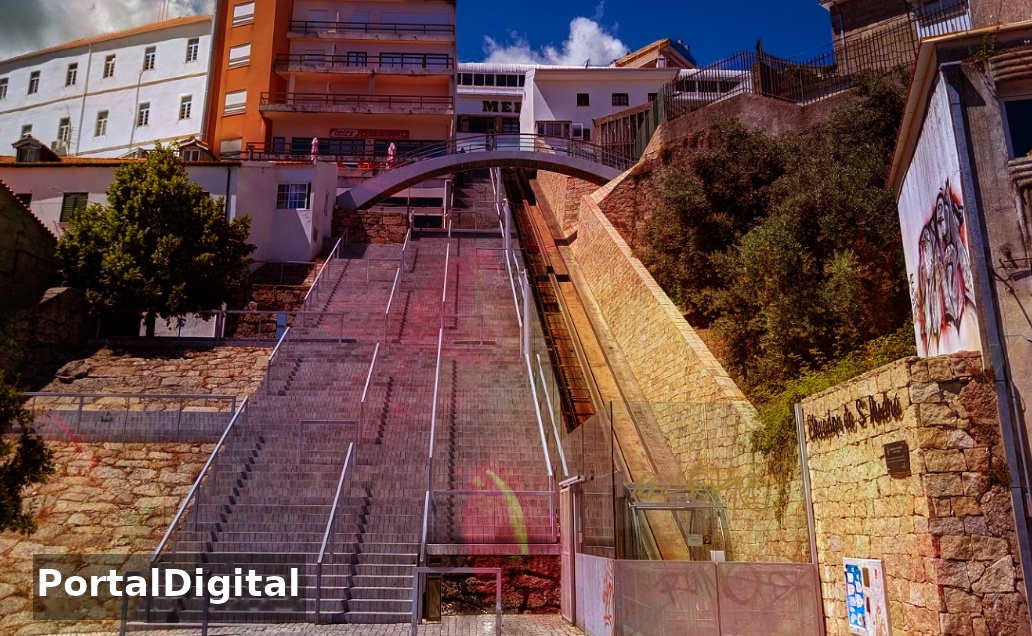
It is located in Escadas de Santo André, city of Covilhã belonging to the district of Castelo Branco, in the province of Beira Baixa, Centro region and sub-region of Beiras and Serra da Estrela
The elevator, equipped with a panoramic cabin and free to use, is a great way to facilitate the pedestrian connection between Rua Marquês d''''Ávila e Bolama, and Rua António Augusto de Aguiar.
Next to the elevator there is a long staircase that seems to further accentuate the difference in level that is necessary to facilitate pedestrian movement around the city as the city has numerous ups/downs.
The Pedestrian Mobility Plan of this fertile city with steep slopes includes two other elevators, one of them very close to this one, and a funicular.
In Covilhã, to get from one part of the city to another, we used the Funicular, which was fully operational and worth the trip, and the bravest and youngest can opt to climb the stairs next to it.
On major climbs in the city (and it costs nothing) it is worth taking the elevator, as it is useful in avoiding going up or down 163 steps and it is an elevator that also provides a view over part of the university.
A funicular that reduces time, has a beautiful view of part of the city and helps you get from one side to the other effortlessly.
In addition to its extreme usefulness in a city like Covilhã, as it promotes urban pedestrian mobility, it is also a tourist attraction, making it possible to enjoy the views through its funiculars, bridges and elevators, also discovering the old urban core, and these facilities make Covilhã a mountain city where it is pleasant to walk around.
Transport serves the community of Covilhã as it is full of hills and mountains, and it is free, modern and very useful transport.
The funicular is a great help to get to the market area, and there is a huge, steep staircase next to the funicular that follows the same route and "shortcuts" the path a lot and you can always do some exercise.
The Funicular is well located and is very useful as it is on the edge of a populated area, thus facilitating access to the Market, avoiding having to climb a large staircase.
The presence of an elevator makes life easier for the elderly, a device that makes it easier to go up and down the immense staircase that practically connects the Municipal Market to the University of Beira Interior (Main Pole).
The place where it is located becomes quite useful given that the alternative is the huge staircase that accompanies it, and the view that you can have over the rest of the city and the horizon is fantastic both day and night and deserves to be appreciated.
The Santo André funicular is a tourist attraction as it is characteristic of Portuguese cities and greatly helps those who have to go up or down the slopes of Covilhã.
Covilhã is a city where there are slopes with a lot of altitude, so anyone traveling with suitcases and not taking a taxi from the station or one of the local buses should take this or another funicular which is very useful and helps to reach a higher point in the city, and then from there you can walk or go to another funicular.
Next to the elevator there is a long staircase that seems to further accentuate the difference in level that is necessary to facilitate pedestrian movement around the city as the city has numerous ups/downs.
The Pedestrian Mobility Plan of this fertile city with steep slopes includes two other elevators, one of them very close to this one, and a funicular.
In Covilhã, to get from one part of the city to another, we used the Funicular, which was fully operational and worth the trip, and the bravest and youngest can opt to climb the stairs next to it.
On major climbs in the city (and it costs nothing) it is worth taking the elevator, as it is useful in avoiding going up or down 163 steps and it is an elevator that also provides a view over part of the university.
A funicular that reduces time, has a beautiful view of part of the city and helps you get from one side to the other effortlessly.
In addition to its extreme usefulness in a city like Covilhã, as it promotes urban pedestrian mobility, it is also a tourist attraction, making it possible to enjoy the views through its funiculars, bridges and elevators, also discovering the old urban core, and these facilities make Covilhã a mountain city where it is pleasant to walk around.
Transport serves the community of Covilhã as it is full of hills and mountains, and it is free, modern and very useful transport.
The funicular is a great help to get to the market area, and there is a huge, steep staircase next to the funicular that follows the same route and "shortcuts" the path a lot and you can always do some exercise.
The Funicular is well located and is very useful as it is on the edge of a populated area, thus facilitating access to the Market, avoiding having to climb a large staircase.
The presence of an elevator makes life easier for the elderly, a device that makes it easier to go up and down the immense staircase that practically connects the Municipal Market to the University of Beira Interior (Main Pole).
The place where it is located becomes quite useful given that the alternative is the huge staircase that accompanies it, and the view that you can have over the rest of the city and the horizon is fantastic both day and night and deserves to be appreciated.
The Santo André funicular is a tourist attraction as it is characteristic of Portuguese cities and greatly helps those who have to go up or down the slopes of Covilhã.
Covilhã is a city where there are slopes with a lot of altitude, so anyone traveling with suitcases and not taking a taxi from the station or one of the local buses should take this or another funicular which is very useful and helps to reach a higher point in the city, and then from there you can walk or go to another funicular.