
It is located in the parish of Verdoejo, city of Valença, district of Viana do Castelo, North region and sub-region of Alto Minho
Adro Velho is a small place in the northern part of the parish of Verdoejo where there is an old medieval cemetery and unveils the mysteries of a medieval cruise from 1398.
The Adro Velho space near Ecopista houses a very rich archaeological collection with a set of anthropomorphic sarcophagi, that is, a sarcophagus is a stone funerary urn placed on the ground.
The importance of sarcophagi are the drawings that on different occasions represented Gods who would help the deceased on their journey to the other world in addition to exposing the social class of the deceased's family.
In the various representations of the sarcophagi, the cult of the God Ra stands out, who accompanies the deceased's journey day and night in his sacred boat.
The fact that the Sun rose every morning symbolized Ra overcoming the dangers of the underground world by continuing his cycle with the dead.
In Adro Velho there is a Medieval Necropolis located near Verdoejo among a thick forest of pine and oak trees.
The site is located on the bank of the River Minho, sitting on river terraces close to the confluence of a river with the River Minho served by local roads.
The vegetation cover is made up of herbaceous and shrubby vegetation and an approximately circular shaped enclosure was identified, delimited by a wall of mamposteria and crossed in the SW/NE direction by a footpath.
Inside, two medieval/monolithic graves with an anthropomorphic shape are buried, two fragments of an epigraphed grave lid corresponding to the remains of a building that local memory identifies as an ancient hermitage.
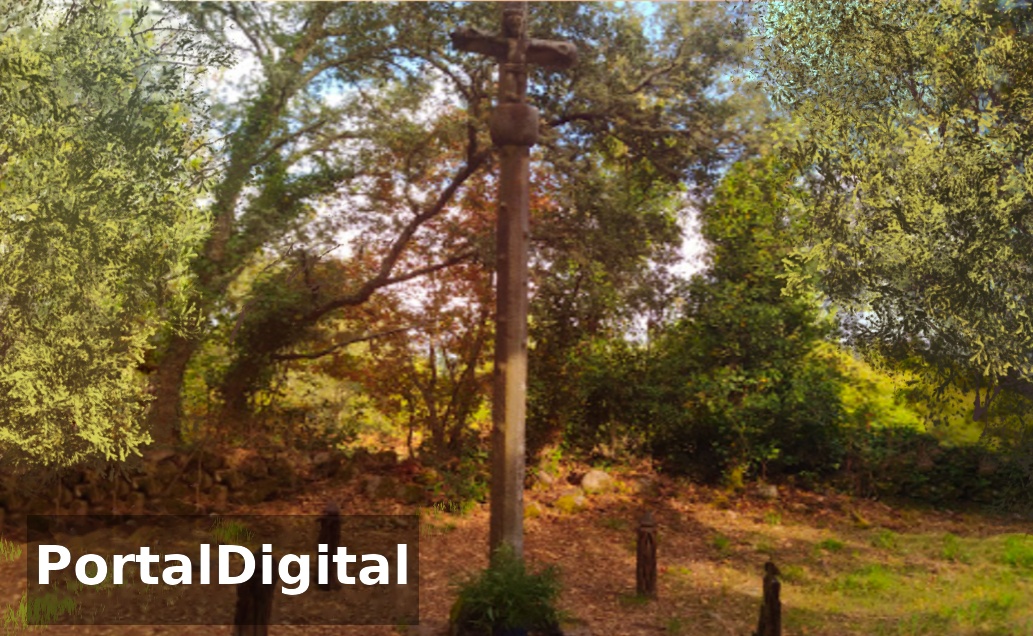
A medieval cross and at its top there is an anatomically disproportionate figure of Christ, especially in the belly area and highlights the arms of the cross.
In the 16th century, a cross was erected to highlight the sacred character of the place with a monolithic shaft decorated with alternately placed scallops, a cross with chamfers and button terminals with a very crude representation of Christ with a beard, crown of thorns and overlapping feet.
Visitors can also admire the thick forest of pine and oak trees, taking the opportunity to take a walk or exercise or take the walking trail that passes through here.
Nearby there is a "ground floor" fort from the times of the Restoration War and the gineleta fishing spot.
In the land that extends to the north, fragments of tegulae, imbrice, ceramics (common and Hispanic sigillata) were collected and granite building blocks can be seen that indicate the existence of a Roman-era settlement.
The Adro Velho space near Ecopista houses a very rich archaeological collection with a set of anthropomorphic sarcophagi, that is, a sarcophagus is a stone funerary urn placed on the ground.
The importance of sarcophagi are the drawings that on different occasions represented Gods who would help the deceased on their journey to the other world in addition to exposing the social class of the deceased's family.
In the various representations of the sarcophagi, the cult of the God Ra stands out, who accompanies the deceased's journey day and night in his sacred boat.
The fact that the Sun rose every morning symbolized Ra overcoming the dangers of the underground world by continuing his cycle with the dead.
In Adro Velho there is a Medieval Necropolis located near Verdoejo among a thick forest of pine and oak trees.
The site is located on the bank of the River Minho, sitting on river terraces close to the confluence of a river with the River Minho served by local roads.
The vegetation cover is made up of herbaceous and shrubby vegetation and an approximately circular shaped enclosure was identified, delimited by a wall of mamposteria and crossed in the SW/NE direction by a footpath.
Inside, two medieval/monolithic graves with an anthropomorphic shape are buried, two fragments of an epigraphed grave lid corresponding to the remains of a building that local memory identifies as an ancient hermitage.
A medieval cross and at its top there is an anatomically disproportionate figure of Christ, especially in the belly area and highlights the arms of the cross.
In the 16th century, a cross was erected to highlight the sacred character of the place with a monolithic shaft decorated with alternately placed scallops, a cross with chamfers and button terminals with a very crude representation of Christ with a beard, crown of thorns and overlapping feet.
Visitors can also admire the thick forest of pine and oak trees, taking the opportunity to take a walk or exercise or take the walking trail that passes through here.
Nearby there is a "ground floor" fort from the times of the Restoration War and the gineleta fishing spot.
In the land that extends to the north, fragments of tegulae, imbrice, ceramics (common and Hispanic sigillata) were collected and granite building blocks can be seen that indicate the existence of a Roman-era settlement.