
It is located in Largo Rainha Dona Amélia, in the parish of São Martinho, in the town of Sintra, District of Lisbon, Central Portugal
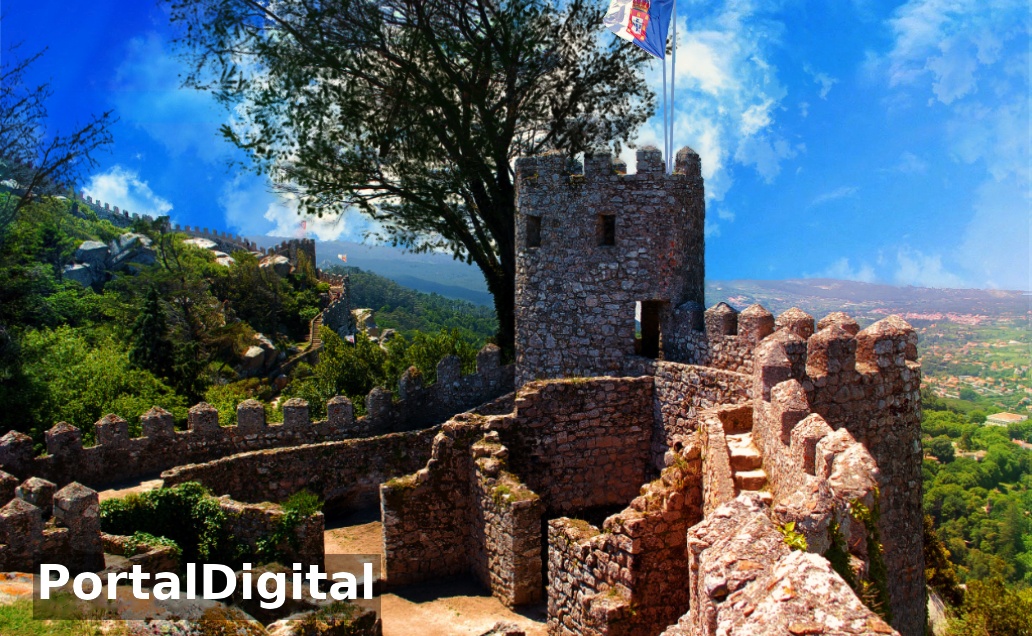
The Castle of the Moors was built on a rocky massif, isolated on one of the peaks of the Sintra mountain range, from the top of its walls you can see a privileged view of all its rural surroundings that extend to the Atlantic Ocean.
The monument has an organic plan (adapted to the terrain) with approximately 450 meters in perimeter and 12,000 m 2 in area.
Its walls are made up of a double waist, exterior and interior, to the East, sections of the exterior wall are still visible where the rotating door to access the enclosure is located, the top of the internal wall, which is crenellated, is covered by a wall and is reinforced by several towers.
The walls were built using the rope and rope technique, which can still be seen in the best-preserved section.
The ashlar bands, approximately 30–40 cm high, are placed alternately in width and length, and are separated by short, narrow bands of stones inserted in mortar.
The technique changes above 4–5 m in height, where a lower quality begins to be recorded, as a result of a second phase of construction.
In another section of the walls, the area of union between the different techniques used is visible, a legacy of the different phases of intervention.
In addition to the crenellated walls, towers and wards, the complex is completed by several access ramps and staircases and the Arabic door with a horseshoe arch.
The wall has five towers: four with a rectangular plan, one with a circular plan topped by pyramidal merlons with no trace of the two floors and the original roof system.
The tower at the highest level of the land, also known as Torre Real, is accessed via a staircase of 500 steps.
In the Islamic period it was the citadel, in the Christian period it is said that Bernardim Ribeiro, a Portuguese writer from the 16th century, lived there.
Inside the castle, close to the Portão de Armas, stands a church dedicated to Saint Peter, the Church of Saint Peter of Canaferrim, which dates back to the 12th century and was built after the conquest of the castle by D. Afonso Henriques. It was the first parish church in Sintra in a small Romanesque style, with a longitudinal plan and a single nave without a roof.
The chancel with a barrel vault is rectangular in plan and has traces of frescoes, the church has two portals, one with a full double arch supported on columns with decorated capitals and the other with a double arch supported on columns similar to those mentioned above with capitals with phytomorphic motifs. Its archaeological prospecting revealed the presence of several tombs belonging to an ancient medieval necropolis.
There is a large capacity cistern dating back to the Islamic period measuring 18 meters long by 6 meters wide and 9 meters high. Inside its vaulted interior flows the spring that supplied the Sintra National Palace.
Its reservoir was rebuilt after the great earthquake of 1755 and is perceived by visitors through two large conical ventilation openings.
The monument visible from the town of Sintra is accessed by climbing Rampa da Pena, a winding path that runs through the interior of the mountain occupied by works of artistic and historical value and the most varied botanical specimens of a rare and exotic nature.
The monument has an organic plan (adapted to the terrain) with approximately 450 meters in perimeter and 12,000 m 2 in area.
Its walls are made up of a double waist, exterior and interior, to the East, sections of the exterior wall are still visible where the rotating door to access the enclosure is located, the top of the internal wall, which is crenellated, is covered by a wall and is reinforced by several towers.
The walls were built using the rope and rope technique, which can still be seen in the best-preserved section.
The ashlar bands, approximately 30–40 cm high, are placed alternately in width and length, and are separated by short, narrow bands of stones inserted in mortar.
The technique changes above 4–5 m in height, where a lower quality begins to be recorded, as a result of a second phase of construction.
In another section of the walls, the area of union between the different techniques used is visible, a legacy of the different phases of intervention.
In addition to the crenellated walls, towers and wards, the complex is completed by several access ramps and staircases and the Arabic door with a horseshoe arch.
The wall has five towers: four with a rectangular plan, one with a circular plan topped by pyramidal merlons with no trace of the two floors and the original roof system.
The tower at the highest level of the land, also known as Torre Real, is accessed via a staircase of 500 steps.
In the Islamic period it was the citadel, in the Christian period it is said that Bernardim Ribeiro, a Portuguese writer from the 16th century, lived there.
Inside the castle, close to the Portão de Armas, stands a church dedicated to Saint Peter, the Church of Saint Peter of Canaferrim, which dates back to the 12th century and was built after the conquest of the castle by D. Afonso Henriques. It was the first parish church in Sintra in a small Romanesque style, with a longitudinal plan and a single nave without a roof.
The chancel with a barrel vault is rectangular in plan and has traces of frescoes, the church has two portals, one with a full double arch supported on columns with decorated capitals and the other with a double arch supported on columns similar to those mentioned above with capitals with phytomorphic motifs. Its archaeological prospecting revealed the presence of several tombs belonging to an ancient medieval necropolis.
There is a large capacity cistern dating back to the Islamic period measuring 18 meters long by 6 meters wide and 9 meters high. Inside its vaulted interior flows the spring that supplied the Sintra National Palace.
Its reservoir was rebuilt after the great earthquake of 1755 and is perceived by visitors through two large conical ventilation openings.
The monument visible from the town of Sintra is accessed by climbing Rampa da Pena, a winding path that runs through the interior of the mountain occupied by works of artistic and historical value and the most varied botanical specimens of a rare and exotic nature.