
They are located in the town of Porto de Mós, province of Estremadura, forming part of the Intermunicipal Community of the Leiria Region, District of Leiria, Central Portugal
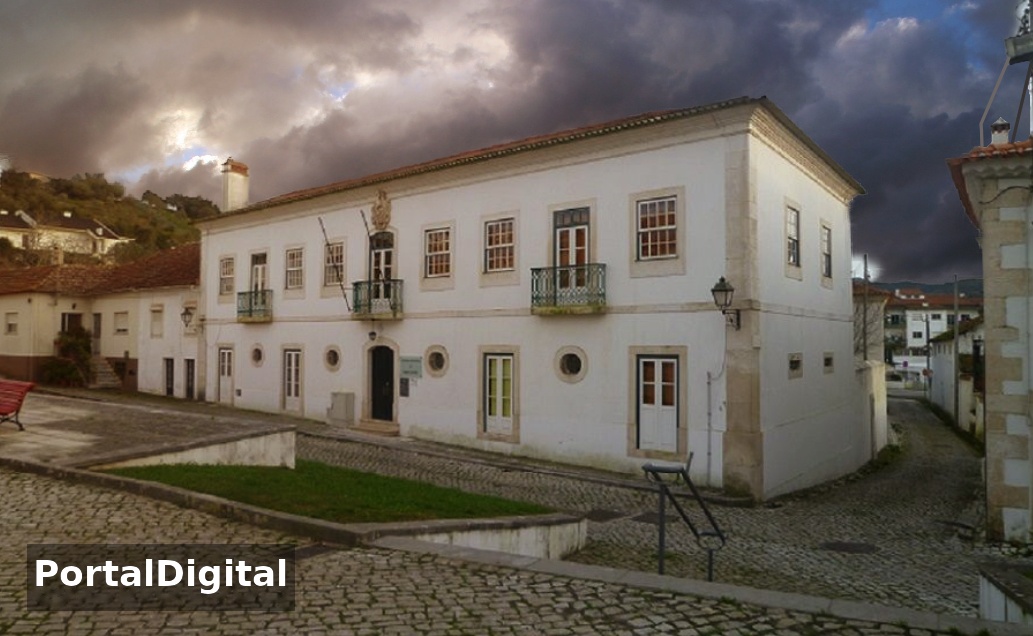
Casa dos Gorjões, also called Casa da Família Gorjão located in Largo de São João, in Porto de Mós, is currently the headquarters of municipal services.
Casa dos Gorjões located in the old part of Porto de Mós, Casa dos Gorjões is a 17th century house completely remodeled between the 19th and 20th centuries.
The Gorjão Family, originally from France, arrived in our country in the 16th century and it is not known when they settled, but a door over the garden bears the date 1630.
The old building dates back to the 17th century, when the Gorjões moved from France to live in Portugal.
After reconstruction in the 19th century, only the staircase leading to the upper floor remained with 17th century features.
The urban manor-style house has a bay window on the upper floor with a coat of arms.
The building follows a housing model characteristic of the 19th century, having a long facade of two floors divided by a frieze at the level of the bay windows.
The three bay windows mark the main floor, revealing greater decorative refinement and alternate with sash windows.
On the lower façade there are oval oculi that are found in the intervals between the doors with straight lines, as is the case in civil architecture from the 18th century, the main portal is open to the center of the façade and overlaps with a bay window on which the coat of arms of the Gorjão family is preserved.
The interior of the building has been significantly altered as a result of renovations and adaptations undergone over time.
The building presents a certain constructive and decorative austerity that characterizes the Casa dos Gorjões, standing out in the urban context of Porto de Mós due to its compact volume, the symmetrical and long elevation in a prominent location and the arms of the Gorjões imposing a mark of prestige and nobility on the locality.
The building is currently used by the Porto de Mós City Council as the headquarters of the Departments of Education, Social Action, Youth and Culture and is the venue for Municipal Assembly meetings.
Casa dos Gorjões located in the old part of Porto de Mós, Casa dos Gorjões is a 17th century house completely remodeled between the 19th and 20th centuries.
The Gorjão Family, originally from France, arrived in our country in the 16th century and it is not known when they settled, but a door over the garden bears the date 1630.
The old building dates back to the 17th century, when the Gorjões moved from France to live in Portugal.
After reconstruction in the 19th century, only the staircase leading to the upper floor remained with 17th century features.
The urban manor-style house has a bay window on the upper floor with a coat of arms.
The building follows a housing model characteristic of the 19th century, having a long facade of two floors divided by a frieze at the level of the bay windows.
The three bay windows mark the main floor, revealing greater decorative refinement and alternate with sash windows.
On the lower façade there are oval oculi that are found in the intervals between the doors with straight lines, as is the case in civil architecture from the 18th century, the main portal is open to the center of the façade and overlaps with a bay window on which the coat of arms of the Gorjão family is preserved.
The interior of the building has been significantly altered as a result of renovations and adaptations undergone over time.
The building presents a certain constructive and decorative austerity that characterizes the Casa dos Gorjões, standing out in the urban context of Porto de Mós due to its compact volume, the symmetrical and long elevation in a prominent location and the arms of the Gorjões imposing a mark of prestige and nobility on the locality.
The building is currently used by the Porto de Mós City Council as the headquarters of the Departments of Education, Social Action, Youth and Culture and is the venue for Municipal Assembly meetings.