
It is located on Rua Dom João de Noronha, Vila de Óbidos, District of Leiria, Central Portugal
The Casa do Arco da Cadeia served as the Town Hall during much of the Middle Ages, being later replaced by the construction of the Manueline Town Hall.
The building, which is presumed to date back to the beginning of the 14th century, has maintained much of its original structure to this day.
In the 20th century it was acquired by the painter, set designer and costume designer Abílio de Mattos e Silva, and by his wife, the interior architect Maria José Salavisa.
The Casa do Arco da Cadeia has Gothic architecture, consisting of a ground floor that opens onto the street through a crossing arch, it is assumed that it dates back to the 15th century and functioned as a Town Hall or as a cordon.
The Casa do Arco da Cadeia is a construction that dates back to the 14th/15th centuries, in its origins it assumed the functions of a jail and Town Hall in the 16th century, in the adjacent building (current Abílio Mattos Silva Museum) maintaining its original characteristics until the 20th century.
In 1958, the painter Abílio de Mattos e Silva acquired Casa do Arco, which was restored in a project developed by Maria José Salavisa, his widow.
The house was donated to Óbidos City Council by herself in honor of her husband, the opening of this space is a tribute to both of them and can be visited by appointment.
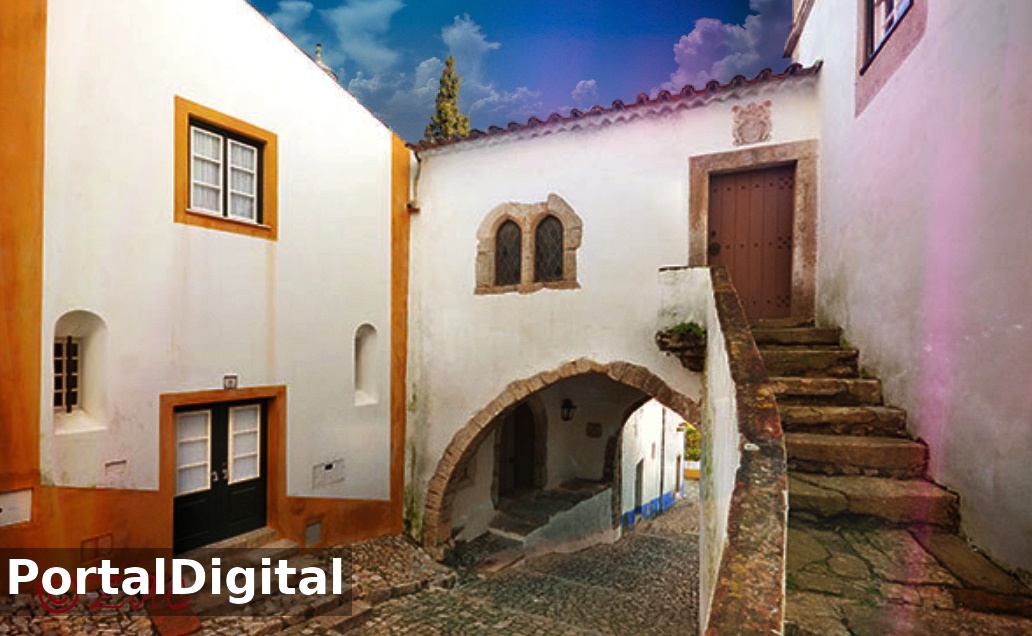
Casa do Arco da Cadeia has a simple, trapezoidal plan, consisting of a single volume of 2 heights with differentiated coverage in 2-pitched roofs.
The building has 2 floors, the main facade facing W, with a large pointed arch, made of stone, where the street passes. Access to the upper floor on the right, via a slightly curved exterior staircase.
On the 2nd floor, on the right, a straight lintel door topped with a coat of arms with the coat of arms of Matos e Silva; on the left, 2 semi-detached windows with a pointed arch, made of stone. Side facades attached to other buildings; corner between the E. and N. facades, also stonework.
The rear facade, on the E., has a winged arch, where the street passes; on the right, access door to the ground floor, with a pointed arch and large dimensions; In front, another door, open in a covered arch, communicating with the adjacent property.
On the 2nd floor, in the center, a straight lintel window and 2 others, semi-detached, with a pointed arch, on the far right of the house. The interior has two living rooms, kitchen, bathroom and two bedrooms, of recent design.
In 2002, the house was donated to the City Council to house the Abílio de Mattos e Silva Museum, which will work in conjunction with the museum that is attached to it.
The building, which is presumed to date back to the beginning of the 14th century, has maintained much of its original structure to this day.
In the 20th century it was acquired by the painter, set designer and costume designer Abílio de Mattos e Silva, and by his wife, the interior architect Maria José Salavisa.
The Casa do Arco da Cadeia has Gothic architecture, consisting of a ground floor that opens onto the street through a crossing arch, it is assumed that it dates back to the 15th century and functioned as a Town Hall or as a cordon.
The Casa do Arco da Cadeia is a construction that dates back to the 14th/15th centuries, in its origins it assumed the functions of a jail and Town Hall in the 16th century, in the adjacent building (current Abílio Mattos Silva Museum) maintaining its original characteristics until the 20th century.
In 1958, the painter Abílio de Mattos e Silva acquired Casa do Arco, which was restored in a project developed by Maria José Salavisa, his widow.
The house was donated to Óbidos City Council by herself in honor of her husband, the opening of this space is a tribute to both of them and can be visited by appointment.
Casa do Arco da Cadeia has a simple, trapezoidal plan, consisting of a single volume of 2 heights with differentiated coverage in 2-pitched roofs.
The building has 2 floors, the main facade facing W, with a large pointed arch, made of stone, where the street passes. Access to the upper floor on the right, via a slightly curved exterior staircase.
On the 2nd floor, on the right, a straight lintel door topped with a coat of arms with the coat of arms of Matos e Silva; on the left, 2 semi-detached windows with a pointed arch, made of stone. Side facades attached to other buildings; corner between the E. and N. facades, also stonework.
The rear facade, on the E., has a winged arch, where the street passes; on the right, access door to the ground floor, with a pointed arch and large dimensions; In front, another door, open in a covered arch, communicating with the adjacent property.
On the 2nd floor, in the center, a straight lintel window and 2 others, semi-detached, with a pointed arch, on the far right of the house. The interior has two living rooms, kitchen, bathroom and two bedrooms, of recent design.
In 2002, the house was donated to the City Council to house the Abílio de Mattos e Silva Museum, which will work in conjunction with the museum that is attached to it.