
It is located on Rua da Esperança, in Largo Nossa Sra. da Purificação, Vila de Bombarral, district of Leiria, Central Portugal
The Chapel of Our Lady of Purification from the 16th century had an oil-bearing baptistry from 1557, good images and a collateral chapel on the side of the epistle and consecrated to the Holy Spirit.
The Nossa Senhora da Purificação Chapel was founded by the Bombarralense nobleman Francisco Gorjão and his wife Brites Henriques. It has a beautiful Renaissance portal, has several tombstones with inscriptions and outside is an ark that appears to be from the 14th century.
The Parish Church of Nossa Senhora da Purificação has a single nave with a wooden ceiling and golden main altar, a narrower chancel, sacristy and bell tower attached to the left side facade, chapel of Gorjões, baptismal chapel attached to the right side facade, it has different roofs in a 2-pitched roof over the nave, chancel, baptismal chapel, sacristy and annexes.
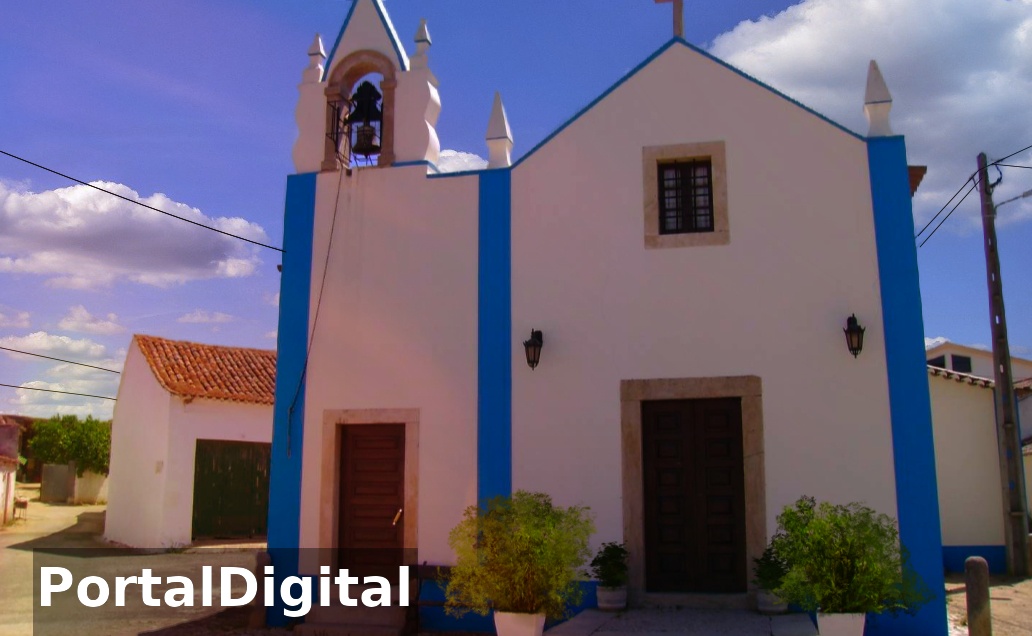
On the outside, the church has facades plastered and painted white with blue-painted friezes.
The main facade facing W. is located at a level lower than the ground level, a 1-flight U-shaped staircase descends to an access skate to a portal with a straight lintel, a projecting cornice topped by a rose window with a stone frame, a triangular gable finish at the apex of which sits a small cross that has an inscription on the plinth that supports it, a frontispiece flanked by 2 blind protruding bodies in a gable straight and bell tower, on the upper floor with bells on each side with a coruché finish with broken angles flanked by pinnacles and topped by a rooster-shaped weather vane.
The interior of the Chapel has an entrance protected by a wooden windshield under the high choir opening onto a single nave, walls plastered and painted white covered by standard industrially manufactured tiles forming ashlar, ceramic flooring and a central corridor in marble stone.
The high choir opened by a colored stained glass oculus resting on 2 columns, a sub-choir with a flat painted wooden roof with stylized foliage volutes joined at the top by a festoon centered by a rosette forming a composition similar to a lyre.
On the Gospel side, a door with a rectangular frame, flanked by a font of holy water embedded in the wall with a circular basin, gives access to the high choir and the bell tower through spiral stairs, the stairs that access the main altar rest on two epigraphed 16th century tomb covers.
In the side chapel with a round arch supported by a crosier and miter on the closing stone, with inside a niche that houses the 16th century sculpture of Saint Blaise and the corner side altars with 18th century altarpieces.
The rectangular Sacristy with access through the main chapel has a three-order chest with cut-out iron fittings resting on a wooden platform, a stone washbasin built into the wall with a reservoir closed by a rectangular back with hollow cushions, in the center a tap that flows water into a rectangular bowl and lighting provided through a rose window and windows in the nave.
The Nossa Senhora da Purificação Chapel was founded by the Bombarralense nobleman Francisco Gorjão and his wife Brites Henriques. It has a beautiful Renaissance portal, has several tombstones with inscriptions and outside is an ark that appears to be from the 14th century.
The Parish Church of Nossa Senhora da Purificação has a single nave with a wooden ceiling and golden main altar, a narrower chancel, sacristy and bell tower attached to the left side facade, chapel of Gorjões, baptismal chapel attached to the right side facade, it has different roofs in a 2-pitched roof over the nave, chancel, baptismal chapel, sacristy and annexes.
On the outside, the church has facades plastered and painted white with blue-painted friezes.
The main facade facing W. is located at a level lower than the ground level, a 1-flight U-shaped staircase descends to an access skate to a portal with a straight lintel, a projecting cornice topped by a rose window with a stone frame, a triangular gable finish at the apex of which sits a small cross that has an inscription on the plinth that supports it, a frontispiece flanked by 2 blind protruding bodies in a gable straight and bell tower, on the upper floor with bells on each side with a coruché finish with broken angles flanked by pinnacles and topped by a rooster-shaped weather vane.
The interior of the Chapel has an entrance protected by a wooden windshield under the high choir opening onto a single nave, walls plastered and painted white covered by standard industrially manufactured tiles forming ashlar, ceramic flooring and a central corridor in marble stone.
The high choir opened by a colored stained glass oculus resting on 2 columns, a sub-choir with a flat painted wooden roof with stylized foliage volutes joined at the top by a festoon centered by a rosette forming a composition similar to a lyre.
On the Gospel side, a door with a rectangular frame, flanked by a font of holy water embedded in the wall with a circular basin, gives access to the high choir and the bell tower through spiral stairs, the stairs that access the main altar rest on two epigraphed 16th century tomb covers.
In the side chapel with a round arch supported by a crosier and miter on the closing stone, with inside a niche that houses the 16th century sculpture of Saint Blaise and the corner side altars with 18th century altarpieces.
The rectangular Sacristy with access through the main chapel has a three-order chest with cut-out iron fittings resting on a wooden platform, a stone washbasin built into the wall with a reservoir closed by a rectangular back with hollow cushions, in the center a tap that flows water into a rectangular bowl and lighting provided through a rose window and windows in the nave.