
It is located in Largo do Toural, city and municipality of Guimarães, district of Braga, northwest of Portugal
The church was built in 1737, featuring elementary architecture and housing the image of the patron saint (1750).
In 1881, work began again with the demolition of the temporary structures and houses in front of the body of the church, and the work ended at the beginning of the 20th century without the two planned towers having been built, but only one.
The church, with its origins at the beginning of the 17th century, only began work in 1737, and it was only in 1750 that the main chapel was blessed.
The work was completed in 1883/1884, although the facade was never completed and the second bell tower still remains today.
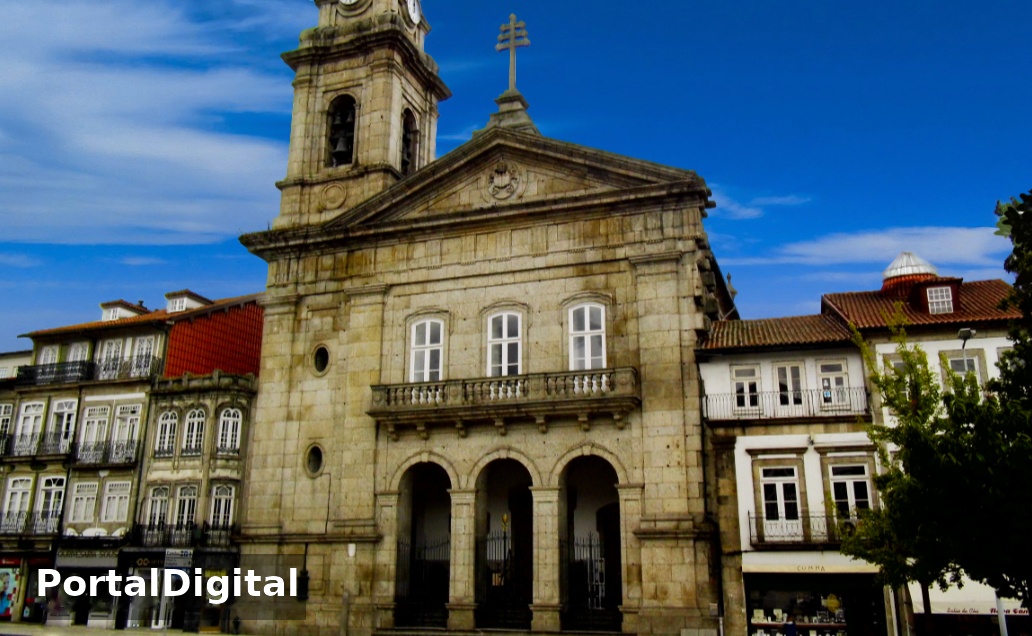
The plan of the church is longitudinal with a chancel and a single rectangular nave with staggered volumes with differentiated gable roof coverings.
The main facade with pillared corners supporting a Doric entablature on which rests a triangular pediment, crowned by an acroterion and cross.
The main façade facing NE, torn by three round arches on pilasters accessed by a staircase, is topped by three bay windows with baluster balconies.
On the left side, the bell tower, which in the first register is torn by two glasses and in the second register by a round arched opening on pilasters containing a bell topped by clocks, covered in a granite dome, and crowned by a spire.
In Galilé, three front doors open to the arches and two side doors, the central portal being larger, and the one on the right being a chapel invoking Saint Philomena and Saint Peter.
The interior of the Basilica features walls plastered and painted white, recent blue monochrome tiles on a white background with an ashlar pattern, and a wooden floor with a central area in granite stonework and stucco ceilings.
The High Choir with a wooden balustrade accessed on both sides by framed lintel doors.
In the nave there are two altarpieces on the side and a pulpit with a rectangular stonework basin, based on a corbel, accessed through a framed lintel door connected by a staircase inside the wall box from a door also with a louvered lintel.
The round triumphal arch on Tuscan pilasters leading to the raised main chapel has a facing door and window on the side walls.
The main altarpiece in polychrome and gilt carving with a convex plan on three axes defined by two columns with fluted shafts and Corinthian capitals, on the central axis there is a tribune with a curved profile housing an exhibition throne and on the lateral axes there are corbels supporting imagery.
The main chapel is separated from the nave by a perfect round arch and the blue and gold carved altarpiece stands out, an eclectic display from the end of the 19th century. XIX.
The Church is located in the city's “visiting room” and despite being incomplete, it received the title of basilica by Breve de Benedito in XIV, and was the first church to receive such distinction in the Archdiocese of Braga in 1751.
In 1881, work began again with the demolition of the temporary structures and houses in front of the body of the church, and the work ended at the beginning of the 20th century without the two planned towers having been built, but only one.
The church, with its origins at the beginning of the 17th century, only began work in 1737, and it was only in 1750 that the main chapel was blessed.
The work was completed in 1883/1884, although the facade was never completed and the second bell tower still remains today.
The plan of the church is longitudinal with a chancel and a single rectangular nave with staggered volumes with differentiated gable roof coverings.
The main facade with pillared corners supporting a Doric entablature on which rests a triangular pediment, crowned by an acroterion and cross.
The main façade facing NE, torn by three round arches on pilasters accessed by a staircase, is topped by three bay windows with baluster balconies.
On the left side, the bell tower, which in the first register is torn by two glasses and in the second register by a round arched opening on pilasters containing a bell topped by clocks, covered in a granite dome, and crowned by a spire.
In Galilé, three front doors open to the arches and two side doors, the central portal being larger, and the one on the right being a chapel invoking Saint Philomena and Saint Peter.
The interior of the Basilica features walls plastered and painted white, recent blue monochrome tiles on a white background with an ashlar pattern, and a wooden floor with a central area in granite stonework and stucco ceilings.
The High Choir with a wooden balustrade accessed on both sides by framed lintel doors.
In the nave there are two altarpieces on the side and a pulpit with a rectangular stonework basin, based on a corbel, accessed through a framed lintel door connected by a staircase inside the wall box from a door also with a louvered lintel.
The round triumphal arch on Tuscan pilasters leading to the raised main chapel has a facing door and window on the side walls.
The main altarpiece in polychrome and gilt carving with a convex plan on three axes defined by two columns with fluted shafts and Corinthian capitals, on the central axis there is a tribune with a curved profile housing an exhibition throne and on the lateral axes there are corbels supporting imagery.
The main chapel is separated from the nave by a perfect round arch and the blue and gold carved altarpiece stands out, an eclectic display from the end of the 19th century. XIX.
The Church is located in the city's “visiting room” and despite being incomplete, it received the title of basilica by Breve de Benedito in XIV, and was the first church to receive such distinction in the Archdiocese of Braga in 1751.
The Classification of St. Peter's Basilica
Saint Peter's Basilica in Guimarães on March 26, 1751 was elevated to the category of basilica and received the title of minor basilica in 1751 by Pope Benedict XIV.