
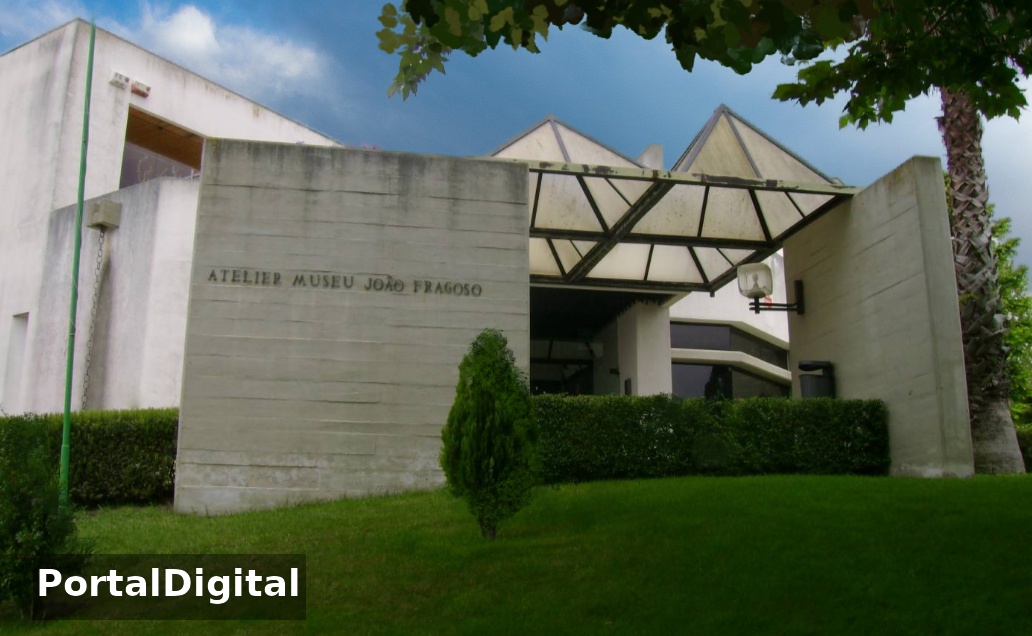
It is located on Rua Columbano Bordalo Pinheiro, city and municipality of Caldas da Rainha, District of Leiria, Central Portugal
The Atelier-Museu João Fragoso is a municipal museum, and is part of the Arts Center, a project developed by the municipality.
The Atelier-Museu João Fragoso was a space created with the aim of housing the work of an eminent sculptor from the city and simultaneously creating a workshop space that would allow him to continue his artistic production (in his works he used materials as diverse as plaster, bronze, wood).
The Atelier-Museu João Fragoso, created to house a significant part of the work of the Caldensian sculptor João Fragoso (1913-2000), a workshop space to continue his artistic expression, was inaugurated on September 24, 1994 by the then President of the Republic, Mário Soares.
Throughout his career, he received dozens of awards and distinctions, including the Officership of the Order of Christ, the bronze medal from the Brazilian Ministry of Education, the Absolute Merit award from the Ministry of Social Equipment for the Monument to the 25th of April project in 1985, the 1st Design Prize from the Council of Europe in Nice and others.
The sculptor João Fragoso was one of the introducers of Minimalism in the country, highlighting the bronze "Sea of Five Moons" acquired for the Cathedral City of Los Angeles, and the bronze "Space Sea" installed in the lake at Parque D. Carlos I in Caldas da Rainha.
The single-nave museum space covers the three fundamental stages of the artist's life that coincide with the most significant movements in Art in the 20th century: figuration, abstraction and minimalism.
The Figurative Phase that began in 1938 marks the beginning of João Fragoso's professional activity, when he worked at the Portuguese World Exhibition 1938-1940, on the project and decoration of the Camões Room, for which he was conferred the Officership of the Order of Christ. The artist expressed an appetite for maritime themes: interpretation of fishing figures and scenes, statues praising Portuguese navigators using the modernist language of Portuguese sculptors of this period.
The Sea Phase started in 1954, João Fragoso managed to create a personal and original style: he acquired a language that singularized him, dominated by abstractionism and the evident maritime influence, which resulted in the use of a grammar linked to boats, caravels, nets, nautical instruments, maritime flora, in short the nostalgic heritage of the Portuguese sea in harmony with the plasticity that it gave to the texture of the bronzes and the transparency of the marble blocks, imprinting the rhythmicity and restlessness of the Portuguese sea.
The Minimalist Phase that began in 1959 refers to the beginning of other aesthetic options where a formal purification that tends to be abstract dominates with geometric marks through the use of industrial materials that favor a conceptual unity, constituting a visual renewal of Portuguese sculpture of the 20th century.
The museum has rooms for temporary exhibitions under the artist João Fragoso dedicated to sculpture, ceramics, painting, drawing and poetry, as well as works by different artists.
The Atelier-Museu João Fragoso was a space created with the aim of housing the work of an eminent sculptor from the city and simultaneously creating a workshop space that would allow him to continue his artistic production (in his works he used materials as diverse as plaster, bronze, wood).
The Atelier-Museu João Fragoso, created to house a significant part of the work of the Caldensian sculptor João Fragoso (1913-2000), a workshop space to continue his artistic expression, was inaugurated on September 24, 1994 by the then President of the Republic, Mário Soares.
Throughout his career, he received dozens of awards and distinctions, including the Officership of the Order of Christ, the bronze medal from the Brazilian Ministry of Education, the Absolute Merit award from the Ministry of Social Equipment for the Monument to the 25th of April project in 1985, the 1st Design Prize from the Council of Europe in Nice and others.
The sculptor João Fragoso was one of the introducers of Minimalism in the country, highlighting the bronze "Sea of Five Moons" acquired for the Cathedral City of Los Angeles, and the bronze "Space Sea" installed in the lake at Parque D. Carlos I in Caldas da Rainha.
The single-nave museum space covers the three fundamental stages of the artist's life that coincide with the most significant movements in Art in the 20th century: figuration, abstraction and minimalism.
The Figurative Phase that began in 1938 marks the beginning of João Fragoso's professional activity, when he worked at the Portuguese World Exhibition 1938-1940, on the project and decoration of the Camões Room, for which he was conferred the Officership of the Order of Christ. The artist expressed an appetite for maritime themes: interpretation of fishing figures and scenes, statues praising Portuguese navigators using the modernist language of Portuguese sculptors of this period.
The Sea Phase started in 1954, João Fragoso managed to create a personal and original style: he acquired a language that singularized him, dominated by abstractionism and the evident maritime influence, which resulted in the use of a grammar linked to boats, caravels, nets, nautical instruments, maritime flora, in short the nostalgic heritage of the Portuguese sea in harmony with the plasticity that it gave to the texture of the bronzes and the transparency of the marble blocks, imprinting the rhythmicity and restlessness of the Portuguese sea.
The Minimalist Phase that began in 1959 refers to the beginning of other aesthetic options where a formal purification that tends to be abstract dominates with geometric marks through the use of industrial materials that favor a conceptual unity, constituting a visual renewal of Portuguese sculpture of the 20th century.
The museum has rooms for temporary exhibitions under the artist João Fragoso dedicated to sculpture, ceramics, painting, drawing and poetry, as well as works by different artists.