
It is located in Praça Faria da Gama, city and municipality of Pombal, District of Leiria, in the province of Beira Litoral, in the region of Central Portugal
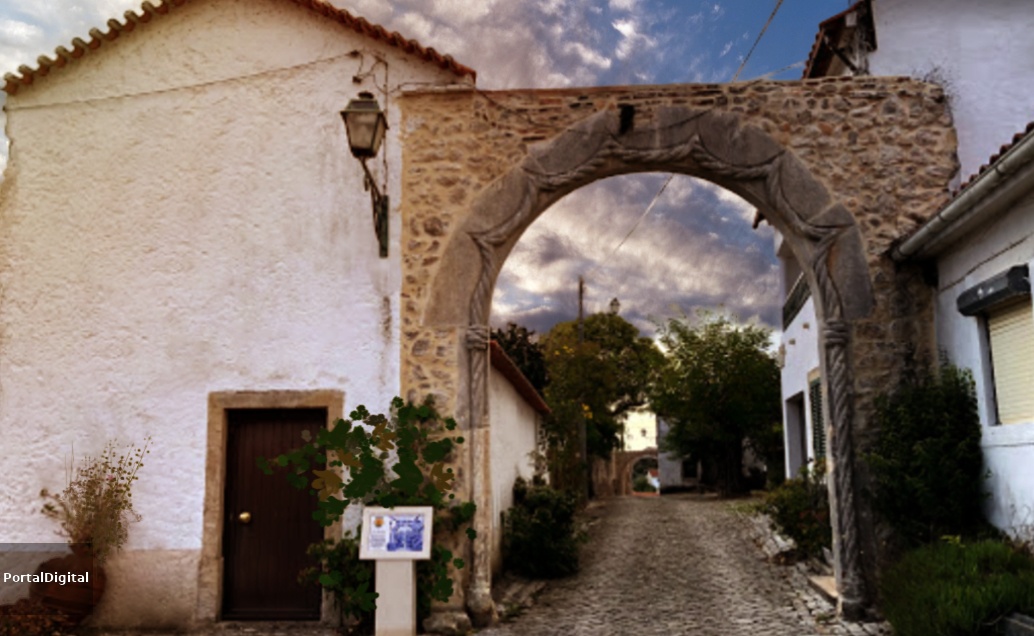
The Manueline Arch that gives access to a Solar inclined laterally over buildings built later.
The Manueline Arch of Abiúl (belonging to the former Palace of the Dukes of Aveiro) is one of the remaining elements of André de Sousa Coutinho's manor house built between the end of the 15th century and the first years of the 16th century.
The probable date of construction of the Palace of André de Sousa Coutinho (15th-16th century) and after his death it would pass to the Duke of Aveiro.
The Duke of Aveiro held the lordship of the town of Abiul until 1759, the year in which, due to accusations of involvement in the attempted regicide, he was stripped of all his property and sentenced to death by order of the Marquis of Pombal.
The Manueline Arch of Abiúl attached to the houses that flank it, providing the passage to the old village yard, the perfect round arch is decorated with a rigging arranged in a cairel loop and resting on two columns
The arch was originally part of the main portal of André de Sousa Coutinho's manor, who acquired part of the town's lordship from the Lorvão Monastery, but with his death the town passed to the domains of the Dukes of Aveiro.
The Manueline Manor Palace with a round access arch decorated with a torçal, recreating a polycentric arch based on capitals and torçal columns.
The arch rests laterally on buildings built later and establishes access to the Terreiro square surrounded by 1 and 2-storey buildings forming a closed square.
The round arch decorated with a torçal recreating a polycentric arch based on capitals and torçala columns and is supported laterally on buildings constructed later.
The Manueline Arch of Abiúl is an example of Manueline architecture from the 16th century and was once the entrance to the Palace of the Dukes of Aveiro.
The Manueline Arch of Abiúl (belonging to the former Palace of the Dukes of Aveiro) is one of the remaining elements of André de Sousa Coutinho's manor house built between the end of the 15th century and the first years of the 16th century.
The probable date of construction of the Palace of André de Sousa Coutinho (15th-16th century) and after his death it would pass to the Duke of Aveiro.
The Duke of Aveiro held the lordship of the town of Abiul until 1759, the year in which, due to accusations of involvement in the attempted regicide, he was stripped of all his property and sentenced to death by order of the Marquis of Pombal.
The Manueline Arch of Abiúl attached to the houses that flank it, providing the passage to the old village yard, the perfect round arch is decorated with a rigging arranged in a cairel loop and resting on two columns
The arch was originally part of the main portal of André de Sousa Coutinho's manor, who acquired part of the town's lordship from the Lorvão Monastery, but with his death the town passed to the domains of the Dukes of Aveiro.
The Manueline Manor Palace with a round access arch decorated with a torçal, recreating a polycentric arch based on capitals and torçal columns.
The arch rests laterally on buildings built later and establishes access to the Terreiro square surrounded by 1 and 2-storey buildings forming a closed square.
The round arch decorated with a torçal recreating a polycentric arch based on capitals and torçala columns and is supported laterally on buildings constructed later.
The Manueline Arch of Abiúl is an example of Manueline architecture from the 16th century and was once the entrance to the Palace of the Dukes of Aveiro.