
Located on Rua do Muro, City of Évora, Alentejo region, Central Portugal
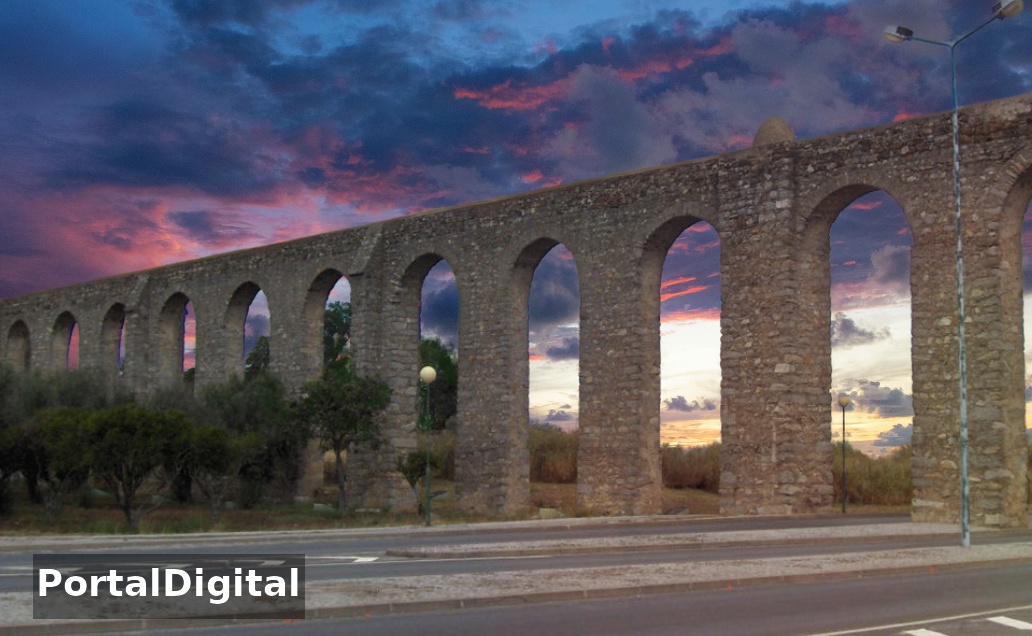
Évora's Silver Water Aqueduct (Aqueduto da Prata) is one of the most obvious and impressive monuments in the city due to its size.
The Monument does not let us forget the ingenuity that was needed to provide water to all Eborenses since ancient times, and for this reason it has been a National Monument since 1910.
The construction of the Água de Prata Aqueduct was initiated by order of D. João III in 1532 and under the direction of the royal architect Francisco de Arruda, an 18 km aqueduct was built from Herdade do Divor where it will supply water to the center of Évora.
The Renaissance-style granite pipes and arcades rested heavily on the old Roman aqueduct completed in 1537, and the inauguration of the Água de Prata Aqueduct was carried out with pomp and circumstance in the presence of the king and the court, in Praça do Giraldo where a fountain with marble lions was built associated with a Roman triumphal arch (both replaced later in the Henrique remodeling of the square), and in the place of the lions' fountain is the current fountain of the Giraldo Square.
The Évora aqueduct beautified the historic center of the city, and until 1873 a beautiful Renaissance portico called the Royal Closure of the Aqueduct stood near the Church of São Francisco.
On Rua Nova (in Santiago) a “Renaissance Water Tower''''''''' was built and can still be seen today with twelve Tuscan columns and a wide entablature.
Some of the most obvious changes to the Prata Aqueduct over the centuries were the various fountains and fountains that were added along the route through the historic center of Évora.
The fountains were supplied by this old water distribution network, such as: the fountain at Portas de Moura, Praça do Giraldo, Portas de Avis, Chão das Covas and the fountain and tanks at Rossio de S. Brás.
In the 17th century, it was necessary to restore the Água de Prata Aqueduct due to the Restoration wars, and other works took place in the 19th and 20th centuries but did not alter the original general design.
The most recent intervention near this monument was carried out recently, when the Água de Prata Route was created, and the nearby fields were cleaned along its entire length.
Évora's environmental route follows the aqueduct 8.3 km through cork oak fields and farms, and on foot or by bike, you will be able to breathe the pure Alentejo air with the view of Évora at your back.
The Água de Prata Aqueduct from Porta da Lagoa (road R114-4 Évora-Arraiolos), at which point you enter the historic center of Évora and you will be able to see how the houses became one with this 16th century construction.
The Monument does not let us forget the ingenuity that was needed to provide water to all Eborenses since ancient times, and for this reason it has been a National Monument since 1910.
The construction of the Água de Prata Aqueduct was initiated by order of D. João III in 1532 and under the direction of the royal architect Francisco de Arruda, an 18 km aqueduct was built from Herdade do Divor where it will supply water to the center of Évora.
The Renaissance-style granite pipes and arcades rested heavily on the old Roman aqueduct completed in 1537, and the inauguration of the Água de Prata Aqueduct was carried out with pomp and circumstance in the presence of the king and the court, in Praça do Giraldo where a fountain with marble lions was built associated with a Roman triumphal arch (both replaced later in the Henrique remodeling of the square), and in the place of the lions' fountain is the current fountain of the Giraldo Square.
The Évora aqueduct beautified the historic center of the city, and until 1873 a beautiful Renaissance portico called the Royal Closure of the Aqueduct stood near the Church of São Francisco.
On Rua Nova (in Santiago) a “Renaissance Water Tower''''''''' was built and can still be seen today with twelve Tuscan columns and a wide entablature.
Some of the most obvious changes to the Prata Aqueduct over the centuries were the various fountains and fountains that were added along the route through the historic center of Évora.
The fountains were supplied by this old water distribution network, such as: the fountain at Portas de Moura, Praça do Giraldo, Portas de Avis, Chão das Covas and the fountain and tanks at Rossio de S. Brás.
In the 17th century, it was necessary to restore the Água de Prata Aqueduct due to the Restoration wars, and other works took place in the 19th and 20th centuries but did not alter the original general design.
The most recent intervention near this monument was carried out recently, when the Água de Prata Route was created, and the nearby fields were cleaned along its entire length.
Évora's environmental route follows the aqueduct 8.3 km through cork oak fields and farms, and on foot or by bike, you will be able to breathe the pure Alentejo air with the view of Évora at your back.
The Água de Prata Aqueduct from Porta da Lagoa (road R114-4 Évora-Arraiolos), at which point you enter the historic center of Évora and you will be able to see how the houses became one with this 16th century construction.