
It is located on Avenida dos Combatentes da Grande Guerra, city of Viana do Castelo, Northern Portugal
Its construction lasted throughout the reigns of D. Manuel I (who initiated it) and D. João III.
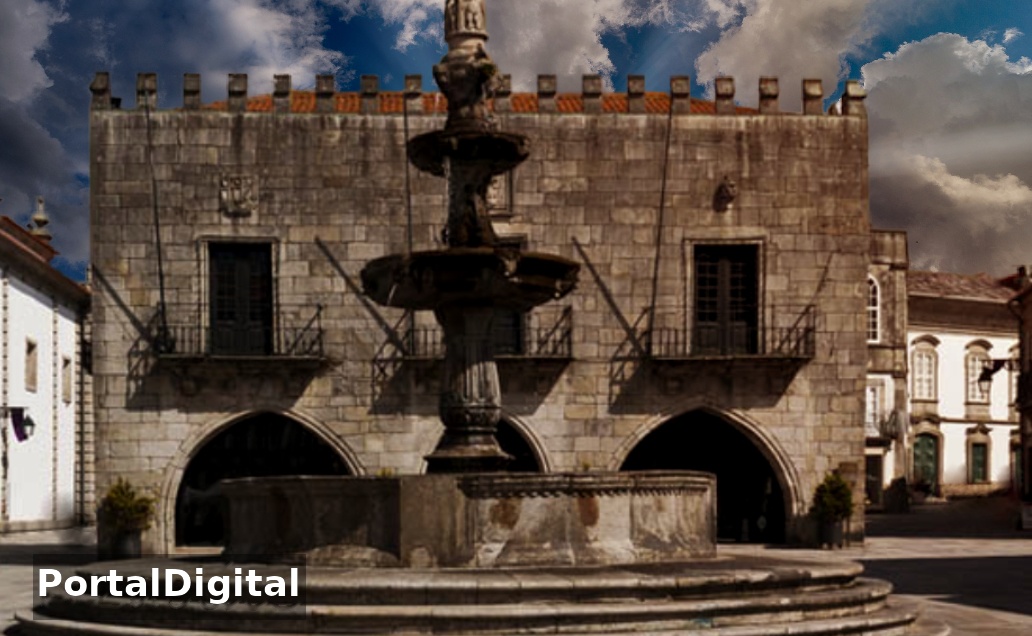
The entire building is built in austere granite stone, forming a porch on the ground floor delimited by three pointed arches, which correspond to three bay windows on the middle floor.
Over the middle window are carved the royal shield, the armillary sphere and a ship symbol of Viana, which owed much of its prosperity to the sea.
From the 15th century onwards, with the expansion of the town's urban perimeter, there was a need to create a new commercial and political center passing from the Town Hall to Campo do Forno, currently Praça da República by order of D. Manuel I.
The Old Town Hall building is a unique building, and has a simple rectangular plan with two floors topped with merlons.
The main facade, on the lower floor, has three broken arches, and the central one is the smallest, topped by three bay windows with iron guards based on modillions belonging to the upper floor.
Above the windows we can also see three heraldic symbols, the one on the left being the caravel of the shield of Viana, in the center the shield of Portugal with a helmet as a crest framed and surmounted by the Cross of Christ, and finally on the right the armillary sphere.
The side facades have the same similarity as the main one, having an arch and a window.
The rear façade simply has two doors on both floors, the upper one being a straight lintel and accessible via a stone staircase.
The building's arcades formed a space dedicated to the sale of bread and flour, with this surface being paved and complete with stalls and benches. As for the second floor, it was dedicated to council sessions, and simultaneously served as a court.
The entire building is built in austere granite stone, forming a porch on the ground floor delimited by three pointed arches, which correspond to three bay windows on the middle floor.
Over the middle window are carved the royal shield, the armillary sphere and a ship symbol of Viana, which owed much of its prosperity to the sea.
From the 15th century onwards, with the expansion of the town's urban perimeter, there was a need to create a new commercial and political center passing from the Town Hall to Campo do Forno, currently Praça da República by order of D. Manuel I.
The Old Town Hall building is a unique building, and has a simple rectangular plan with two floors topped with merlons.
The main facade, on the lower floor, has three broken arches, and the central one is the smallest, topped by three bay windows with iron guards based on modillions belonging to the upper floor.
Above the windows we can also see three heraldic symbols, the one on the left being the caravel of the shield of Viana, in the center the shield of Portugal with a helmet as a crest framed and surmounted by the Cross of Christ, and finally on the right the armillary sphere.
The side facades have the same similarity as the main one, having an arch and a window.
The rear façade simply has two doors on both floors, the upper one being a straight lintel and accessible via a stone staircase.
The building's arcades formed a space dedicated to the sale of bread and flour, with this surface being paved and complete with stalls and benches. As for the second floor, it was dedicated to council sessions, and simultaneously served as a court.
The Classification of the Old Town Hall in Viana do Castelo
The Old Town Hall in Viana do Castelo was classified as a National Monument in 1910.