
It is located on the Minho river joined by the International Bridge, City of Valença, district of Viana do Castelo, North region and sub-region of Alto Minho
In the Old Customs House in Valença, the building has a painting panel facing the river with the representation of a mermaid strumming a zither by master Júlio Resende.
Júlio Martins Resende da Silva Dias (23 October 1917 – 21 September 2011 in Valbom, Gondomar) was a Portuguese painter of the 19th/20th century.
The artist left some works: Caminhantes (1950), Lavadeira (1951), Mendigos (1954), Pentecostes (1955), Pescadores (1957), Moça (1982), Ribeira Negra (1984) and Stained Glass of the Church of the Monastery of São Salvador de Grijó, Vila Nova de Gaia (1998).
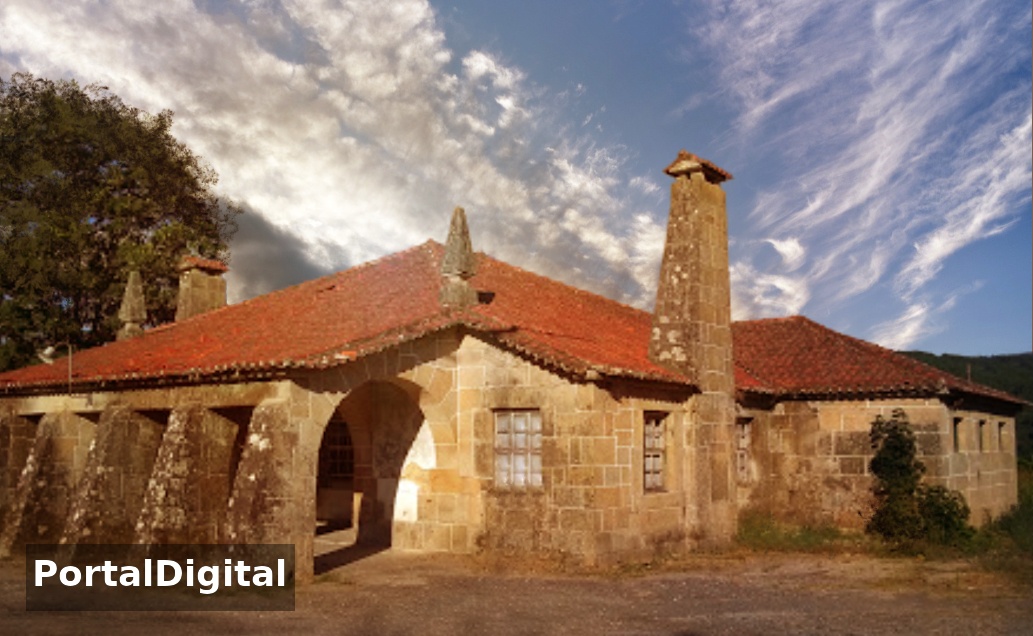
The old Customs building is a landmark of memories of relations between Portugal and Spain and the space holds testimonies of lengthy crossings, guarded borders, the showing of documents and the smuggling of goods.
In the old Valença do Minho Customs House, products such as sardines, linen cloth, cattle, corn, hats and olive oil were traded.
In the spring of 2015, an intervention was carried out at the old and deactivated customs post in Valença do Minho on the border with Galicia.
In this building, the aim was to recover an unknown mosaic panel attributed to the painter José Gastão Seixas (1926-1982) that time had degraded and that the vegetation had hidden from passers-by.
On the opposite side there is a contemporary work of art called “Ritmos de Primavera” by Arlindo Rocha, 1961.
Arlindo Rocha (1921-1999) was a Portuguese sculptor considered a pioneer of abstract sculpture in the country, and one of the most influential personalities of the movement that emancipated statutory sculpture.
His works include: Woman and Tree (1948), Science (1961), Poetry, Sea and Earth, Setúbal (1971), D. António Ferreira Gomes, Bishop of Porto (1979) and Decorative Panel - building H - ISEP | Polytechnic of Porto (1968).
The border demarcated by the River Minho and joined by the International Bridge marked the lives of the two communities for centuries but today it is less monitored.
Júlio Martins Resende da Silva Dias (23 October 1917 – 21 September 2011 in Valbom, Gondomar) was a Portuguese painter of the 19th/20th century.
The artist left some works: Caminhantes (1950), Lavadeira (1951), Mendigos (1954), Pentecostes (1955), Pescadores (1957), Moça (1982), Ribeira Negra (1984) and Stained Glass of the Church of the Monastery of São Salvador de Grijó, Vila Nova de Gaia (1998).
The old Customs building is a landmark of memories of relations between Portugal and Spain and the space holds testimonies of lengthy crossings, guarded borders, the showing of documents and the smuggling of goods.
In the old Valença do Minho Customs House, products such as sardines, linen cloth, cattle, corn, hats and olive oil were traded.
In the spring of 2015, an intervention was carried out at the old and deactivated customs post in Valença do Minho on the border with Galicia.
In this building, the aim was to recover an unknown mosaic panel attributed to the painter José Gastão Seixas (1926-1982) that time had degraded and that the vegetation had hidden from passers-by.
On the opposite side there is a contemporary work of art called “Ritmos de Primavera” by Arlindo Rocha, 1961.
Arlindo Rocha (1921-1999) was a Portuguese sculptor considered a pioneer of abstract sculpture in the country, and one of the most influential personalities of the movement that emancipated statutory sculpture.
His works include: Woman and Tree (1948), Science (1961), Poetry, Sea and Earth, Setúbal (1971), D. António Ferreira Gomes, Bishop of Porto (1979) and Decorative Panel - building H - ISEP | Polytechnic of Porto (1968).
The border demarcated by the River Minho and joined by the International Bridge marked the lives of the two communities for centuries but today it is less monitored.