
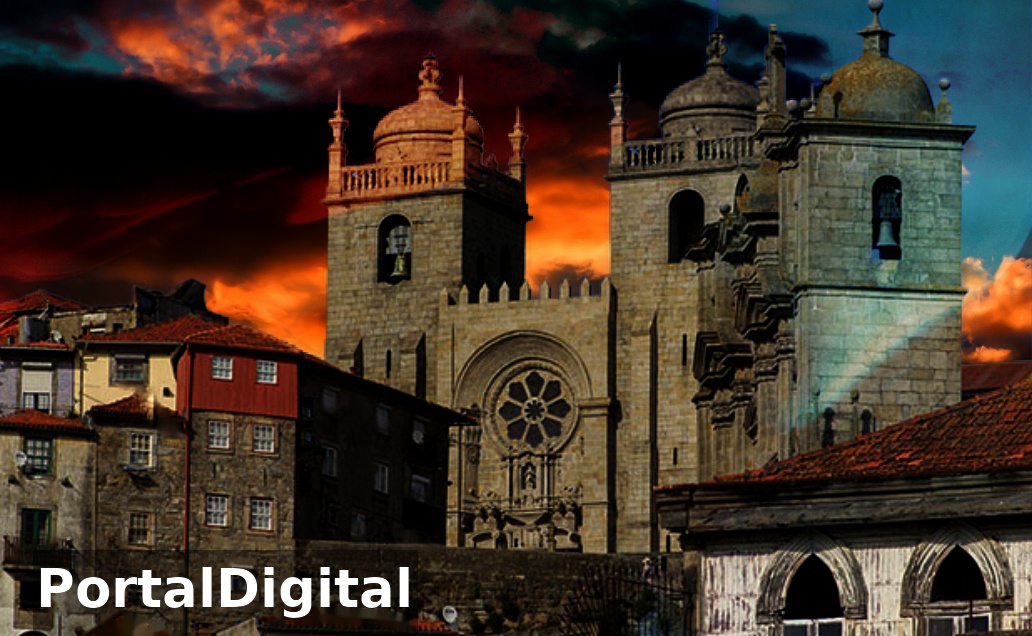
The Porto Cathedral or Sé do Porto, is located in the heart of the historic center of the city of Porto, in Terreiro da Sé, city of Porto, northern Portugal.
The Construction of the Porto Cathedral
The Porto Cathedral or Sé do Porto, is considered one of the main and oldest monuments in Portugal.
The Porto Cathedral is a building with a Roman-Gothic structure, from the 17th century. XII and XIII, having undergone major renovations in the Baroque period (17th-18th century).
Its construction began in the first half of the 12th century and continued until the beginning of the 13th century.
This first Romanesque-style building underwent many changes over the centuries.
The general character of the facade with the towers and the beautiful rose window dates back to the Romanesque period, in addition to the body of the church with three naves covered by a barrel vault.
The vault of the central nave is supported by flying buttresses, the Porto Cathedral being one of the first Portuguese buildings in which this architectural element was used.
In the Gothic period, around the year 1333, the funerary chapel of João Gordo, knight of the Order of Hospitallers and collaborator of D. Dinis, was built, and he was buried in a tomb with a recumbent.
The cloister also dates back to the Gothic period (14th-15th century), built during the reign of D. João I (this king married D. Filipa de Lencastre in the Cathedral of Porto in 1387).
The Porto Cathedral is a building with a Roman-Gothic structure, from the 17th century. XII and XIII, having undergone major renovations in the Baroque period (17th-18th century).
Its construction began in the first half of the 12th century and continued until the beginning of the 13th century.
This first Romanesque-style building underwent many changes over the centuries.
The general character of the facade with the towers and the beautiful rose window dates back to the Romanesque period, in addition to the body of the church with three naves covered by a barrel vault.
The vault of the central nave is supported by flying buttresses, the Porto Cathedral being one of the first Portuguese buildings in which this architectural element was used.
In the Gothic period, around the year 1333, the funerary chapel of João Gordo, knight of the Order of Hospitallers and collaborator of D. Dinis, was built, and he was buried in a tomb with a recumbent.
The cloister also dates back to the Gothic period (14th-15th century), built during the reign of D. João I (this king married D. Filipa de Lencastre in the Cathedral of Porto in 1387).
The Facade of Porto Cathedral
The exterior of the Cathedral was greatly modified in the Baroque period.
In 1736, the Italian architect Nicolau Nasoni added a beautiful baroque galilee to the side facade of the Cathedral, and later a new portal was built to replace the original Romanesque one, the balustrades and domes of the towers are also baroque (1772).
The lantern tower was built on the cruise in the second half of the 19th century. XVI in the time of D. Rodrigo Pinheiro and the lantern-tower consists of an accentuated verticalism of the central nave marked by thick fasciculated pillars, with vaults and arches already slightly pointed, resulting in superb grandeur.
The entire monument underwent major restoration work during the 1930s.
In 1736, the Italian architect Nicolau Nasoni added a beautiful baroque galilee to the side facade of the Cathedral, and later a new portal was built to replace the original Romanesque one, the balustrades and domes of the towers are also baroque (1772).
The lantern tower was built on the cruise in the second half of the 19th century. XVI in the time of D. Rodrigo Pinheiro and the lantern-tower consists of an accentuated verticalism of the central nave marked by thick fasciculated pillars, with vaults and arches already slightly pointed, resulting in superb grandeur.
The entire monument underwent major restoration work during the 1930s.
Magnificent silver altar and the medieval image of Our Lady of Vandoma
To the left of the main chapel, there is a magnificent silver altar built in the second half of the 17th century by several Portuguese artists.
In 1807 the silver altar was saved from French troops by means of a hastily constructed plaster wall, and we can also see the medieval image of Our Lady of Vandoma (patron saint of the city).
In 1807 the silver altar was saved from French troops by means of a hastily constructed plaster wall, and we can also see the medieval image of Our Lady of Vandoma (patron saint of the city).
The main chapel of Porto Cathedral
In the 17th century, the original Romanesque chancel (which was equipped with an ambulatory) was replaced by a larger one in Baroque style.
Between 1727-1729, the main altar was designed by Santos Pacheco and sculpted by Miguel Francisco da Silva, and is an important work of the Johannine Baroque, that is, the main altar is made up of curves and countercurves (twisted columns), diagonal lines, painting and the drama of the Saints' ecstasies.
The wall paintings in the chancel are by Nasoni, and the south transept gives access to the 14th-century cloisters and the Chapel of Saint Vincent, and a graceful 18th-century staircase by Nasoni leads to the upper floors.
The Cathedral includes three beautiful organs: one of them in the high choir marks a period in Portugal that began organ development, and it is an instrument by the builder Jann, the same as the organ in the church of Lapa (Porto), both promoted by the effort and initiative of Cónego Ferreira dos Santos.
Between 1727-1729, the main altar was designed by Santos Pacheco and sculpted by Miguel Francisco da Silva, and is an important work of the Johannine Baroque, that is, the main altar is made up of curves and countercurves (twisted columns), diagonal lines, painting and the drama of the Saints' ecstasies.
The wall paintings in the chancel are by Nasoni, and the south transept gives access to the 14th-century cloisters and the Chapel of Saint Vincent, and a graceful 18th-century staircase by Nasoni leads to the upper floors.
The Cathedral includes three beautiful organs: one of them in the high choir marks a period in Portugal that began organ development, and it is an instrument by the builder Jann, the same as the organ in the church of Lapa (Porto), both promoted by the effort and initiative of Cónego Ferreira dos Santos.
The Interior of Porto Cathedral
Inside, the Porto Cathedral still retains the appearance of a fortress-church with crenellations. It is worth highlighting the beautiful rose window (12th century), the loggia or lateral galilee (1736) designed by Nicolau Nasoni facing the city.
At the end of the 17th century, next to the doors there are monumental fonts of holy water, near the 17th century baptismal font there is a bas-relief of Teixeira Lopes (Father).
At the end of the 17th century, next to the doors there are monumental fonts of holy water, near the 17th century baptismal font there is a bas-relief of Teixeira Lopes (Father).