
It is located in Largo Instituto Histórico do Minho, city and municipality of Viana do Castelo, North of Portugal
The construction of the Viana do Castelo Mother Church dates back to the first half of the 15th century, influenced by Gothic aesthetics.
The region located between the Minho and Lima rivers has always enjoyed a certain autonomy, having its religious headquarters successively in Tuy (from 569 to 1362), in Valença (from 1382 to 1444) and in Ceuta (from 1444 to 1514).
In 1977, satisfying a secular aspiration of the people of the region, Pope Paul VI authorized the creation of the diocese of Viana do Castelo, elevating the Mother Church to the Cathedral.
The church was initially dedicated to the Divine Savior and only later consecrated to the Marian cult and having “Santa Maria Maior” as its patron saint.
The Temple was ready for worship in 1455, and in 1483 it was promoted to a collegiate church on the initiative of the Bishop of Ceuta, D. Justo Balduíno.
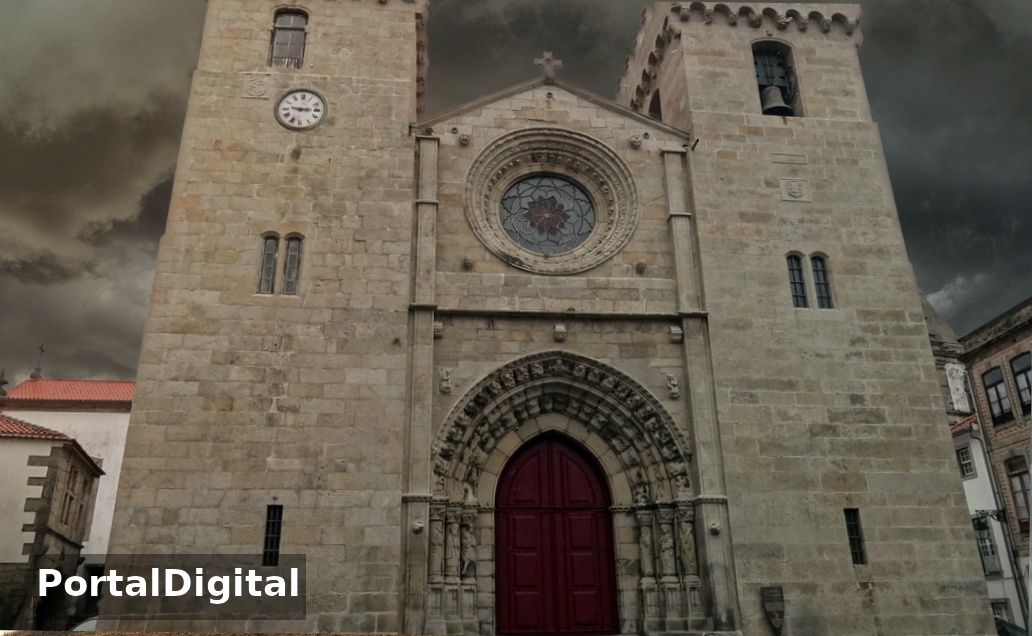
Its exterior retains the appearance of a fortified church of Romanesque inspiration and similar to some temples in Galicia: on the facade it has two imposing crenellated towers that frame a central body, in which the rose window with a lacy frame stands out over an ogival portal composed of four archivolts, three of which are decorated.
Christ reigning crowns the composition at the close of the last archivolt, and flanked by a vision of the heavenly court.
Protecting the entrance to the Cathedral are the sculptures of the six Apostles most linked to the traditions of the town and the region: “Saint Peter”, “Saint Paul”, “Saint John”, “Saint Bartholomew”, “Saint James” and “Saint Andrew”.
The sculptural ensemble on the main portal is a notable and rare work of national Gothic, and the interior, consisting of three naves, highlights the exquisite ornamentation and the set of armored tombs of the local nobility.
The various chapels deserve special attention, especially that of the “Senhor Jesus dos Mareantes” belonging to the Confraria dos Mareantes, which preserves a notable artistic collection including an image of the “Dead Lord” acquired in England in 1593 with Milanese vestments from the 17th century, and a tombstone dated 1404 decorated with astronomical symbols possibly originating from a previous chapel erected by seafarers.
In 1656 and in 1809, two violent fires caused serious destruction, and the last one led to the abandonment of the church for a few decades, and it only took on its parish functions in 1835.
The original covering of the naves was replaced by painted plaster at that time, and the sacristy has rich baroque ornamentation.
The region located between the Minho and Lima rivers has always enjoyed a certain autonomy, having its religious headquarters successively in Tuy (from 569 to 1362), in Valença (from 1382 to 1444) and in Ceuta (from 1444 to 1514).
In 1977, satisfying a secular aspiration of the people of the region, Pope Paul VI authorized the creation of the diocese of Viana do Castelo, elevating the Mother Church to the Cathedral.
The church was initially dedicated to the Divine Savior and only later consecrated to the Marian cult and having “Santa Maria Maior” as its patron saint.
The Temple was ready for worship in 1455, and in 1483 it was promoted to a collegiate church on the initiative of the Bishop of Ceuta, D. Justo Balduíno.
Its exterior retains the appearance of a fortified church of Romanesque inspiration and similar to some temples in Galicia: on the facade it has two imposing crenellated towers that frame a central body, in which the rose window with a lacy frame stands out over an ogival portal composed of four archivolts, three of which are decorated.
Christ reigning crowns the composition at the close of the last archivolt, and flanked by a vision of the heavenly court.
Protecting the entrance to the Cathedral are the sculptures of the six Apostles most linked to the traditions of the town and the region: “Saint Peter”, “Saint Paul”, “Saint John”, “Saint Bartholomew”, “Saint James” and “Saint Andrew”.
The sculptural ensemble on the main portal is a notable and rare work of national Gothic, and the interior, consisting of three naves, highlights the exquisite ornamentation and the set of armored tombs of the local nobility.
The various chapels deserve special attention, especially that of the “Senhor Jesus dos Mareantes” belonging to the Confraria dos Mareantes, which preserves a notable artistic collection including an image of the “Dead Lord” acquired in England in 1593 with Milanese vestments from the 17th century, and a tombstone dated 1404 decorated with astronomical symbols possibly originating from a previous chapel erected by seafarers.
In 1656 and in 1809, two violent fires caused serious destruction, and the last one led to the abandonment of the church for a few decades, and it only took on its parish functions in 1835.
The original covering of the naves was replaced by painted plaster at that time, and the sacristy has rich baroque ornamentation.