
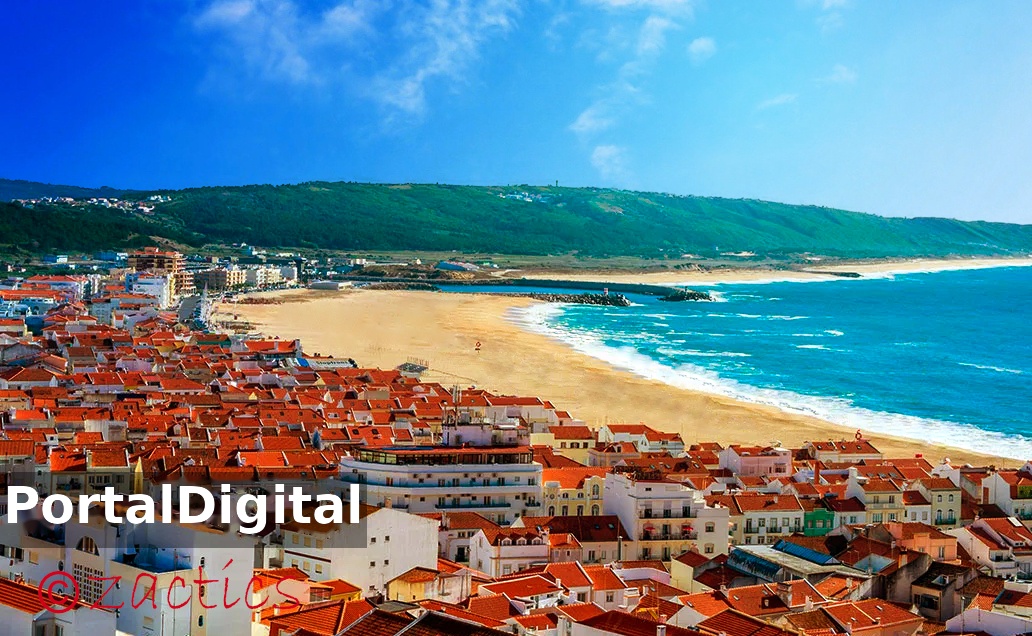
Nazaré is a Portuguese village, in the district of Leiria, seat of the municipality of the same name and with around 10,300 inhabitants, located in the province of Estremadura, forming part of the Intermunicipal Community of the West in the Centro region
The small municipality of Nazaré has an area of 82.43 km 2 and 15,158 inhabitants (2011) and is subdivided into 3 parishes: Famalicão, Nazaré and Valado dos Frades.
The municipality is surrounded to the north, east and south by the municipality of Alcobaça and to the west it borders the Atlantic Ocean.
The town's current urban space encompasses three old villages, Pederneira, Sítio da Nazaré, Praia da Nazaré, new neighborhoods from the second half of the 20th century, Urbisol or Rio Novo arising from the natural expansion of the three primitive nuclei.
The village is located 99 km north of Lisbon (122 km via A8, or 128 km via IC2/A1) and 88 km southwest of Coimbra (109 km via A1/A8).
The municipality and parish were called Pederneira until 1912, when by law the toponym was changed to Nazaré.
The old municipality of Pederneira had a charter in 1514 given by D. Manuel I and was integrated into the Coutos de Alcobaça.
Pederneira, currently one of the neighborhoods of the town of Nazaré, still maintains the building of the old Town Hall, the pillory, the Igreja Matriz de Nossa Senhora das Areias and the Igreja da Misericórdia, testimonies of its former status as a town.
The toponym Nazaré is intrinsically linked to the Legend of Our Lady of Nazaré which tells the story that, at dawn on September 14, 1182, D. Fuas Roupinho, mayor of the castle of Porto de Mós was hunting along the coast in dense fog near his lands when he saw a deer that he began to chase.
D. Fuas, in the middle of the fog, moved away from his companions and when he realized he was at the top of the cliff on the edge of the precipice in danger of death and he was right next to a cave where an image of the Virgin Mary with the Baby Jesus was venerated. more than a hundred meters.
D. Fuas went down to the cave to pray and give thanks for the miracle and ordered masons to build a chapel over the cave in memory of the miracle, the Ermida da Memória, so that the miraculous image could be displayed there for the veneration of the faithful.
Throughout the 20th century, Nazaré progressively evolved from a fishing village to a town dedicated to tourism, having been one of the first points of international tourist interest in Portugal.
The Nazarene tradition of women wearing seven skirts is closely linked to work: the Nazarene women had the habit of waiting for their husbands and sons to return from fishing on the beach, sitting on the sand, spending hours awake, using the various skirts to cover themselves, the top ones to protect their heads and shoulders from the sea spray and the remaining ones to cover their legs.
During the 50s and 60s, the women's seven skirts and the men's flannel shirt and black cap attracted names such as Lino António, Jorge Barradas, Stanley Kubrick or Cartier-Bresson, who documented the day-to-day life of the Nazarene people in painting and photography.
It is currently impossible to talk about Nazaré without mentioning the world record for the biggest wave ever surfed of 30 meters set by Garrett McNamara, in Praia do Norte in November 2011.
With the worldwide recognition of Nazaré's giant waves, the town has become the host of the biggest international surfing championships and receives many surfers, thousands of onlookers and tourists who come to watch their courageous demonstrations.
The main attractions of Nazaré are: Forte de São Miguel Arcanjo, Miradouro do Suberco, Santuário de Nossa Senhora da Nazaré, Praia do Norte (beach with huge waves for surfing), Forno de Orca Cave (Praia do Norte, Nazaré), Praia da Nazaré (long and busy beach for swimming and popular for its big waves for surfing), Pederneira, Igreja da Misericórdia da Pederneira, Fishing village, Ermida da Memória (R. 25 de Abril, Nazaré) and the Dr. Joaquim Manso Museum (R. Dom Fuas Roupinho, Nazaré).
The municipality is surrounded to the north, east and south by the municipality of Alcobaça and to the west it borders the Atlantic Ocean.
The town's current urban space encompasses three old villages, Pederneira, Sítio da Nazaré, Praia da Nazaré, new neighborhoods from the second half of the 20th century, Urbisol or Rio Novo arising from the natural expansion of the three primitive nuclei.
The village is located 99 km north of Lisbon (122 km via A8, or 128 km via IC2/A1) and 88 km southwest of Coimbra (109 km via A1/A8).
The municipality and parish were called Pederneira until 1912, when by law the toponym was changed to Nazaré.
The old municipality of Pederneira had a charter in 1514 given by D. Manuel I and was integrated into the Coutos de Alcobaça.
Pederneira, currently one of the neighborhoods of the town of Nazaré, still maintains the building of the old Town Hall, the pillory, the Igreja Matriz de Nossa Senhora das Areias and the Igreja da Misericórdia, testimonies of its former status as a town.
The toponym Nazaré is intrinsically linked to the Legend of Our Lady of Nazaré which tells the story that, at dawn on September 14, 1182, D. Fuas Roupinho, mayor of the castle of Porto de Mós was hunting along the coast in dense fog near his lands when he saw a deer that he began to chase.
D. Fuas, in the middle of the fog, moved away from his companions and when he realized he was at the top of the cliff on the edge of the precipice in danger of death and he was right next to a cave where an image of the Virgin Mary with the Baby Jesus was venerated. more than a hundred meters.
D. Fuas went down to the cave to pray and give thanks for the miracle and ordered masons to build a chapel over the cave in memory of the miracle, the Ermida da Memória, so that the miraculous image could be displayed there for the veneration of the faithful.
Throughout the 20th century, Nazaré progressively evolved from a fishing village to a town dedicated to tourism, having been one of the first points of international tourist interest in Portugal.
The Nazarene tradition of women wearing seven skirts is closely linked to work: the Nazarene women had the habit of waiting for their husbands and sons to return from fishing on the beach, sitting on the sand, spending hours awake, using the various skirts to cover themselves, the top ones to protect their heads and shoulders from the sea spray and the remaining ones to cover their legs.
During the 50s and 60s, the women's seven skirts and the men's flannel shirt and black cap attracted names such as Lino António, Jorge Barradas, Stanley Kubrick or Cartier-Bresson, who documented the day-to-day life of the Nazarene people in painting and photography.
It is currently impossible to talk about Nazaré without mentioning the world record for the biggest wave ever surfed of 30 meters set by Garrett McNamara, in Praia do Norte in November 2011.
With the worldwide recognition of Nazaré's giant waves, the town has become the host of the biggest international surfing championships and receives many surfers, thousands of onlookers and tourists who come to watch their courageous demonstrations.
The main attractions of Nazaré are: Forte de São Miguel Arcanjo, Miradouro do Suberco, Santuário de Nossa Senhora da Nazaré, Praia do Norte (beach with huge waves for surfing), Forno de Orca Cave (Praia do Norte, Nazaré), Praia da Nazaré (long and busy beach for swimming and popular for its big waves for surfing), Pederneira, Igreja da Misericórdia da Pederneira, Fishing village, Ermida da Memória (R. 25 de Abril, Nazaré) and the Dr. Joaquim Manso Museum (R. Dom Fuas Roupinho, Nazaré).