
It is located in the parish of Friestas, municipality of Valença, North of Portugal
History of the Sanfins Monastery
The Sanfins Monastery (7th/13th centuries) is one of the most notable examples of Romanesque style in Portugal as a national monument since 1910.
The Sanfins Monastery was the head of the old Couto Monastic de Sanfins, which lasted until 1834.
Its importance merited several royal letters of privileges and the old monastery and the farm's fence provide a journey through time in a unique natural space and the first buildings date back to 604 AD.
The Sanfins Monastery presents characteristics of the so-called Romanesque style of Alto Minho and Galician influence and stands out in the landscape where it is surrounded by an oak forest at 200 meters of altitude with wide views over the Minho river valley.
The Romanesque Church dates back to 604 AD with subsequent changes.
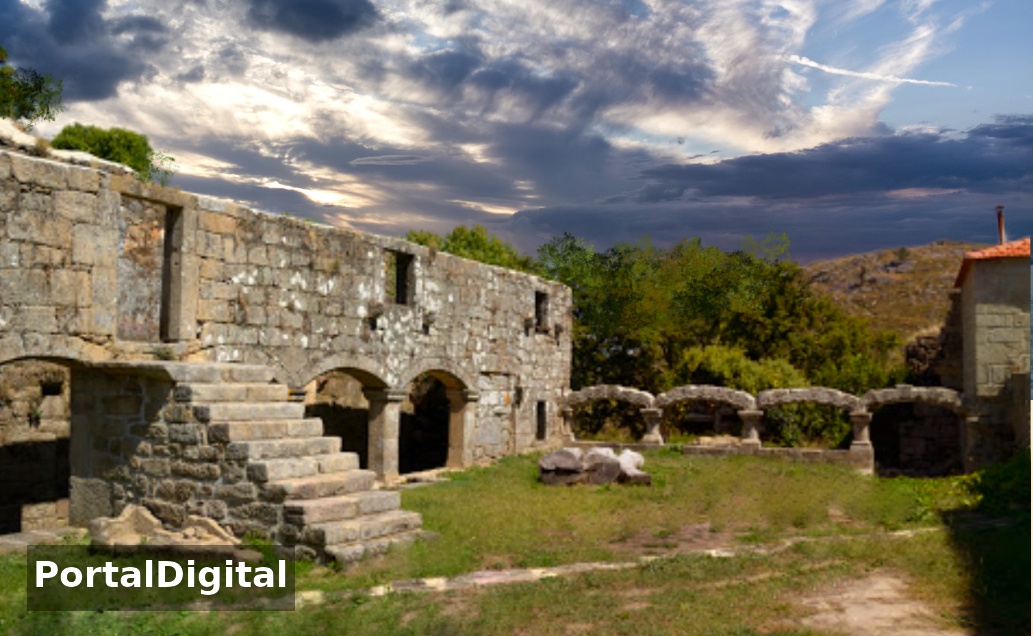
To the north and east of the church and around a courtyard there are the ruins of the two-story Benedictine monastery and an aqueduct and small outbuildings.
On the first level there are arcades carved in granite and some interiors with vaults and part of the small cloister has 18th century characteristics. XVI and the second level already has 18th century characteristics.
Saint Francisco de Borja (1510-1572) of the Society of Jesus lived in the Monastery for some time.
The church of São Fins de Friestas is one of the most important Romanesque monuments and one of those that most clearly demonstrates the long-lasting Galician influence that continued on the left side of the River Miño from the turn of the 13th century.
The existence of a narthex attached to the main façade of at least two floors and of a funerary nature led Manuel Luís Real to hypothesize that the monastery may have belonged to the Canons Regular of Saint Augustine, an institution that sponsored a specific model of architecture and religious space in the 12th century.
In this space there was an inscription containing the year 1221, a date that has been interpreted as an element alluding to the end of the construction campaign.
The beginning of the shipyard's operations has been difficult to establish, although the most consensual opinions point to the end of the 12th century.
The Sanfins Monastery was the head of the old Couto Monastic de Sanfins, which lasted until 1834.
Its importance merited several royal letters of privileges and the old monastery and the farm's fence provide a journey through time in a unique natural space and the first buildings date back to 604 AD.
The Sanfins Monastery presents characteristics of the so-called Romanesque style of Alto Minho and Galician influence and stands out in the landscape where it is surrounded by an oak forest at 200 meters of altitude with wide views over the Minho river valley.
The Romanesque Church dates back to 604 AD with subsequent changes.
To the north and east of the church and around a courtyard there are the ruins of the two-story Benedictine monastery and an aqueduct and small outbuildings.
On the first level there are arcades carved in granite and some interiors with vaults and part of the small cloister has 18th century characteristics. XVI and the second level already has 18th century characteristics.
Saint Francisco de Borja (1510-1572) of the Society of Jesus lived in the Monastery for some time.
The church of São Fins de Friestas is one of the most important Romanesque monuments and one of those that most clearly demonstrates the long-lasting Galician influence that continued on the left side of the River Miño from the turn of the 13th century.
The existence of a narthex attached to the main façade of at least two floors and of a funerary nature led Manuel Luís Real to hypothesize that the monastery may have belonged to the Canons Regular of Saint Augustine, an institution that sponsored a specific model of architecture and religious space in the 12th century.
In this space there was an inscription containing the year 1221, a date that has been interpreted as an element alluding to the end of the construction campaign.
The beginning of the shipyard's operations has been difficult to establish, although the most consensual opinions point to the end of the 12th century.
Characteristics of the Sanfins Monastery
The Sanfins church remains faithful to the Romanesque style of Alto Minho and the Galician influence.
The church of Sanfins has a disproportionately tall single nave that highlights the scenographic monumentality of the complex to the detriment of its real spatiality.
The main chapel is made up of two sections, the first being straight and the second semicircular in an arrangement that Ferreira de Almeida considered to be an evolution of the Ganfei chevet.
The main chapel contains the exuberant sculptural decoration, which constitutes another proof of the late completion of this work, as it shows a superior taste for the human image and figurative themes, unlike the neighboring temple of Ganfei (whose works ended at the moment when those of Friestas began) where the vegetal nature of the decoration is preponderant.
Next to the Romanesque church, a monastery complex developed which was substantially renovated in the modern era.
The conventual dependencies are largely preserved, including its fence, part of a 16th century cloister and important sections of the aqueduct that supplied the "cenobium".
In the 20th century, restorers from the General Directorate of National Buildings and Monuments worked only on the church and demolished the narthex and other attached spaces, expanding the entire western surroundings in order to guarantee greater monumentality to the church.
The monastic complex has remained unchanged and is still awaiting careful study and an improvement project.
The church of Sanfins has a disproportionately tall single nave that highlights the scenographic monumentality of the complex to the detriment of its real spatiality.
The main chapel is made up of two sections, the first being straight and the second semicircular in an arrangement that Ferreira de Almeida considered to be an evolution of the Ganfei chevet.
The main chapel contains the exuberant sculptural decoration, which constitutes another proof of the late completion of this work, as it shows a superior taste for the human image and figurative themes, unlike the neighboring temple of Ganfei (whose works ended at the moment when those of Friestas began) where the vegetal nature of the decoration is preponderant.
Next to the Romanesque church, a monastery complex developed which was substantially renovated in the modern era.
The conventual dependencies are largely preserved, including its fence, part of a 16th century cloister and important sections of the aqueduct that supplied the "cenobium".
In the 20th century, restorers from the General Directorate of National Buildings and Monuments worked only on the church and demolished the narthex and other attached spaces, expanding the entire western surroundings in order to guarantee greater monumentality to the church.
The monastic complex has remained unchanged and is still awaiting careful study and an improvement project.
Classification of the Sanfins Monastery
The Sanfins Monastery in Valença has been classified as a national monument since 1910.