
It is located on Avenida Frei Heitor Pinto, city of Covilhã, district of Castelo Branco, in the province of Beira Baixa, Centro region and sub-region of Beiras and Serra da Estrela
In 1908, the land of the extinct convent of São Francisco was used to build a public garden and a bandstand and the author was João de Ascensão Loriga.
The Garden at the beginning of the 20th century had several functions: a place for complementary festivities for the Feira de São Tiago (July 16th to August 1st 1999) and with the harmonious bandstand as its stage.
At the bandstand it was customary on Sundays and Thursdays during the summer season to hear the Band of “21” (Infantry Regiment 21), under the baton of Costa Spear and the stage for charity shows, with prominent light music artists playing there.
On February 15, 1951, Covilhã suffered a strong storm accompanied by a large cyclone that destroyed many trees.
From 1951 onwards the garden underwent major changes, the bandstand was demolished and there was a new urbanization and the people of Covilha began to enjoy a modern garden but considered by many to be less attractive than the previous one.
At the end of the 20th century, the garden underwent renovation work again, becoming an amusement park and was opened on July 29, 2001.
For decades, the space was the stage for charity shows, the site of festivals such as Feira de São Tiago and its bandstand was entertained by the Regimento 21 band.
The current Public Garden was remodeled in 2001 according to a project by architect Luís Cabral in order to provide more and larger green areas, wooden walkways, a bridge over the lake, and a renovated children's space are some of the many attractions that make up this Garden.
One of its attractions is the rectangular-shaped artificial lake, the statue in honor of mothers and the monument to the Unknown Soldier in memory of the people of Covilha who died during the First World War.
The area has lots of grass and dense vegetation and small light sources were installed at the base of each tree, highlighting the immense greenery that makes up this space and overlooks the northern part of the Zêzere river basin.
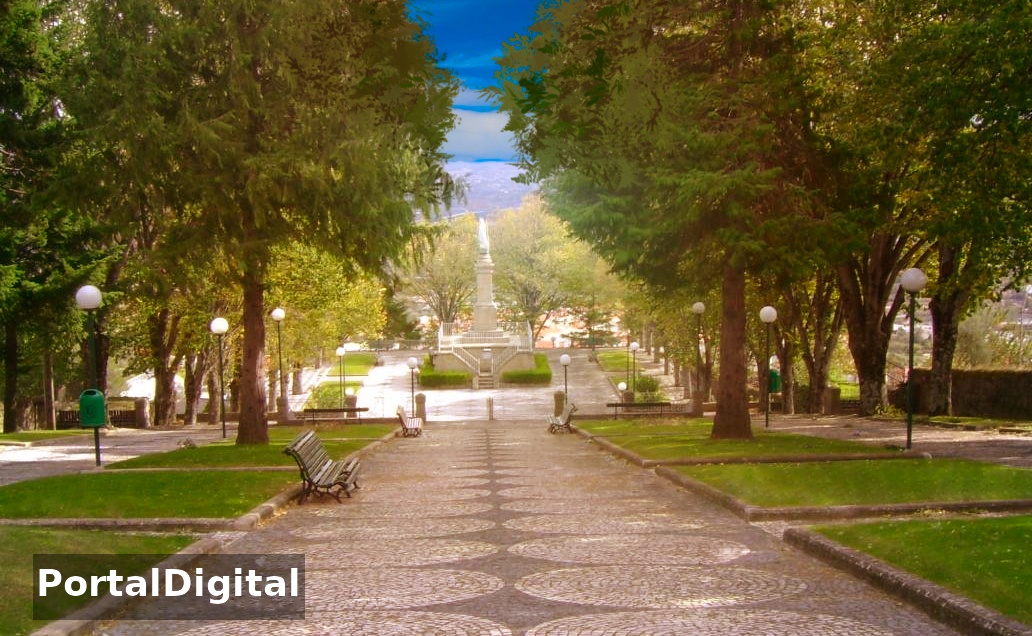
The garden has grass beds, lots of trees, benches, lamps, a Portuguese sidewalk worked in white and black stone, a large reflecting pool with water fountains and a wooden pedestrian bridge.
The space has lots of grass where local people and visitors can sit on the grass and have picnics, and next to the garden there are cafes, restaurants with large terraces, historic buildings and houses.
The Sacred Art museum housed in Casa Maria José Alçada in a 1921 building by architect Raul Lino (author of the Tivoli Theater project in Lisbon) is located next to the public garden in the center of Covilhã.
The Garden at the beginning of the 20th century had several functions: a place for complementary festivities for the Feira de São Tiago (July 16th to August 1st 1999) and with the harmonious bandstand as its stage.
At the bandstand it was customary on Sundays and Thursdays during the summer season to hear the Band of “21” (Infantry Regiment 21), under the baton of Costa Spear and the stage for charity shows, with prominent light music artists playing there.
On February 15, 1951, Covilhã suffered a strong storm accompanied by a large cyclone that destroyed many trees.
From 1951 onwards the garden underwent major changes, the bandstand was demolished and there was a new urbanization and the people of Covilha began to enjoy a modern garden but considered by many to be less attractive than the previous one.
At the end of the 20th century, the garden underwent renovation work again, becoming an amusement park and was opened on July 29, 2001.
For decades, the space was the stage for charity shows, the site of festivals such as Feira de São Tiago and its bandstand was entertained by the Regimento 21 band.
The current Public Garden was remodeled in 2001 according to a project by architect Luís Cabral in order to provide more and larger green areas, wooden walkways, a bridge over the lake, and a renovated children's space are some of the many attractions that make up this Garden.
One of its attractions is the rectangular-shaped artificial lake, the statue in honor of mothers and the monument to the Unknown Soldier in memory of the people of Covilha who died during the First World War.
The area has lots of grass and dense vegetation and small light sources were installed at the base of each tree, highlighting the immense greenery that makes up this space and overlooks the northern part of the Zêzere river basin.
The garden has grass beds, lots of trees, benches, lamps, a Portuguese sidewalk worked in white and black stone, a large reflecting pool with water fountains and a wooden pedestrian bridge.
The space has lots of grass where local people and visitors can sit on the grass and have picnics, and next to the garden there are cafes, restaurants with large terraces, historic buildings and houses.
The Sacred Art museum housed in Casa Maria José Alçada in a 1921 building by architect Raul Lino (author of the Tivoli Theater project in Lisbon) is located next to the public garden in the center of Covilhã.