
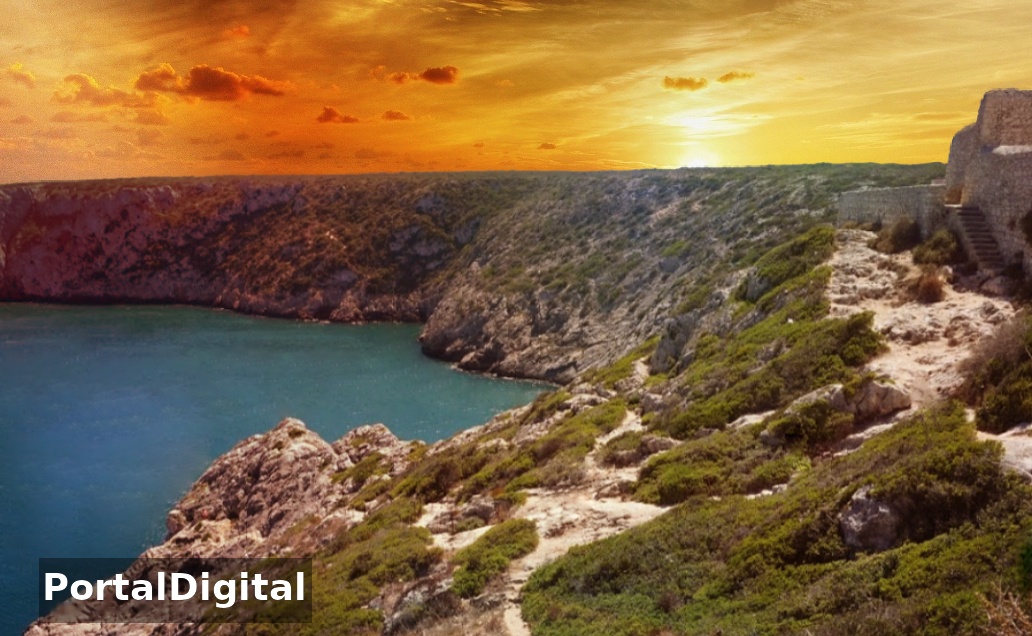
It is located in Cabo de São Vicente, on the beach of Belixe Velho, parish of Sagres, Vila do Bispo, City of Faro, Algarve, Southern Portugal
Located on the top of the cliff that dominates the bay of Beliche (or Belixe), the time of construction of this fortress is unknown, although it is certain that it already existed in the 16th century, as there is a shield of King D. Sebastião on it.
The Fort dedicated to Santo António was built during the reigns of D. Manuel or D. João III, on an undetermined date, but prior to 1587 since the attack by the English privateer Francis Drake that destroyed it is depicted on the map of this Algarve region.
The Monument's function was to control that anchorage and protect the fishermen who kept a tuna fishing trap there.
Inside there is a Chapel dedicated to Saint Catherine, and the entrance to the Fort bears a Shield with the Royal Arms and an inscription dated 1632 that refers to the reconstruction of the fort in that year.
The Fort was restored in 1960, and on the foundations of the old barracks a tea house was built, the works of which were carried out by the Directorate of National Buildings and Monuments, following work carried out in Cabo de São Vicente and in Sagres at the end of the 1950s in view of the celebrations of the 5th Centenary of the Death of Infante D. Henrique.
The current fortification dates back to a reconstruction ordered by Philip III of Portugal (1621-1640), and was reopened in 1632 according to the epigraphic inscription on the weapons gate.
The 1755 earthquake caused extensive damage to the Santo Antônio de Beliche Fort, and it was progressively abandoned.
The Fort was restored at the end of the 1950s by the then General Directorate of National Buildings and Monuments, in the context of work carried out in Cabo de São Vicente and in Sagres in view of the celebrations of the 5th Centenary of the Death of Infante D. Henrique (1960).
The Fort has been closed since the 1990s due to the threat of the slope on which it stands collapsing, and in 2013 the Vila do Bispo City Council plans its recovery and reopening.
In the Fortress, highlights include the remaining walls, batteries and casemates, the Chapel of Santa Catarina whose origins date back to a donation from Infante D. Henrique (1394-1460) shortly before his death, and whose baroque altarpiece was transferred in 1997 to the Church of Nossa Senhora da Graça, in the neighboring Fortaleza de Sagres.
The fortress follows a structure common to military architecture of the time, having a starry polygonal plan, strategically with the batteries facing the sea.
The main door, with a round arch, is located to the west in a recess formed by a buttress of a tower.
Inside there is a second curtain that protects a long staircase that gives access to the beach and where supplies and other materials entered in the event of a land siege.
Entry to the fortress itself is through a round arch in this inner fortified line and is dominated by a quadrangular tower with access via a walkway.
The support facilities for the military garrison (wardrobe, storage rooms and covered common compartments) next to the wall allow for a relatively large space for military maneuvers.
On the wall is the chapel of Santa Catarina (currently dedicated to Santo António), a small temple with a centralized plan composed of a quadrangular nave covered by a dome and a small chancel.
In the 20th century, he gave it other functions, namely tourism, and it was with this objective that the complex was transformed into a guesthouse, building around 1960 the various facilities to support hotel activity, such as the restaurant.
At that time, important sections of the interior were also revealed and some sections of the military curtain were reconstructed.
Despite being harmoniously integrated into the surrounding landscape, it did not prevent the constant erosion of the cliff on which the fortress stands.
From the 90s of the 20th century onwards, there has been increased care with this issue, with the risk of the entire structure collapsing.
Some studies were commissioned from the Higher School of Technology of the University of Algarve, and the Chapel was the subject of particular attention due to its location subject to erosion and sea storms.
The Fort dedicated to Santo António was built during the reigns of D. Manuel or D. João III, on an undetermined date, but prior to 1587 since the attack by the English privateer Francis Drake that destroyed it is depicted on the map of this Algarve region.
The Monument's function was to control that anchorage and protect the fishermen who kept a tuna fishing trap there.
Inside there is a Chapel dedicated to Saint Catherine, and the entrance to the Fort bears a Shield with the Royal Arms and an inscription dated 1632 that refers to the reconstruction of the fort in that year.
The Fort was restored in 1960, and on the foundations of the old barracks a tea house was built, the works of which were carried out by the Directorate of National Buildings and Monuments, following work carried out in Cabo de São Vicente and in Sagres at the end of the 1950s in view of the celebrations of the 5th Centenary of the Death of Infante D. Henrique.
The current fortification dates back to a reconstruction ordered by Philip III of Portugal (1621-1640), and was reopened in 1632 according to the epigraphic inscription on the weapons gate.
The 1755 earthquake caused extensive damage to the Santo Antônio de Beliche Fort, and it was progressively abandoned.
The Fort was restored at the end of the 1950s by the then General Directorate of National Buildings and Monuments, in the context of work carried out in Cabo de São Vicente and in Sagres in view of the celebrations of the 5th Centenary of the Death of Infante D. Henrique (1960).
The Fort has been closed since the 1990s due to the threat of the slope on which it stands collapsing, and in 2013 the Vila do Bispo City Council plans its recovery and reopening.
In the Fortress, highlights include the remaining walls, batteries and casemates, the Chapel of Santa Catarina whose origins date back to a donation from Infante D. Henrique (1394-1460) shortly before his death, and whose baroque altarpiece was transferred in 1997 to the Church of Nossa Senhora da Graça, in the neighboring Fortaleza de Sagres.
The fortress follows a structure common to military architecture of the time, having a starry polygonal plan, strategically with the batteries facing the sea.
The main door, with a round arch, is located to the west in a recess formed by a buttress of a tower.
Inside there is a second curtain that protects a long staircase that gives access to the beach and where supplies and other materials entered in the event of a land siege.
Entry to the fortress itself is through a round arch in this inner fortified line and is dominated by a quadrangular tower with access via a walkway.
The support facilities for the military garrison (wardrobe, storage rooms and covered common compartments) next to the wall allow for a relatively large space for military maneuvers.
On the wall is the chapel of Santa Catarina (currently dedicated to Santo António), a small temple with a centralized plan composed of a quadrangular nave covered by a dome and a small chancel.
In the 20th century, he gave it other functions, namely tourism, and it was with this objective that the complex was transformed into a guesthouse, building around 1960 the various facilities to support hotel activity, such as the restaurant.
At that time, important sections of the interior were also revealed and some sections of the military curtain were reconstructed.
Despite being harmoniously integrated into the surrounding landscape, it did not prevent the constant erosion of the cliff on which the fortress stands.
From the 90s of the 20th century onwards, there has been increased care with this issue, with the risk of the entire structure collapsing.
Some studies were commissioned from the Higher School of Technology of the University of Algarve, and the Chapel was the subject of particular attention due to its location subject to erosion and sea storms.
The Classification of Fortaleza do Beliche or Forte de Santo António de Beliche
Fortaleza do Beliche is classified as a Property of Public Interest.