
It is located in the parish of Benfeita, Vila de Arganil, district of Coimbra, in the province of Beira Litoral, Centro region (Beiras Region) and sub-region Coimbra Region
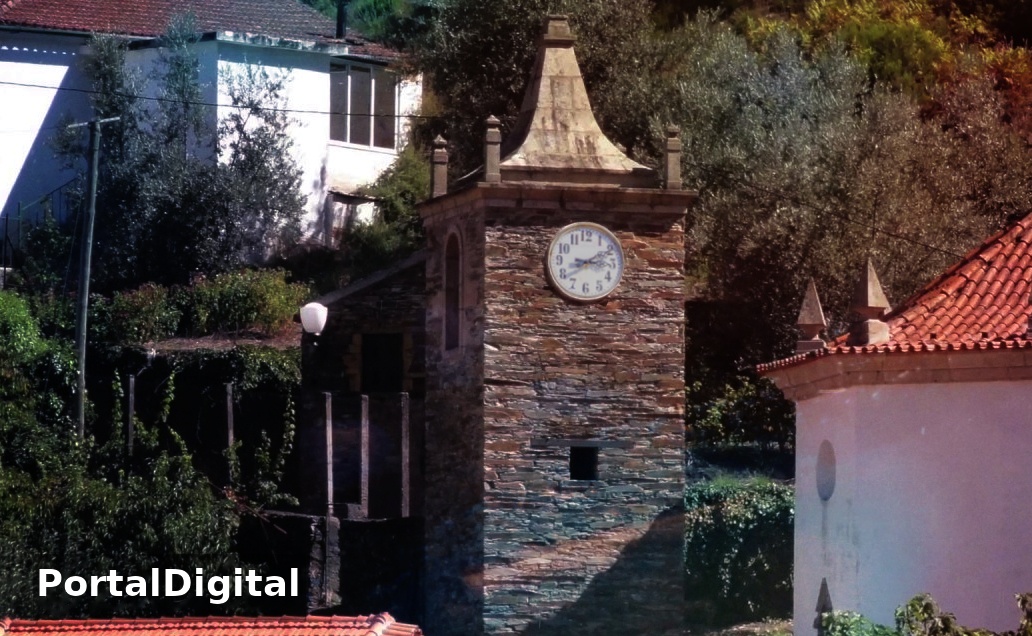
One of the "white villages" of the Schist Villages Network and has a peace tower, a bell and a clock.
The Tower, first named Torre Salazar, was renamed the Tower of Peace in 1945 to celebrate the end of World War II.
The Peace Tower rings 1620 chimes every year on the 7th of May and is characterized by being a square building three meters high and 11 meters on a side, at the top two windows serve to house its two bells and the dome is made of granite.
The so-called “Peace Bell” has the following inscription: “Dr. Mario Mathias had it made in 1945”.
The Bell was manufactured in Almada by the firm Manoel F. Couzinha and weighs 6 kg and was placed in the Torre da Paz in April 1945.
The watch is an extraordinary machine and several parts of the mechanism display phrases that praise Peace. One is engraved “We bless Peace” and another “Peace be with us”.
The Village has a Mother Church (18th century), the Chapel of Nossa Senhora da Assunção, the Chapel of Santa Rita (18th century with an octagonal rectangular plan), and the Chapel of Senhor dos Passos (1954 received extensive restoration, a small chapel with a rectangular plan with a portal facing south).
At the top of a nearby hill is the Chapel of S. Bartolomeu, Senhora da Guia and Senhora das Necessidades.
At Casa Simões Dias, a stone affixed to the façade states: “The great professor and distinguished poet Dr. Jose Simoes Dias was born in this house on February 5, 1884” and had a great reputation in political and literary circles.
José Simões Dias (Benfeita, February 5, 1844-Lisbon, March 3, 1899) was a Portuguese short story writer, poet, literary critic, politician and pedagogue.
His poetry is generally associated with the late romantic tradition sometimes called ultra romanticism, but some of his popular poems may reveal an affinity for the realistic aesthetic that was beginning to flourish in Portuguese letters.
The Aldeias do Xisto Store on the lower floor intends to house the documentary center about Simões Dias.
Moinho do Figueiral is located on Av. Dr. Mário Mathias next to the left bank of Ribeira da Mata, powered by recently recovered hydraulic power and whose interior can be visited.
The importance of olive tree cultivation led to the village having two infrastructures for olive oil production: the Lagar de Cima and the Lagar de Baixo and the abandonment does not allow visits to the interior.
The Tower, first named Torre Salazar, was renamed the Tower of Peace in 1945 to celebrate the end of World War II.
The Peace Tower rings 1620 chimes every year on the 7th of May and is characterized by being a square building three meters high and 11 meters on a side, at the top two windows serve to house its two bells and the dome is made of granite.
The so-called “Peace Bell” has the following inscription: “Dr. Mario Mathias had it made in 1945”.
The Bell was manufactured in Almada by the firm Manoel F. Couzinha and weighs 6 kg and was placed in the Torre da Paz in April 1945.
The watch is an extraordinary machine and several parts of the mechanism display phrases that praise Peace. One is engraved “We bless Peace” and another “Peace be with us”.
The Village has a Mother Church (18th century), the Chapel of Nossa Senhora da Assunção, the Chapel of Santa Rita (18th century with an octagonal rectangular plan), and the Chapel of Senhor dos Passos (1954 received extensive restoration, a small chapel with a rectangular plan with a portal facing south).
At the top of a nearby hill is the Chapel of S. Bartolomeu, Senhora da Guia and Senhora das Necessidades.
At Casa Simões Dias, a stone affixed to the façade states: “The great professor and distinguished poet Dr. Jose Simoes Dias was born in this house on February 5, 1884” and had a great reputation in political and literary circles.
José Simões Dias (Benfeita, February 5, 1844-Lisbon, March 3, 1899) was a Portuguese short story writer, poet, literary critic, politician and pedagogue.
His poetry is generally associated with the late romantic tradition sometimes called ultra romanticism, but some of his popular poems may reveal an affinity for the realistic aesthetic that was beginning to flourish in Portuguese letters.
The Aldeias do Xisto Store on the lower floor intends to house the documentary center about Simões Dias.
Moinho do Figueiral is located on Av. Dr. Mário Mathias next to the left bank of Ribeira da Mata, powered by recently recovered hydraulic power and whose interior can be visited.
The importance of olive tree cultivation led to the village having two infrastructures for olive oil production: the Lagar de Cima and the Lagar de Baixo and the abandonment does not allow visits to the interior.