
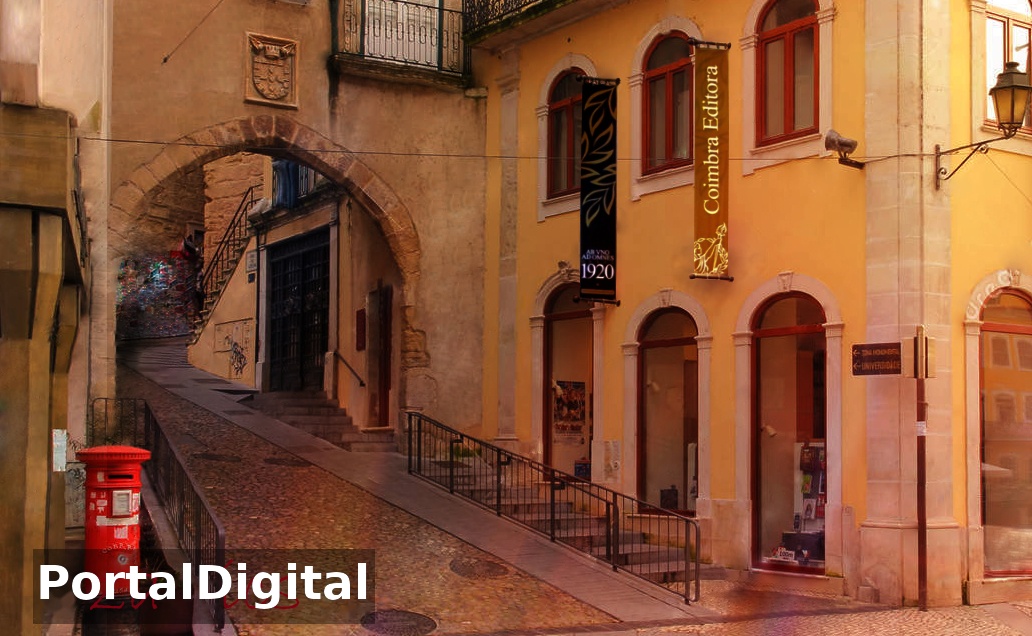
It is located on Rua do Arco Almedina, parish of Almedina, city and municipality of Coimbra, central Portugal
The Almedina Gate and Tower was the Almedina Gate, the main entrance to the intramural city and is accessed from the Barbacã Gate, on Rua Ferreira Borges, one of the main arteries in downtown Coimbra, and both form part of the Walled City Center.
The Monument is based on the lowest part of the medieval fence, its construction may date back to the time of Count Sesnando Davides who conquered Coimbra in 1064, having been renovated and remodeled several times over the centuries.
The gate was initially defended by two advanced cubes, and later they were connected by means of a deep arch over which the strong turret was raised.
Its current appearance may be the result of a renovation at the beginning of the 16th century by order of Manuel I of Portugal.
The Monument is decorated internally with a frieze with bas-reliefs of the Virgin and Child flanked by two coats of arms.
This was possibly one of the most imposing towers on the perimeter of the wall due to its strategic importance as it constituted the most important civil and military access to the city.
The Almedina Arch was part of the medieval walls, and is today the entrance to ancient Coimbra where you can see a sculpture from João de Ruão's workshop.
The Arco de Almedina, also known as Arco da Barbacã, is surmounted by a tower that had various functions over the centuries, and in the 14th and 15th centuries it was the seat of municipal power, the Chamber House, and later the Audience House where the council met.
At the top, the running bell announced the council sessions and the opening and closing hours of the doors for the population, a function that it maintained until 1870.
There was a small chapel dedicated to Nossa Senhora da Conceição on site where mass was held before the meetings.
In 1835, with the definition of a new space for the Town Hall, the tower began to have new occupations, including the Workers' Instruction Society (1851), the Conimbricense Philharmonic and the Free School of Arts and Design (1878).
In 1954, the space was adapted to the Ethnographic Museum, giving it its current appearance, and began to serve the Municipal Historical Archive, a function it still maintains (1988).
The Monument is based on the lowest part of the medieval fence, its construction may date back to the time of Count Sesnando Davides who conquered Coimbra in 1064, having been renovated and remodeled several times over the centuries.
The gate was initially defended by two advanced cubes, and later they were connected by means of a deep arch over which the strong turret was raised.
Its current appearance may be the result of a renovation at the beginning of the 16th century by order of Manuel I of Portugal.
The Monument is decorated internally with a frieze with bas-reliefs of the Virgin and Child flanked by two coats of arms.
This was possibly one of the most imposing towers on the perimeter of the wall due to its strategic importance as it constituted the most important civil and military access to the city.
The Almedina Arch was part of the medieval walls, and is today the entrance to ancient Coimbra where you can see a sculpture from João de Ruão's workshop.
The Arco de Almedina, also known as Arco da Barbacã, is surmounted by a tower that had various functions over the centuries, and in the 14th and 15th centuries it was the seat of municipal power, the Chamber House, and later the Audience House where the council met.
At the top, the running bell announced the council sessions and the opening and closing hours of the doors for the population, a function that it maintained until 1870.
There was a small chapel dedicated to Nossa Senhora da Conceição on site where mass was held before the meetings.
In 1835, with the definition of a new space for the Town Hall, the tower began to have new occupations, including the Workers' Instruction Society (1851), the Conimbricense Philharmonic and the Free School of Arts and Design (1878).
In 1954, the space was adapted to the Ethnographic Museum, giving it its current appearance, and began to serve the Municipal Historical Archive, a function it still maintains (1988).
The Barbican Gate
In this most vulnerable section of the fence between the Porta de Almedina and the Porta de Belcouce, it was necessary to reinforce the defense by erecting a second walled belt: “the Porta da Barbacã” made up of a broken arch typical of the fortifications of the Manueline period, and has also reached our days being confused with the Almedina gate itself, which in reality precedes it.
Currently, Porta da Barbacã serves as the boundary between the parishes of Almedina and São Bartolomeu in the city of Coimbra.
Currently, Porta da Barbacã serves as the boundary between the parishes of Almedina and São Bartolomeu in the city of Coimbra.