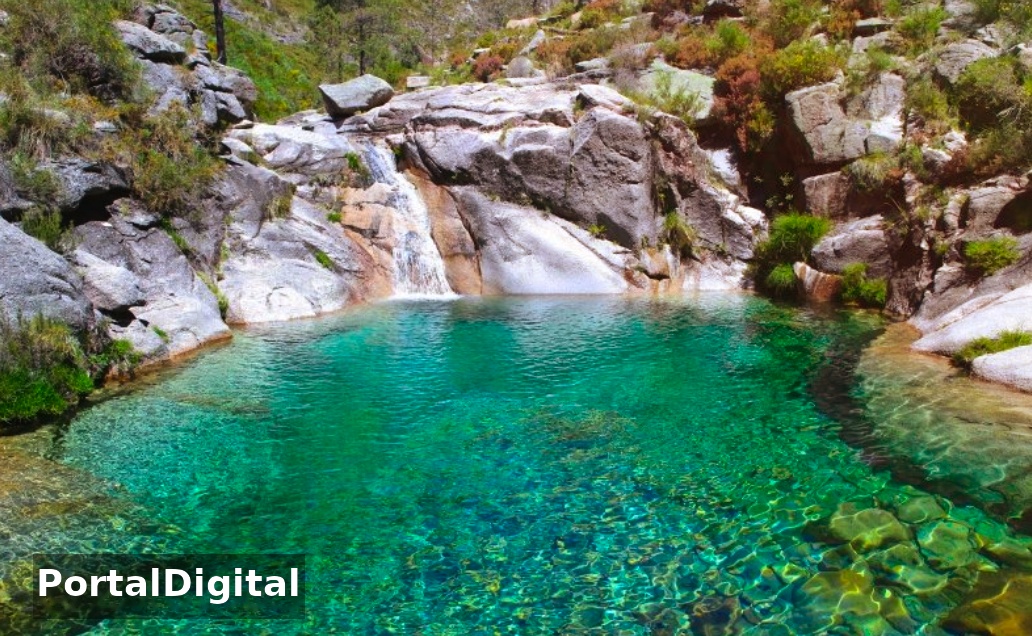


They are located in the parish of São Bento, Municipality of Porto de Mós, District of Leiria, Central Portugal
Jurássica beach is in the parish of São Bento, Municipality of Porto de Mós, passing through Covões Largos and Chainça towards Chão das Pias, turn left towards Covões Largos and once the asphalt is complete, follow the tout-venant path for 500m and turn left between the stone walls and follow the right for another 600m to the site.
On Praia Jurássica de São Bento, a unique deposit has been known for more than a decade in Porto de Mós, which is a gateway to a seabed that is around 169 million years old.
The collection now in the custody of the Geological Museum of the National Engineering and Geology Laboratory probably contains a new species of echinoid.
The labyrinthine walls characteristic of the Aire and Candeeiros mountains lead to a small quarry measuring just over two thousand square meters.
Dozens of fossils of urchins, stars and sea lilies are visible on the ground, strange to the sea of stone and mountains that mark the current landscape of the mountain.
There were also waves in this place, known from the marks of sea currents preserved in the rock, indisputable indicators of the environment 168 to 170 million years ago.
In the Middle Jurassic it would have been submerged by a shallow inlet of sea with reasonable luminosity and subject to constant swells, leaving ripple marks imprinted on the carbonate bottom.
The discovery took place in 2003 in one of the hundreds of quarries found in the Serras de Aire and Candeeiros.
Limestone exploration brought to light one of the most important paleontological finds ever found in Portugal.
The fossils found constitute an authentic Jurassic beach with echinoderms, sea urchins, creatures with bizarre shapes trapped in the rock.
In 2013, the find was made known to the general public to avoid degradation, particularly that caused by atmospheric agents, the original fossils were removed and replaced by replicas.
However, the echinoderm deposit has not lost any of its charm and is a fascinating place for natural history lovers.
In 2003, during a routine visit by technicians from the Serras de Aire and Candeeiros Natural Park to the quarry, the first fossils were discovered.
In 2005-2006, technicians from the Geological Museum of the National Energy and Geology Laboratory (LNEG) of the Open University visited the site and immediately understood its importance, identifying the paleontological value of the site.
Andrew Smith, researcher at the Department of Paleontology at the Natural History Museum in London, confirmed the global rarity of the deposit, whose characteristics and age are only paralleled in another location in Switzerland.
The discovery of a Jurassic beach in the heart of the Serras de Aire e Candeeiros Natural Park was surprising as a unique place in the world. The find was publicly announced at the end of 2013 after the quarry was deactivated and the debris was removed.
The importance of the fossils from the Cabeço da Ladeira deposit is due to the state of conservation and abundance of molds and fossilized remains of animals in the Portuguese geological context.
The occurrence of fossilized remains, which is rare, is that many of these remains are found in semi-articulation, preserving the original anatomical connection.
A deposit of this type is another piece to improve knowledge, a partial photograph of a habitat from that time.
Identification work is still ongoing, but more than ninety specimens have already been detected and new fossils are discovered with each visit.
The last specimens were detected in July 2014 and ten morphospecies of sea urchins (echinoids), five of sea stars (asteroids), two of sea lilies (crinoids) and one of sea snakes (ophiuroids) have been identified, widely represented in today's oceans.
Studies conducted on contemporary animals suggest that echinoderms disintegrate quickly after their death and for this type of preservation to occur, the burial of these animals must have been rapid.
The deposit also presents favorable conditions for the occurrence of type specimens, that is, specimens that allow the identification of new species or a better understanding of species already described for the Middle Jurassic.
The mapping and inventory of fossils from the deposit were developed by Bruno Pereira, Susana Machado, LNEG technician, Lia Mergulhão, ICNF technician, and José António, technician at the Geological Museum.
In the most unstable fossils, stabilization or consolidation actions were developed and several molds were produced for study in the laboratory.
At the Geological Museum each fossil is carefully analyzed, prepared and cleaned and delicate structures are discovered.
The joints of fossilized organisms are revealed under the light of a magnifying glass, under the watchful eye of someone who has seen a lot but has not yet seen everything and far from being finished, it is a work that will take several years.
On Praia Jurássica de São Bento, a unique deposit has been known for more than a decade in Porto de Mós, which is a gateway to a seabed that is around 169 million years old.
The collection now in the custody of the Geological Museum of the National Engineering and Geology Laboratory probably contains a new species of echinoid.
The labyrinthine walls characteristic of the Aire and Candeeiros mountains lead to a small quarry measuring just over two thousand square meters.
Dozens of fossils of urchins, stars and sea lilies are visible on the ground, strange to the sea of stone and mountains that mark the current landscape of the mountain.
There were also waves in this place, known from the marks of sea currents preserved in the rock, indisputable indicators of the environment 168 to 170 million years ago.
In the Middle Jurassic it would have been submerged by a shallow inlet of sea with reasonable luminosity and subject to constant swells, leaving ripple marks imprinted on the carbonate bottom.
The discovery took place in 2003 in one of the hundreds of quarries found in the Serras de Aire and Candeeiros.
Limestone exploration brought to light one of the most important paleontological finds ever found in Portugal.
The fossils found constitute an authentic Jurassic beach with echinoderms, sea urchins, creatures with bizarre shapes trapped in the rock.
In 2013, the find was made known to the general public to avoid degradation, particularly that caused by atmospheric agents, the original fossils were removed and replaced by replicas.
However, the echinoderm deposit has not lost any of its charm and is a fascinating place for natural history lovers.
In 2003, during a routine visit by technicians from the Serras de Aire and Candeeiros Natural Park to the quarry, the first fossils were discovered.
In 2005-2006, technicians from the Geological Museum of the National Energy and Geology Laboratory (LNEG) of the Open University visited the site and immediately understood its importance, identifying the paleontological value of the site.
Andrew Smith, researcher at the Department of Paleontology at the Natural History Museum in London, confirmed the global rarity of the deposit, whose characteristics and age are only paralleled in another location in Switzerland.
The discovery of a Jurassic beach in the heart of the Serras de Aire e Candeeiros Natural Park was surprising as a unique place in the world. The find was publicly announced at the end of 2013 after the quarry was deactivated and the debris was removed.
The importance of the fossils from the Cabeço da Ladeira deposit is due to the state of conservation and abundance of molds and fossilized remains of animals in the Portuguese geological context.
The occurrence of fossilized remains, which is rare, is that many of these remains are found in semi-articulation, preserving the original anatomical connection.
A deposit of this type is another piece to improve knowledge, a partial photograph of a habitat from that time.
Identification work is still ongoing, but more than ninety specimens have already been detected and new fossils are discovered with each visit.
The last specimens were detected in July 2014 and ten morphospecies of sea urchins (echinoids), five of sea stars (asteroids), two of sea lilies (crinoids) and one of sea snakes (ophiuroids) have been identified, widely represented in today's oceans.
Studies conducted on contemporary animals suggest that echinoderms disintegrate quickly after their death and for this type of preservation to occur, the burial of these animals must have been rapid.
The deposit also presents favorable conditions for the occurrence of type specimens, that is, specimens that allow the identification of new species or a better understanding of species already described for the Middle Jurassic.
The mapping and inventory of fossils from the deposit were developed by Bruno Pereira, Susana Machado, LNEG technician, Lia Mergulhão, ICNF technician, and José António, technician at the Geological Museum.
In the most unstable fossils, stabilization or consolidation actions were developed and several molds were produced for study in the laboratory.
At the Geological Museum each fossil is carefully analyzed, prepared and cleaned and delicate structures are discovered.
The joints of fossilized organisms are revealed under the light of a magnifying glass, under the watchful eye of someone who has seen a lot but has not yet seen everything and far from being finished, it is a work that will take several years.