

It is located in Lugar do Barrio, Sítio do Retiro, town and municipality of Mondim de Basto, in the region of Northern Portugal, district of Vila Real
Serra do Alvão is an elevation in mainland Portugal with an altitude of 1283 meters. It is located northwest of Vila Real with a predominance of schist and granite separated by quartzite outcrops, and the Alvão Natural Park is located there.
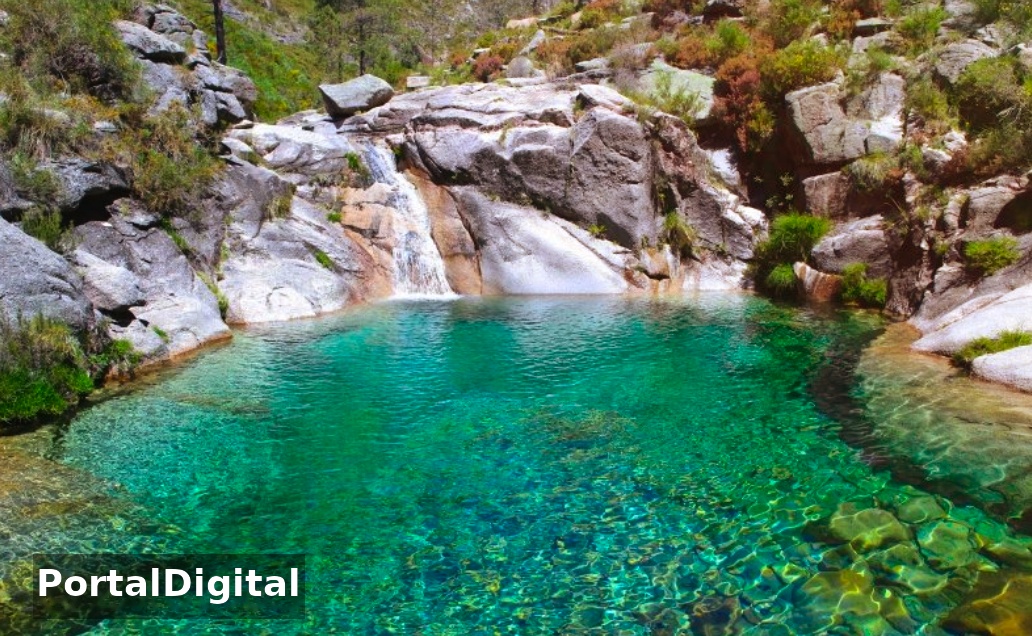
The main geological curiosities of this place are the waterfalls known as the Fisgas do Ermelo Cascade, (one of the largest in Europe) and the Agarez Cascade.
Geological accidents that give rise to spectacular waterfalls, a great diversity of natural ecosystems and a preserved social heritage make a walk through the Alvão Natural Park a pilgrimage of authenticity.
The Alvão Natural Park with 7,238.3 ha is a granite area with patches of schist and rocky outcrops, highlighting the Olo River associated with the famous Fisgas do Ermelo waterfall.
On the western slope of Serra do Alvão, which is part of the imposing mountain massif that includes Serra do Marão, this protected area is crossed by the River Olo, which runs between cliffs and cliffs and crosses the rocks at Fisgas de Ermelo, falling in cascades from a height of around 250 meters.
The course of the Olo River unites two distinct realities: at an average altitude of 1,000 m in the Lamas de Olo area, granite and high mountain vegetation predominate, below near Ermelo where the altitude is around 450 m, shale and verdant landscape prevail.
On the slopes near the watercourses, a multi-centuries-old irrigation system has been developed that distributes running water over the entire meadow, preventing the formation of ice in the marshes and lime meadows with high biodiversity.
Agricultural areas include fields of rye (altitude cereal), corn, potatoes and marshes where Maronese cattle are raised, and wastelands where goats are grazed.
Rare plants, such as the orvalhinha or rorela (Drosera rotundifolia), a carnivorous species that grows in poor waterlogged land and on the banks of watercourses, enriching the local flora.
In the typical fauna of the mountains of the interior north, the presence of the Iberian wolf, amphibians and reptiles stands out.
The blue peat butterfly (Phengaris alcon) lives in peat bogs and damp marshes where there is the wood gentian plant (Gentiana pneumonanthe) and ants of the genus Myrmica that depend on both to complete their life cycle.
Appreciate the type of settlement and rural architecture, examples of which are the villages of Lamas de Olo, Ermelo and Barreiro.
Schist, granite and thatch are the materials used in the construction of houses in the typical villages of Lamas de Olo, Anta or Ermelo where time runs so slowly that it seems like we are very far from any city, but after all, Porto is just an hour's drive away.
The Arnal Eco Museological Center recreates the atmosphere of a traditional Alvão village, giving an idea of the way of life of the people of these places where it seems like time runs so slowly.
The visitor can observe the floristic diversity and the color of the marshes, the strange "choir" of frogs during the breeding season, the sowing, the mountain cattle made up of Maronese cows and wild goats.
Enjoy the magnificent landscapes, walk along the various watercourses, taste the excellent regional cuisine that brings together delicacies such as meat ball and roast veal whose highest quality meat comes from an indigenous breed called the “maronesa”.
The main geological curiosities of this place are the waterfalls known as the Fisgas do Ermelo Cascade, (one of the largest in Europe) and the Agarez Cascade.
Geological accidents that give rise to spectacular waterfalls, a great diversity of natural ecosystems and a preserved social heritage make a walk through the Alvão Natural Park a pilgrimage of authenticity.
The Alvão Natural Park with 7,238.3 ha is a granite area with patches of schist and rocky outcrops, highlighting the Olo River associated with the famous Fisgas do Ermelo waterfall.
On the western slope of Serra do Alvão, which is part of the imposing mountain massif that includes Serra do Marão, this protected area is crossed by the River Olo, which runs between cliffs and cliffs and crosses the rocks at Fisgas de Ermelo, falling in cascades from a height of around 250 meters.
The course of the Olo River unites two distinct realities: at an average altitude of 1,000 m in the Lamas de Olo area, granite and high mountain vegetation predominate, below near Ermelo where the altitude is around 450 m, shale and verdant landscape prevail.
On the slopes near the watercourses, a multi-centuries-old irrigation system has been developed that distributes running water over the entire meadow, preventing the formation of ice in the marshes and lime meadows with high biodiversity.
Agricultural areas include fields of rye (altitude cereal), corn, potatoes and marshes where Maronese cattle are raised, and wastelands where goats are grazed.
Rare plants, such as the orvalhinha or rorela (Drosera rotundifolia), a carnivorous species that grows in poor waterlogged land and on the banks of watercourses, enriching the local flora.
In the typical fauna of the mountains of the interior north, the presence of the Iberian wolf, amphibians and reptiles stands out.
The blue peat butterfly (Phengaris alcon) lives in peat bogs and damp marshes where there is the wood gentian plant (Gentiana pneumonanthe) and ants of the genus Myrmica that depend on both to complete their life cycle.
Appreciate the type of settlement and rural architecture, examples of which are the villages of Lamas de Olo, Ermelo and Barreiro.
Schist, granite and thatch are the materials used in the construction of houses in the typical villages of Lamas de Olo, Anta or Ermelo where time runs so slowly that it seems like we are very far from any city, but after all, Porto is just an hour's drive away.
The Arnal Eco Museological Center recreates the atmosphere of a traditional Alvão village, giving an idea of the way of life of the people of these places where it seems like time runs so slowly.
The visitor can observe the floristic diversity and the color of the marshes, the strange "choir" of frogs during the breeding season, the sowing, the mountain cattle made up of Maronese cows and wild goats.
Enjoy the magnificent landscapes, walk along the various watercourses, taste the excellent regional cuisine that brings together delicacies such as meat ball and roast veal whose highest quality meat comes from an indigenous breed called the “maronesa”.