
It is located on Rua Francisco de Passos, city of Guarda, in the region of Central Portugal, sub-region of Beiras and Serra da Estrela
The church dates back to the 18th century, within Baroque typologies, commissioned by Bishop D. Jerónimo Rogado de Carvalhal e Silva, with the restoration completed in 1790.
The Church of São Vicente was rebuilt in 1790 on the initiative of Bishop D. Jerónimo Rogado de Carvalhal e Silva.
The building is a reconstruction from the end of the 18th century under the patronage of the episcopal prelate, D. Jerónimo Carvalhal e Silva (1720-1797).
The work was created and directed by the artist António Fernandes Rodrigues, about whom little is known, other than that he was a mulatto of Portuguese nationality and was sent to Italy as a state pensioner.
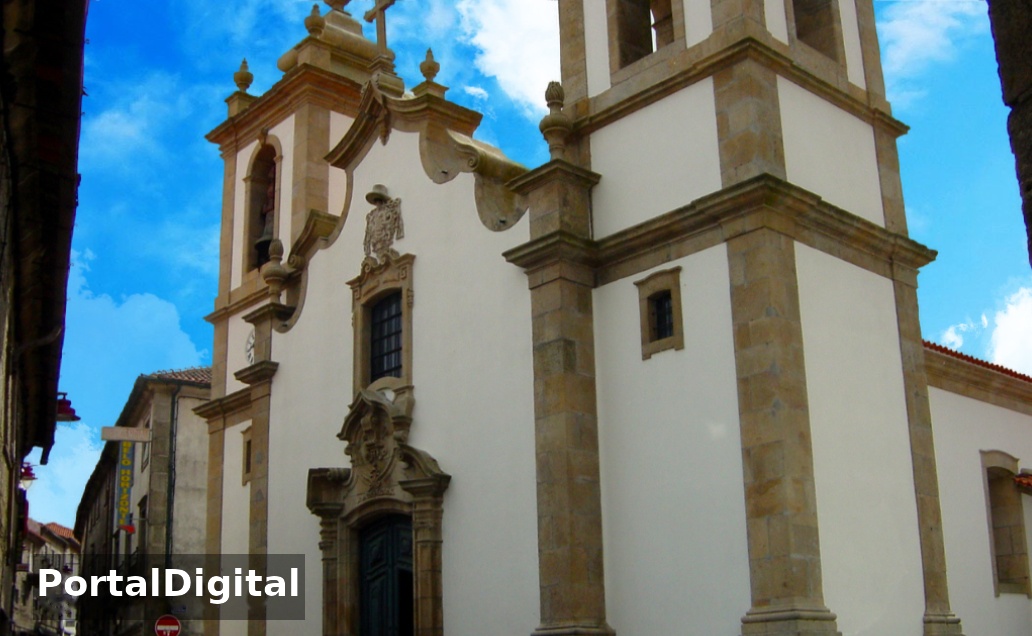
The Church of São Vicente has a baroque facade flanked by two bell towers, where the historical tile panels that are located in the church's nave and chancel stand out.
The main facade displays a pediment flanked by two bell towers with the coat of arms of Bishop D. Jerónimo.
Inside the church, the auriful tone of the carving attributed to José da Fonseca Ribeiro contrasts with the chromatic sobriety of the series of eighteenth-century figured tile panels displaying scenes from the Passion of Christ in the main chapel and scenes from the life of Our Lady in the body of the church.
The tile panels are attributed to Salvador de Sousa Carvalho (ca. 1727-1810), an artist born in Lisbon and a notable figure in Coimbra tile production in the second half of the 18th century.
The panels in their largest dimension reach 26 tiles in height and with a dense and exuberant decoration, lively voluminous “shells”, sinuous rococo with painting in shades of blue and more heavy on the border.
The framing with manganese yellow marbles appearing in the upper part composes the entire set of flowers and green copper foliage and in the lower part a typically rococo cartouche centers the composition.
In the Chancel, the panels appear in a logical sequence: Flagellation, Symbols of the Passion - on the Gospel and Epistle side, Crowning with Thorns, Pilate and Christ - Ecce Homo, Fall of Jesus on the road to Calvary and Door in Tromp l’oeil.
In the body of the church, the panels are identical to those in the chancel, reaching 26 tiles in height with the same size and in the frames that surround the decorative parts the same shell elements with an irregular contour.
The figurative part has a Marian theme and we can observe: Our Lady in the Temple, Wedding of Our Lady, Annunciation, Ivory Tower, Visitation of Our Lady to Saint Elizabeth, Birth of Jesus, Gate of Heaven, Adoration of the Magi, In the Baptistery: The baptism of Jesus, Saint Francis and Saint Jerome and Flight into Egypt.
The Church of São Vicente was rebuilt in 1790 on the initiative of Bishop D. Jerónimo Rogado de Carvalhal e Silva.
The building is a reconstruction from the end of the 18th century under the patronage of the episcopal prelate, D. Jerónimo Carvalhal e Silva (1720-1797).
The work was created and directed by the artist António Fernandes Rodrigues, about whom little is known, other than that he was a mulatto of Portuguese nationality and was sent to Italy as a state pensioner.
The Church of São Vicente has a baroque facade flanked by two bell towers, where the historical tile panels that are located in the church's nave and chancel stand out.
The main facade displays a pediment flanked by two bell towers with the coat of arms of Bishop D. Jerónimo.
Inside the church, the auriful tone of the carving attributed to José da Fonseca Ribeiro contrasts with the chromatic sobriety of the series of eighteenth-century figured tile panels displaying scenes from the Passion of Christ in the main chapel and scenes from the life of Our Lady in the body of the church.
The tile panels are attributed to Salvador de Sousa Carvalho (ca. 1727-1810), an artist born in Lisbon and a notable figure in Coimbra tile production in the second half of the 18th century.
The panels in their largest dimension reach 26 tiles in height and with a dense and exuberant decoration, lively voluminous “shells”, sinuous rococo with painting in shades of blue and more heavy on the border.
The framing with manganese yellow marbles appearing in the upper part composes the entire set of flowers and green copper foliage and in the lower part a typically rococo cartouche centers the composition.
In the Chancel, the panels appear in a logical sequence: Flagellation, Symbols of the Passion - on the Gospel and Epistle side, Crowning with Thorns, Pilate and Christ - Ecce Homo, Fall of Jesus on the road to Calvary and Door in Tromp l’oeil.
In the body of the church, the panels are identical to those in the chancel, reaching 26 tiles in height with the same size and in the frames that surround the decorative parts the same shell elements with an irregular contour.
The figurative part has a Marian theme and we can observe: Our Lady in the Temple, Wedding of Our Lady, Annunciation, Ivory Tower, Visitation of Our Lady to Saint Elizabeth, Birth of Jesus, Gate of Heaven, Adoration of the Magi, In the Baptistery: The baptism of Jesus, Saint Francis and Saint Jerome and Flight into Egypt.
Classification of the Church of São Vicente
The Church of São Vicente in the city of Guarda was classified as a Property of Public Interest on February 26, 1982.