
It is located on the north bank of the Sado river, in the municipality and district of Setúbal, Central Portugal
In the past, it was part of the defensive line of the stretch of coast known today as Costa Azul tourism, and in the 17th century it extended from Albarquel to Sesimbra, complementing the defense of the important maritime town of Setúbal.
The original fort during the reign of D. Sebastião (1568-1578) underwent extensive modernization and expansion works (1572), when a bulwarked fence was erected around the original tower, under the responsibility of the master of fortification works, Afonso Álvares.
During the succession crisis of 1580, together with the town of Setúbal, this fort remained faithful to D. António, prior of Crato under the command of Mendo Mota, its garrison of a hundred men, with 47 artillery pieces of different calibers, resisted the Spanish forces under the command of the Duke of Alba from the 22nd to the 24th of July.
At the time of the Philippine Dynasty, the officials of the Casa do Corpo Santo, an important institution in Setúbal, requested the sovereign to install, on the premises of this fort, a lighthouse to aid navigation (1625).
At the outbreak of the Restoration of independence, the fort's garrison remained loyal to D. Filipe III (1621-1640) until December 8, 1640.
As part of the complete remodeling of the kingdom's defensive strategy implemented under the reign of D. João IV (1640-56), including the defense of the Setúbal bar, new and extensive modernization and reinforcement works were initiated.
Cosmander worked on them in 1642, with the foundation stone being laid on July 30, 1643, according to the epigraphic plaque on the door of the Casa da Guarda, on the stretch of wall on the sea side: “The tower of this fortress of Santiago do Outão was built by King Dom João the First and then surrounded by a wall by King D. Sebastião and the serene D. João IV, liberator of the country, ordered the fortress to be added to the sea and land with magnificence and grandeur that can be seen today...fortification João de Saldanha ordered this memory to be placed here in the year of MDCILIX”.
The sovereign warned Manuel da Silva Mascarenhas to complete the works as quickly as possible during this period, the owners of the salt navies and the navigators of the Casa do Corpo Santo, with the works on this fort having been completed in 1657.
The progressive loss of its defensive functions in the face of the evolution of the means of war, it was dismantled in the 19th century, with its facilities being used as a prison.
In 1890, it underwent adaptation works for the summer residence of D. Carlos (1889-1908) and his wife D. Maria Amélia de Orleans, works carried out by the engineer Xavier da Silva.
Due to the natural virtues of that side of the Arrábida mountain range, on the initiative of the worthy queen, it was adapted into a sanatorium, when hospital facilities were built in place of the old casemates (1900).
Operations began at the Outão Maritime Sanatorium aimed at treating bone and lymph node tuberculosis, provisionally receiving children and women.
From 1909 onwards, the Sanatorium was converted into an Orthopedic Hospital, a function it retains to this day (Hospital Ortopédico Sant’Iago Outão).
In the 1950s, interventions were carried out to consolidate, restore and improve the Sanatorium's facilities by the General Directorate of National Buildings and Monuments, which was repeated in 1986 and 1991.
In the period 1996-1997, the same body served the premises of the old Chapel, which dates back to the second half of the 17th century, restoring its tile covering. The facilities of the old fort also house the Outão Lighthouse.
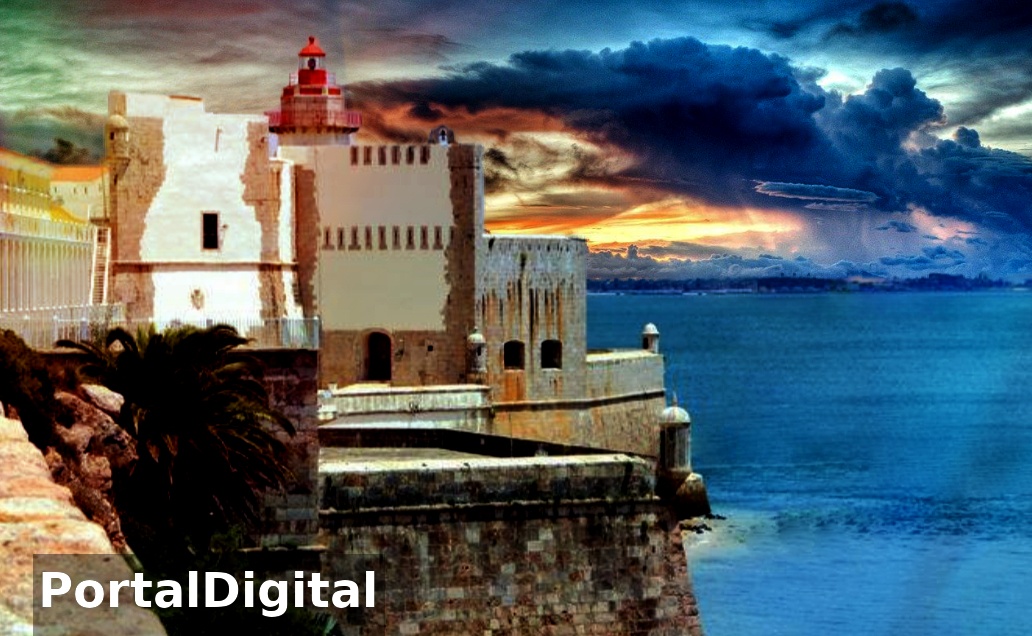
Currently, the maritime fortification combines elements of late-medieval military architecture (bulwark), Gothic and Mannerist, following the evolution of artillery, featuring an irregular polygonal plan (organic) featuring the three-story medieval tower with bay windows and balconies with boulders on the corners.
In the tower and on the embankment accessed by the gate on the north side stand the old service quarters of the fort, with two and three floors, the chapel invoking Santiago, three bastions with platforms for artillery, on the land side you can see a tent with two elevated bastions and an embankment wall, in the protruding angles of the bastions there are circular covered guardhouses.
The original fort during the reign of D. Sebastião (1568-1578) underwent extensive modernization and expansion works (1572), when a bulwarked fence was erected around the original tower, under the responsibility of the master of fortification works, Afonso Álvares.
During the succession crisis of 1580, together with the town of Setúbal, this fort remained faithful to D. António, prior of Crato under the command of Mendo Mota, its garrison of a hundred men, with 47 artillery pieces of different calibers, resisted the Spanish forces under the command of the Duke of Alba from the 22nd to the 24th of July.
At the time of the Philippine Dynasty, the officials of the Casa do Corpo Santo, an important institution in Setúbal, requested the sovereign to install, on the premises of this fort, a lighthouse to aid navigation (1625).
At the outbreak of the Restoration of independence, the fort's garrison remained loyal to D. Filipe III (1621-1640) until December 8, 1640.
As part of the complete remodeling of the kingdom's defensive strategy implemented under the reign of D. João IV (1640-56), including the defense of the Setúbal bar, new and extensive modernization and reinforcement works were initiated.
Cosmander worked on them in 1642, with the foundation stone being laid on July 30, 1643, according to the epigraphic plaque on the door of the Casa da Guarda, on the stretch of wall on the sea side: “The tower of this fortress of Santiago do Outão was built by King Dom João the First and then surrounded by a wall by King D. Sebastião and the serene D. João IV, liberator of the country, ordered the fortress to be added to the sea and land with magnificence and grandeur that can be seen today...fortification João de Saldanha ordered this memory to be placed here in the year of MDCILIX”.
The sovereign warned Manuel da Silva Mascarenhas to complete the works as quickly as possible during this period, the owners of the salt navies and the navigators of the Casa do Corpo Santo, with the works on this fort having been completed in 1657.
The progressive loss of its defensive functions in the face of the evolution of the means of war, it was dismantled in the 19th century, with its facilities being used as a prison.
In 1890, it underwent adaptation works for the summer residence of D. Carlos (1889-1908) and his wife D. Maria Amélia de Orleans, works carried out by the engineer Xavier da Silva.
Due to the natural virtues of that side of the Arrábida mountain range, on the initiative of the worthy queen, it was adapted into a sanatorium, when hospital facilities were built in place of the old casemates (1900).
Operations began at the Outão Maritime Sanatorium aimed at treating bone and lymph node tuberculosis, provisionally receiving children and women.
From 1909 onwards, the Sanatorium was converted into an Orthopedic Hospital, a function it retains to this day (Hospital Ortopédico Sant’Iago Outão).
In the 1950s, interventions were carried out to consolidate, restore and improve the Sanatorium's facilities by the General Directorate of National Buildings and Monuments, which was repeated in 1986 and 1991.
In the period 1996-1997, the same body served the premises of the old Chapel, which dates back to the second half of the 17th century, restoring its tile covering. The facilities of the old fort also house the Outão Lighthouse.
Currently, the maritime fortification combines elements of late-medieval military architecture (bulwark), Gothic and Mannerist, following the evolution of artillery, featuring an irregular polygonal plan (organic) featuring the three-story medieval tower with bay windows and balconies with boulders on the corners.
In the tower and on the embankment accessed by the gate on the north side stand the old service quarters of the fort, with two and three floors, the chapel invoking Santiago, three bastions with platforms for artillery, on the land side you can see a tent with two elevated bastions and an embankment wall, in the protruding angles of the bastions there are circular covered guardhouses.